


Gen2050 Youth Action Forum Recap
29 December 2025
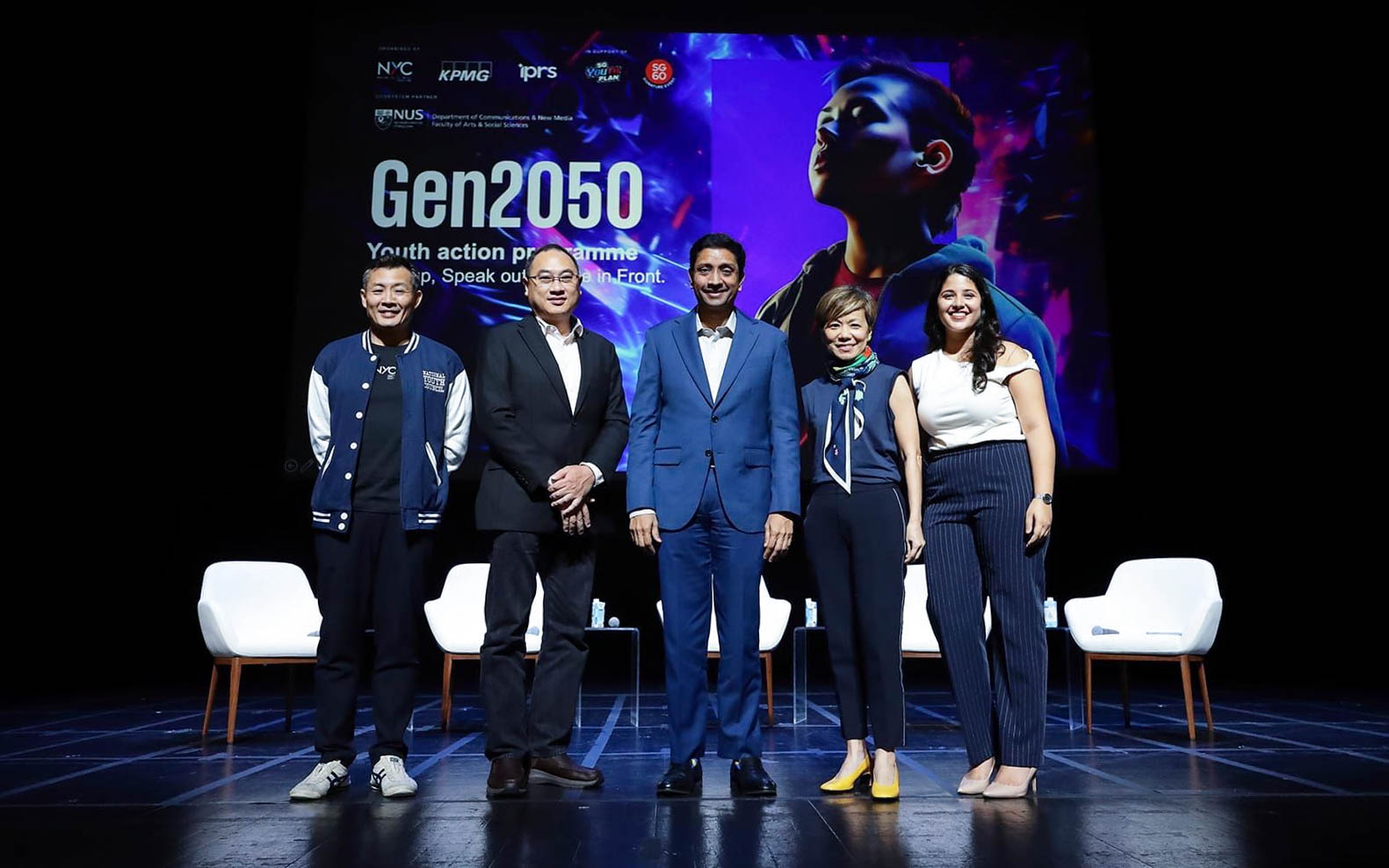
The Department of Communications and New Media (CNM) at the National University of Singapore (NUS) was the eco-system partner for the Gen2050 Youth Action Forum, held at the University Cultural Centre on 25 November 2025. Organised by the National Youth Council (NYC), KPMG in Singapore, and the Institute of Public Relations of Singapore (IPRS), the event encouraged youths to step up, speak out and be in front through critical thinking and action on issues such as sustainability, AI and the future of work.
The event included opening speeches, a presentation of a survey on youths’ awareness and attitudes towards current affairs and personal growth, a Youth Dialogue, and industry exchange sessions. On the panel were Mr Dinesh Vasu Dash, Minister of State (MOS), Ministry of Culture, Community and Youth and Ministry of Manpower; Mr David Chua, Chief Executive Officer, NYC; Ms Lee Sze Yeng, Managing Partner, KPMG; and Mr Ross Gan, President, IPRS. The panel was moderated by Ms Suhaana Khanna, a Video Journalist at The Business Times and a CNM alumnus.
In the first opening speech, Ms Lee Sze Yeng noted that young people today are deeply invested in making a meaningful difference. She encouraged youths to embrace the transformative potential of AI, particularly its role in enabling sustainable innovation. Ms Lee urged participants to seek out opportunities for growth, to embrace new challenges, and to cultivate a strong personal voice. Ms Lee also reminded the audience to prepare for a rapidly changing world by paying close attention to how they imagine the future.
The second opening speech was delivered by Mr David Chua, who encouraged youths to recognise the ecosystem of support accessible to them as they navigate an evolving and complex world. Mr Chua encouraged youths to expand their horizons beyond knowledge and skills in preparation for the future. He highlighted the importance of strengthening one’s social capital by building diverse and meaningful networks, cultivating healthy routines for wellbeing and seeking mentorship, and empowering youths to thrive with confidence and agency amid ambiguity and uncertainty.
The next segment featured a presentation of survey findings by Blackbox Research on youths’ views about current affairs, essential competencies for future readiness, and career and financial planning. Ms Monica Chitnis, the Chief Research Officer, noted that young Singaporeans are highly aware and concerned about global economic developments. The poll showed that youths place strong emphasis on core soft skills as essential for future workforce success, and many feel they need greater support in areas such as career and financial planning. Ms Chitnis highlighted that this need is consistent across diverse youth groups, and emphasised that preparing young people for the future is a shared responsibility across the people, public, and private sectors.
The Youth Action Forum’s main segment, the Youth Dialogue, received many interesting questions posed by the audience. In responding to a question on whether young people are prepared for a rapidly changing world, MOS Dinesh emphasised the importance of global awareness and adaptability. He noted that while Singapore’s economic fundamentals remain strong, opportunities and competition are now international. Youths must therefore cultivate psychological flexibility, continuously pick up new skills, such as leveraging AI, and staying attuned to how industries evolve.
In addressing how youths can better advocate for themselves and the issues they care about, Mr Gan emphasised that effective advocacy requires empathy, clarity of message, and awareness of how one’s ideas will be received.
Ms Khanna then asked how youths can cope with the evolving nature of AI. MOS Dinesh advised young people to stay engaged in their work and proactively look for opportunities to develop their adaptability as the job market evolves. Ms Lee added that AI should be viewed as a tool to enhance productivity and insight. As AI becomes embedded across all sectors, she encouraged youths to learn to use it effectively to support high-quality work.
The topic of the panel then shifted to the future of work. MOS Dinesh encouraged youths to look at their careers as a journey, and encouraged youths to tap into the GRaduate Industry Traineeships (GRIT) Programme which supports young people transitioning from internships to full-time roles. Mr Gan urged young people to evaluate opportunity costs when comparing jobs, placing value on networks and social capital rather than focusing solely on pay. Ms Lee added that youths should embrace self-discovery by taking on opportunities that will enable them to discover their strengths and interests.
When asked about the government’s plans to ensure youth voices continue to be heard, MOS Dinesh stressed that youth interests are closely aligned with national interests. He encouraged young people to stay engaged through youth networks provided by NYC and grassroots organisations. Mr Chua outlined NYC’s youth research and development efforts, such as various leadership programmes, mentoring opportunities, and volunteering opportunities. Mr Chua also encouraged youths to take initiative and seize the opportunities available to them.
For the final question, Ms Khanna asked what young people can do beyond completing their schooling to prepare for the future. Ms Lee encouraged youths to be proactive and to step out of their comfort zones. MOS Dinesh urged them to believe in themselves and make confident decisions rooted in their values. Mr Gan reminded the audience that “decisions are made by those who turn up,” underscoring the importance of participation and engagement. Mr Chua closed by sharing a quote on self-confidence, highlighting its importance in navigating an uncertain future.
Following the panel, two industry exchange sessions offered participants a closer look at emerging opportunities shaping the future workforce. The first session, “Navigating Career Landscapes, Not Ladders,” was led by Mr Brandon Lee, Assistant Chief Executive of the Transformation Support Group at Workforce Singapore. He discussed the shifting nature of career pathways and encouraged youths to think beyond traditional progression models as industries continue to evolve.
During the second session, Ms Elsie Tongson, Manager, Trade and Customs at KPMG, spoke on the topic of “Trade Policy and the Future of Work for Youth.” She highlighted how global trade developments will influence new sectors and shape the demand for skills. She also shared her insights on how young people can position themselves in an increasingly interconnected economy.
Together, these dialogues provided youths with practical guidance from professionals at the forefront of change, reinforcing the event’s broader goal of helping young people chart confident, future-ready career journeys.
The Gen2050 Youth Action Forum closed on an energising note, having given young participants the opportunity to engage directly with policymakers and industry leaders, network with peers and sector experts, and take part in activities that encouraged innovative thinking.