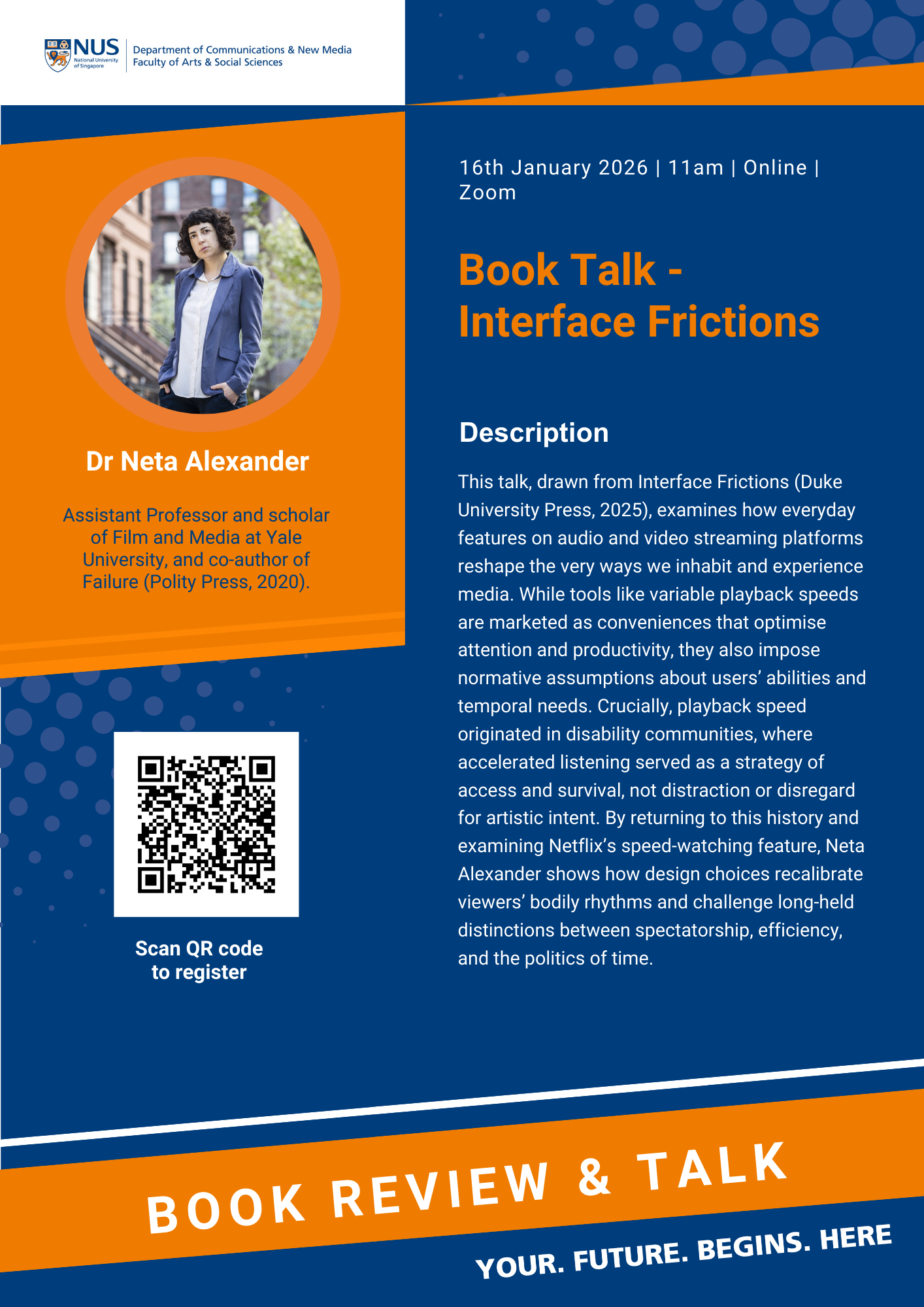


Interface Frictions
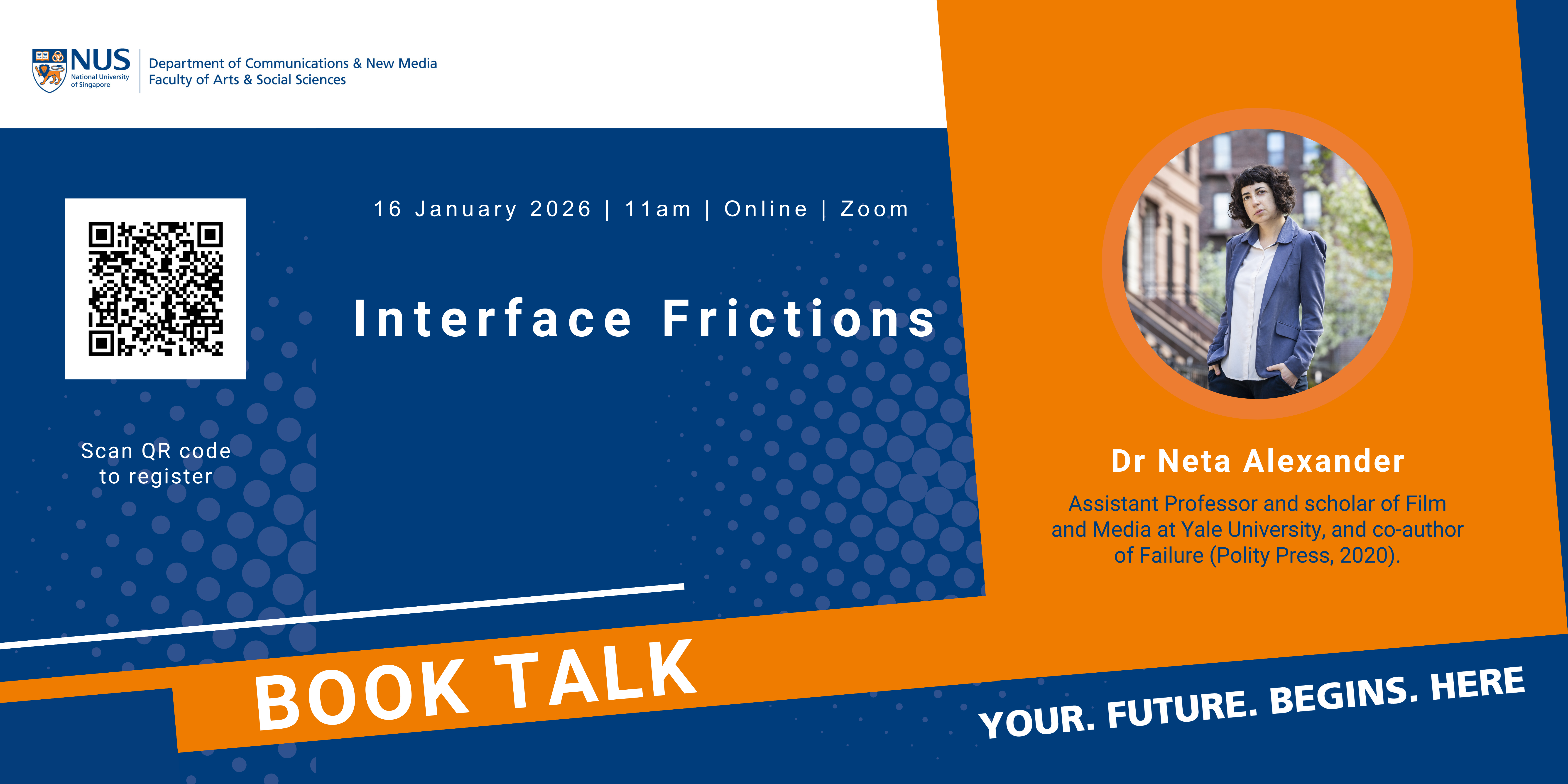
Online Event Registration
Participants will receive a registration confirmation via an automated email after signing up.
Speaker


Dr Neta Alexander is an Assistant Professor and scholar of Film and Media at Yale University, and co-author of Failure (Polity Press, 2020). Her work focuses on digital culture, film and media, science and technology studies, and critical disability studies. Her recent book, Interface Frictions (Duke University Press, 2025), explores four ubiquitous interface design features—refresh, playback speed, autoplay, and Night Shift—to develop a theory of digital debility.
Abstract
This talk, drawn from Interface Frictions (Duke University Press, 2025), examines how everyday features on audio and video streaming platforms reshape the very ways we inhabit and experience media. While tools like variable playback speeds are marketed as conveniences that optimise attention and productivity, they also impose normative assumptions about users’ abilities and temporal needs. Crucially, playback speed originated in disability communities, where accelerated listening served as a strategy of access and survival, not distraction or disregard for artistic intent. By returning to this history and examining Netflix’s speed-watching feature, Neta Alexander shows how design choices recalibrate viewers’ bodily rhythms and challenge long-held distinctions between spectatorship, efficiency, and the politics of time.