

What world is this? Students’ Urban Ethnography of Seoul & Tokyo
Sociology & Anthropology Seminar Series
Registration
Event Flyer
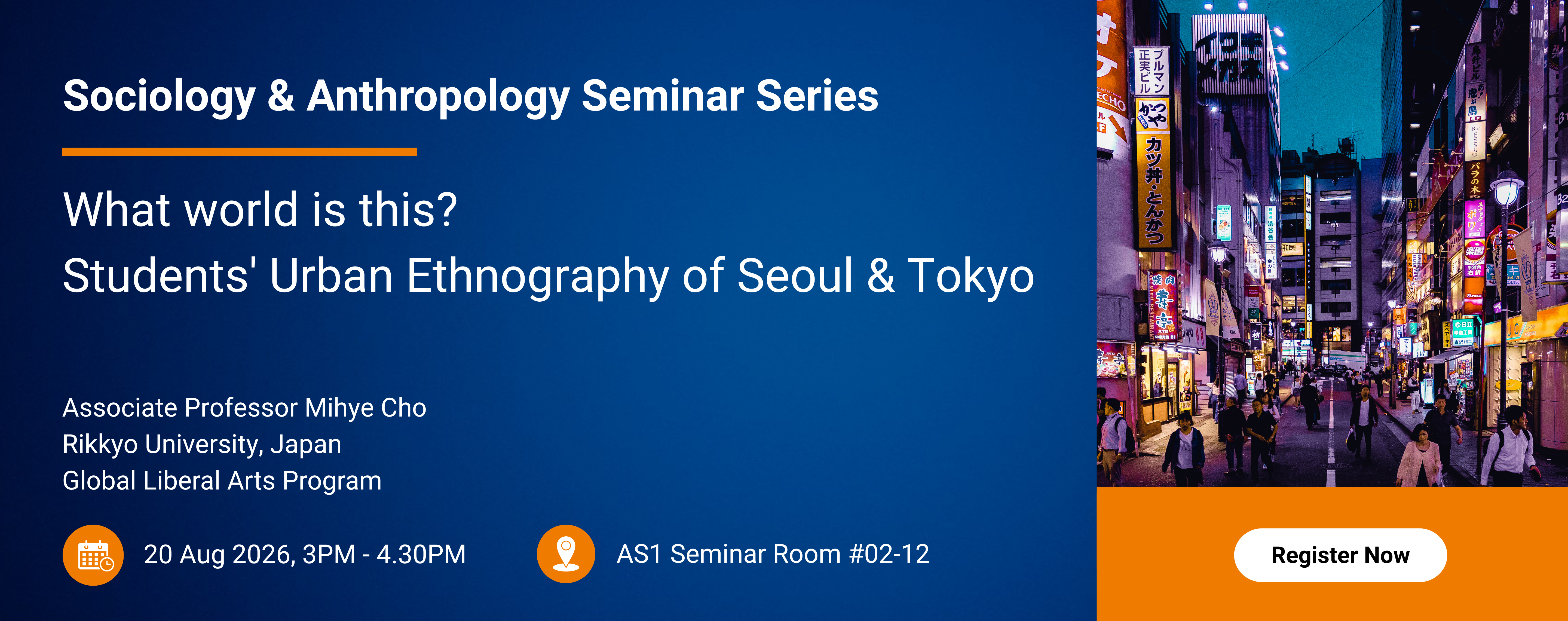
What world is this? Students' Urban Ethnography of Seoul & Tokyo
Drawing on my experience teaching urban sociology courses in Seoul and Tokyo, this presentation examines the potential of teaching urban ethnography as a means of accessing marginalized ways of knowing cities. The presentation conceptualizes the classroom as a site for the co-production of urban knowledge. In this framework, students' lived experiences function as ethnographic resources because Seoul and Tokyo are already embedded in their everyday lives through sensory encounters, memories, emotions, and spatial practices. Students enroll in urban studies courses to acquire analytical tools; however, they also bring forms of situated knowledge that are underrepresented in dominant academic discourses and formal urban policy. Many of these students—whether young local citizens or foreign sojourners—are excluded from decision-making processes. Yet, they actively participate in producing and observing urban spaces as part-time workers, civic group members, consumers, and flâneurs. Their perspectives reveal dimensions of Seoul and Tokyo that are often overlooked in academic research and institutional representations. Specifically, the presentation will examine ethnographic assignments produced by undergraduate students in Seoul from 2022 to 2023 and in Tokyo in 2026. The students were asked to conduct mini-fieldwork in their neighborhoods or places of personal significance and produce ethnographic reports incorporating field notes, sketches, maps, and photographs. Since the onset of the pandemic, it has become evident that spending time outdoors is therapeutic for these students, providing an opportunity for them to reflect on their sense of belonging or lack thereof in the city, both spatially and socially. This presentation will examine these student-generated analyses, paying particular attention to the observed sense of un-grievability and fear. It will also discuss how pedagogical ethnography can reveal emotions and alternative urban knowledge.
By Associate Professor Mihye Cho
Global Liberal Arts Program - Rikkyo University, Japan
About the Speaker
Mihye Cho teaches in the Global Liberal Arts Program at Rikkyo University, Japan.
Her current research focuses on smart urbanization, citizenship, mobility, and valuation. Her major publications include the monograph Entrepreneurial Seoulite: culture and subjectivity in Hongdae, Seoul (University of Michigan Press, 2019) and several recent articles, including: "Unpacking smartness: solving old urban problems with digital technologies in Singapore" (co-authored, Community Development Journal, forthcoming), "Reflections on the mobility turn and the relationality of (im)mobilities " (co-authored, Journal of Contemporary East Asia Studies, 2026), “Neighbourhood Quality of Life and Space”, (co-authored, Data-driven Smart Community Design, Routledge, 2025), “10.29 Itaewon Halloween Tragedy and Grievability for the Living: the Stories of the Survivors” (co-authored, Korean Journal of Cultural Sociology, 2023), and “Seoul 2022”, (co-authored, Streetnotes, 2023).