
𝗘𝗩𝗘𝗡𝗧 | 𝗧𝗲𝗰𝗵𝗻𝗼𝗹𝗼𝗴𝘆, 𝗪𝗲𝗹𝗹𝗯𝗲𝗶𝗻𝗴, 𝗮𝗻𝗱 𝗣𝗼𝗹𝗶𝗰𝘆 𝗶𝗻 𝗦𝗶𝗻𝗴𝗮𝗽𝗼𝗿𝗲 | 𝟮 𝗢𝗰𝘁, 𝟮-𝟱 𝗽𝗺
September 30, 2025
𝗘𝗩𝗘𝗡𝗧 | 𝗧𝗲𝗰𝗵𝗻𝗼𝗹𝗼𝗴𝘆, 𝗪𝗲𝗹𝗹𝗯𝗲𝗶𝗻𝗴, 𝗮𝗻𝗱 𝗣𝗼𝗹𝗶𝗰𝘆 𝗶𝗻 𝗦𝗶𝗻𝗴𝗮𝗽𝗼𝗿𝗲 | 𝟮 𝗢𝗰𝘁, 𝟮-𝟱 𝗽𝗺
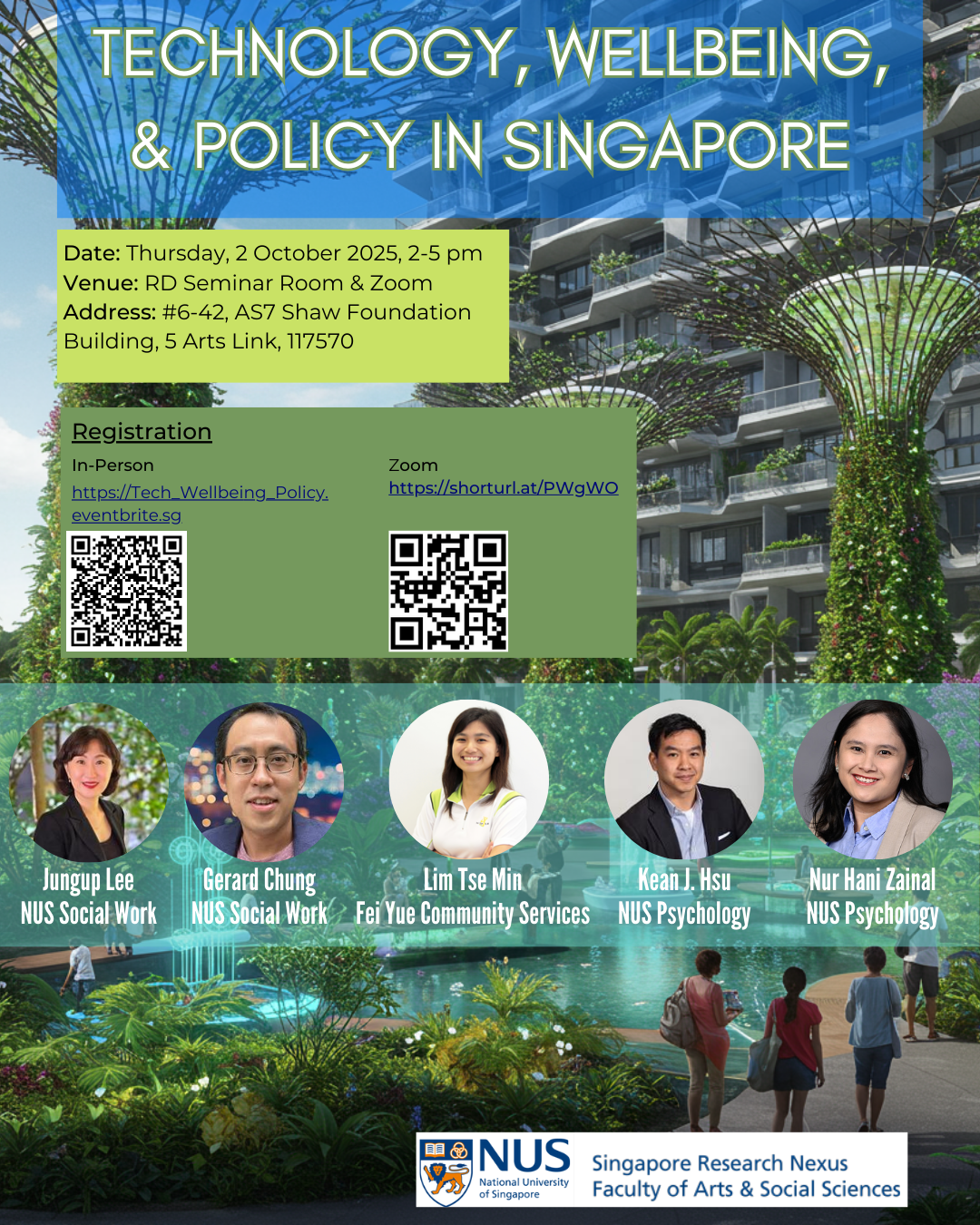
The Singapore Research Nexus is holding ‘Technology, Wellbeing, and Policy in Singapore’, an event featuring four presentations:
1. ‘𝗧𝗲𝗰𝗵𝗻𝗼𝗹𝗼𝗴𝘆-𝗥𝗲𝗹𝗮𝘁𝗲𝗱 𝗛𝗮𝗿𝗺𝘀 𝗮𝗻𝗱 𝗬𝗼𝘂𝘁𝗵 𝗠𝗲𝗻𝘁𝗮𝗹 𝗛𝗲𝗮𝗹𝘁𝗵’ by Dr Jungup LEE, Associate Professor, NUS Social Work
2. ‘𝗖𝗼𝗿𝗲 𝗖𝗼𝗺𝗽𝗼𝗻𝗲𝗻𝘁𝘀 𝗼𝗳 𝗘𝗳𝗳𝗲𝗰𝘁𝗶𝘃𝗲 𝗧𝗲𝘅𝘁-𝗯𝗮𝘀𝗲𝗱 𝗖𝗼𝗻𝘃𝗲𝗿𝘀𝗮𝘁𝗶𝗼𝗻𝘀: 𝗘𝘃𝗶𝗱𝗲𝗻𝗰𝗲 𝗳𝗿𝗼𝗺 𝗮 𝗟𝗼𝗰𝗮𝗹 𝗦𝗼𝗰𝗶𝗮𝗹 𝗦𝗲𝗿𝘃𝗶𝗰𝗲 𝗔𝗴𝗲𝗻𝗰𝘆 𝗮𝗻𝗱 𝗜𝗺𝗽𝗹𝗶𝗰𝗮𝘁𝗶𝗼𝗻𝘀 𝗳𝗼𝗿 𝗣𝗿𝗮𝗰𝘁𝗶𝗰𝗲, 𝗧𝗿𝗮𝗶𝗻𝗶𝗻𝗴, 𝗮𝗻𝗱 𝗦𝗲𝗿𝘃𝗶𝗰𝗲 𝗗𝗲𝘀𝗶𝗴𝗻’ by Dr Gerard CHUNG, Assistant Professor, NUS Social Work and Ms LIM Tse Min, Senior Social Worker, Fei Yue Community Services
3. ‘𝗠𝗲𝗻𝘁𝗮𝗹 𝗛𝗲𝗮𝗹𝘁𝗵 𝗶𝗻 𝘁𝗵𝗲 𝗔𝗴𝗲 𝗼𝗳 𝗔𝗜 𝗧𝗲𝗰𝗵𝗻𝗼𝗹𝗼𝗴𝘆’ by Dr Kean J. HSU, Assistant Professor, NUS Psychology
4. ‘𝗣𝗿𝗼𝗺𝗶𝘀𝗲𝘀 𝗮𝗻𝗱 𝗣𝗶𝘁𝗳𝗮𝗹𝗹𝘀 𝗼𝗳 𝗗𝗶𝗴𝗶𝘁𝗮𝗹 𝗠𝗲𝗻𝘁𝗮𝗹 𝗛𝗲𝗮𝗹𝘁𝗵 𝗜𝗻𝘁𝗲𝗿𝘃𝗲𝗻𝘁𝗶𝗼𝗻𝘀 (𝗗𝗠𝗛𝗜𝘀): 𝗜𝗺𝗽𝗹𝗶𝗰𝗮𝘁𝗶𝗼𝗻𝘀 𝗳𝗼𝗿 𝗣𝗼𝗹𝗶𝗰𝘆, 𝗘𝗾𝘂𝗶𝘁𝘆, 𝗮𝗻𝗱 𝗣𝗲𝗿𝘀𝗼𝗻𝗮𝗹𝗶𝘇𝗲𝗱 𝗖𝗮𝗿𝗲 𝗶𝗻 𝗦𝗶𝗻𝗴𝗮𝗽𝗼𝗿𝗲’ by Dr Nur Hani ZAINAL, Assistant Professor, NUS Psychology
𝗗𝗮𝘁𝗲 & 𝗧𝗶𝗺𝗲: Thursday, 2 October 2025, 2 to 5 pm
𝗩𝗲𝗻𝘂𝗲: Zoom & in-person (NUS AS7 Shaw Foundation Building, FASS Research Division Seminar Room Level 6, Room 42, 5 Arts Link, 117570)
𝗥𝗲𝗴𝗶𝘀𝘁𝗲𝗿:
Download the programme here.
𝗣𝗿𝗲𝘀𝗲𝗻𝘁𝗮𝘁𝗶𝗼𝗻 𝗔𝗯𝘀𝘁𝗿𝗮𝗰𝘁𝘀 𝗮𝗻𝗱 𝗕𝗶𝗼𝗴𝗿𝗮𝗽𝗵𝗶𝗰𝗮𝗹 𝗦𝘁𝗮𝘁𝗲𝗺𝗲𝗻𝘁𝘀 𝗼𝗳 𝗦𝗽𝗲𝗮𝗸𝗲𝗿𝘀
𝗧𝗲𝗰𝗵𝗻𝗼𝗹𝗼𝗴𝘆-𝗥𝗲𝗹𝗮𝘁𝗲𝗱 𝗛𝗮𝗿𝗺𝘀 𝗮𝗻𝗱 𝗬𝗼𝘂𝘁𝗵 𝗠𝗲𝗻𝘁𝗮𝗹 𝗛𝗲𝗮𝗹𝘁𝗵
Digital technologies are deeply embedded in young people’s daily lives, yet their pervasive use poses complex challenges for wellbeing and public policy. This presentation draws on two studies with university students in Singapore to examine how problematic smartphone use and cyberbullying victimization intersect with mental health outcomes. The first study (N=1,105) found that smartphone addiction was associated with higher levels of cyberbullying involvement, depression, and anxiety, with anxiety mediating the impact of cybervictimization on problematic smartphone use. The second study (N=723) showed that cyberbullying victimization was linked to disordered eating behaviours through lowered self-esteem, and how this risk was intensified by deviant peer affiliation. Together, these findings reveal that digital harms extend beyond individual behaviour to peer dynamics and broader socio-educational contexts. They underscore the importance of routine screening, digital literacy initiatives, and peer support systems within schools and communities. The results also point to opportunities for cross-sectoral collaboration across education, health, and community organisations to design evidence-based interventions and policies that foster safe digital engagement and strengthen youth resilience.
𝗔𝘀𝘀𝗼𝗰𝗶𝗮𝘁𝗲 𝗣𝗿𝗼𝗳𝗲𝘀𝘀𝗼𝗿 𝗝𝘂𝗻𝗴𝘂𝗽 𝗟𝗲𝗲 | 𝗡𝗨𝗦 𝗦𝗼𝗰𝗶𝗮𝗹 𝗪𝗼𝗿𝗸
Dr Jungup Lee is an Associate Professor in the Department of Social Work and Co-Director of the Social Service Research Centre at the National University of Singapore. Her research focuses on youth mental health and digital well-being, cyberbullying and online harms, parenting and peer support, and AI/technology in children and youth development. She currently conducts several interdisciplinary research projects aligned with these interests, including a multipronged study on the mechanisms of cyberbullying, a mixed-method investigation into campus sexual misconduct and online harassment, a longitudinal mixed-method study of parenting styles and children’s emotional regulation, a project exploring human–AI collaboration in reducing mental health stigma and enhancing social care, and a cross-cultural study on the integration of technological innovation to support youth mental health and well-being. She has over 70 academic publications including Handbook of School Violence, Bullying, and Safety (Edward Elgar, 2024), articles in leading journals such as Computers in Human Behavior, Journal of Medical Internet Research, and Trauma, Violence, & Abuse, and conference papers in top human-computer interaction and computation conferences like ACM CHI and ACL. She is a Review Editor of Frontiers in Public Health (Injury Prevention and Control Specialty Section).
𝗖𝗼𝗿𝗲 𝗖𝗼𝗺𝗽𝗼𝗻𝗲𝗻𝘁𝘀 𝗼𝗳 𝗘𝗳𝗳𝗲𝗰𝘁𝗶𝘃𝗲 𝗧𝗲𝘅𝘁-𝗯𝗮𝘀𝗲𝗱 𝗖𝗼𝗻𝘃𝗲𝗿𝘀𝗮𝘁𝗶𝗼𝗻𝘀: 𝗘𝘃𝗶𝗱𝗲𝗻𝗰𝗲 𝗳𝗿𝗼𝗺 𝗮 𝗟𝗼𝗰𝗮𝗹 𝗦𝗼𝗰𝗶𝗮𝗹 𝗦𝗲𝗿𝘃𝗶𝗰𝗲 𝗔𝗴𝗲𝗻𝗰𝘆 𝗮𝗻𝗱 𝗜𝗺𝗽𝗹𝗶𝗰𝗮𝘁𝗶𝗼𝗻𝘀 𝗳𝗼𝗿 𝗣𝗿𝗮𝗰𝘁𝗶𝗰𝗲, 𝗧𝗿𝗮𝗶𝗻𝗶𝗻𝗴, 𝗮𝗻𝗱 𝗦𝗲𝗿𝘃𝗶𝗰𝗲 𝗗𝗲𝘀𝗶𝗴𝗻
This presentation examines the core components of effective text-based conversations with youths, using evidence from a local social service agency providing online chats to youths and young persons. The analysis identifies specific linguistic features and counsellor skills associated with helpful outcomes. Findings show that text crafting skills are key especially to express emotions and support, and that multiple communication styles—from emotionally expressive to inquiry-driven—can be equally effective. The findings provide a basis for improving practice and have direct implications for the training of chat supporters, the design of digital mental health services, and the development of AI in chatbots.
𝗔𝘀𝘀𝗶𝘀𝘁𝗮𝗻𝘁 𝗣𝗿𝗼𝗳𝗲𝘀𝘀𝗼𝗿 𝗚𝗲𝗿𝗮𝗿𝗱 𝗖𝗵𝘂𝗻𝗴 | 𝗡𝗨𝗦 𝗦𝗼𝗰𝗶𝗮𝗹 𝗪𝗼𝗿𝗸
Dr Gerard Chung is an assistant professor of Social Work at the Department of Social Work, National University of Singapore, researching technology in social work. Before academia, he practiced as a social worker at Fei Yue Family Service Centre. He explores how social work professional identity shapes our interpretation and adaptation of new technologies, particularly AI. He focuses on ensuring meaningful technology interactions that maintain quality professional standards and ethics. He identifies as a quantitative methodologist and is interested in advancing the use of administrative data in the social service sector to improve social work practices and to evaluate interventions and services.
𝗟𝗶𝗺 𝗧𝘀𝗲 𝗠𝗶𝗻 | 𝗙𝗲𝗶 𝗬𝘂𝗲 𝗖𝗼𝗺𝗺𝘂𝗻𝗶𝘁𝘆 𝗦𝗲𝗿𝘃𝗶𝗰𝗲𝘀
Ms Lim Tse Min is currently a team leader and senior social worker at Fei Yue Community Services with over 10 years of experience working with youths and families. Her current main portfolio includes supporting youths on eC2, a community mental health programme for youths. eC2 aims to promote mental resilience by empowering youths to take charge of their mental health by connecting them to available resources and instilling courage in them to seek help and engage with the community. She also has prior experiences working with youth at risk, reaching out to them on the streets and steering them back to meaningful engagements. She believes that every youth has the potential to shine, given the opportunities and support that they need.
𝗠𝗲𝗻𝘁𝗮𝗹 𝗛𝗲𝗮𝗹𝘁𝗵 𝗶𝗻 𝘁𝗵𝗲 𝗔𝗴𝗲 𝗼𝗳 𝗔𝗜 𝗧𝗲𝗰𝗵𝗻𝗼𝗹𝗼𝗴𝘆
Modern understandings of mental health are increasingly impacted by AI technology, both in terms of how we conduct clinical science and in terms of factors that influence mental health. For instance, scientific studies increasingly incorporate machine learning and other AI approaches to study mental health. Alternatively, social media personalization algorithms and generative AI may contribute to growing difficulties with mental health in adolescents and young adults. This presentation will highlight some of the recent developments in our understanding of mental health and AI in the domains of science, education, and policy that my lab is contributing to.
𝗔𝘀𝘀𝗶𝘀𝘁𝗮𝗻𝘁 𝗣𝗿𝗼𝗳𝗲𝘀𝘀𝗼𝗿 𝗞𝗲𝗮𝗻 𝗝. 𝗛𝘀𝘂 | 𝗡𝗨𝗦 𝗣𝘀𝘆𝗰𝗵𝗼𝗹𝗼𝗴𝘆
Kean J. Hsu, Ph.D., is an Assistant Professor in the Department of Psychology at National University of Singapore. His research investigates how basic cognitive processes (e.g., attention, executive functioning) impact the etiology and exacerbate symptom severity of depression and anxiety. He is also interested in scalable mental health interventions (e.g., cognitive training, brief interventions) and examining mechanisms underlying psychotherapeutic interventions, as well as increasing awareness of issues surrounding mental health and stigma in communities that are typically under-served or under-utilize mental health services. Clinically, Kean specialises in the treatment of depression, anxiety disorders, and stress in adults. Kean completed a B.A. with honours in psychology (with a behavioural neuroscience specialization) at Yale University before receiving his Ph.D. in clinical psychology at the University of Southern California in 2014. He completed postdoctoral research fellowships at McLean Hospital/Harvard Medical School, the University of California, Los Angeles, and the University of Texas at Austin. He previously co-directed the Anxiety and Stress Clinic with Jasper Smits, Ph.D., at UT-Austin. Most recently, Kean was an Assistant Professor in the Department of Psychiatry at Georgetown University.
𝗣𝗿𝗼𝗺𝗶𝘀𝗲𝘀 𝗮𝗻𝗱 𝗣𝗶𝘁𝗳𝗮𝗹𝗹𝘀 𝗼𝗳 𝗗𝗶𝗴𝗶𝘁𝗮𝗹 𝗠𝗲𝗻𝘁𝗮𝗹 𝗛𝗲𝗮𝗹𝘁𝗵 𝗜𝗻𝘁𝗲𝗿𝘃𝗲𝗻𝘁𝗶𝗼𝗻𝘀 (𝗗𝗠𝗛𝗜𝘀): 𝗜𝗺𝗽𝗹𝗶𝗰𝗮𝘁𝗶𝗼𝗻𝘀 𝗳𝗼𝗿 𝗣𝗼𝗹𝗶𝗰𝘆, 𝗘𝗾𝘂𝗶𝘁𝘆, 𝗮𝗻𝗱 𝗣𝗲𝗿𝘀𝗼𝗻𝗮𝗹𝗶𝘇𝗲𝗱 𝗖𝗮𝗿𝗲 𝗶𝗻 𝗦𝗶𝗻𝗴𝗮𝗽𝗼𝗿𝗲
Digital Mental Health Interventions (DMHIs), including virtual reality exposure therapy, mindfulness apps, and scalable cognitive-behavioral therapy (CBT) platforms, offer unprecedented opportunities to expand access to evidence-based mental health care. Drawing on recent clinical trials, machine learning research, and meta-analytic findings, this presentation will outline the therapeutic promise of DMHIs in reducing anxiety, enhancing executive functioning, and sustaining long-term gains for diverse populations. However, this promise is tempered by critical implementation and ethical challenges. These include low sustained user engagement, algorithmic bias, disparities in digital health literacy, and logistical constraints in coaching supervision and fidelity. The talk will also address cost-effectiveness, public trust, and equitable access, especially for underrepresented groups in Singapore. Specific attention will be given to how DMHI research at NUS has informed treatment-matching rules, precision digital care, and scalable delivery models. The session concludes with policy-relevant recommendations for Singapore’s National Mental Health Strategy, emphasizing the importance of blended care, public-private partnerships, and culturally responsive digital health innovation. In doing so, this talk highlights actionable steps for advancing ethical, equitable, and personalized mental health care in a tech-enabled society.
𝗔𝘀𝘀𝗶𝘀𝘁𝗮𝗻𝘁 𝗣𝗿𝗼𝗳𝗲𝘀𝘀𝗼𝗿 𝗡𝘂𝗿 𝗛𝗮𝗻𝗶 𝗭𝗮𝗶𝗻𝗮𝗹 | 𝗡𝗨𝗦 𝗣𝘀𝘆𝗰𝗵𝗼𝗹𝗼𝗴𝘆
Dr Hani is a Presidential Young Professorship (PYP) Assistant Professor in Clinical Psychology at the National University of Singapore (NUS) and the Director of the Optimizing Wellness (OWL) Lab. She completed a two-year postdoctoral research fellowship at the Harvard Medical School (HMS), received her Ph.D. in Clinical Psychology from The Pennsylvania State University, and completed her predoctoral clinical fellowship at the HMS-affiliated Massachusetts General Hospital (MGH) – Cognitive Behavioral Scientist Track. Her research focuses on how executive functioning, social cognition, and cognitive-behavioral strategies link to the etiology, maintenance, and treatment of anxiety and depressive disorders. She is also interested in technology-facilitated interventions and psychoneuroimmunology. To achieve these aims, she uses a variety of approaches and datasets. These include cross-sectional and longitudinal surveys, basic science experiments, ecological momentary assessments, and prospective cross-panel designs. To this end, she hopes to make novel and positively impactful contributions to basic science and translational clinical research and practice. Also, Dr Hani is a recipient of awards such as the Association for Behavioral and Cognitive Therapies (ABCT) Leonard Krasner Dissertation Award, Anxiety and Depression Association of America (ADAA) Alies Muskin Career Development Leadership Program (CDLP), and the Pennsylvania State University (PSU) Superior Teaching and Research (STAR) award.
If you have any questions, feel free to contact us at nexus@nus.edu.sg. Thank you and see you on October 2nd!