
Archaeological Approaches and Possibilities in Humanities/Social Science Education in Singapore
November 5, 2025
In “Archaeological Approaches and Possibilities in Humanities/Social Science Education in Singapore” (Studies in Singapore Education: Research, Innovation & Practice, 2021), Professor John N. Miksic (NUS Southeast Asian Studies) and Associate Professor Geok Yian Goh (NTU) capture the essence of their life’s work — that archaeology is, above all, a deeply educational pursuit.
In this essay, they distil four decades of teaching, fieldwork, and institution-building into a coherent philosophy: that material culture can anchor abstract thought, and that the study of the past is most meaningful when it engages learners directly in the process of discovery.
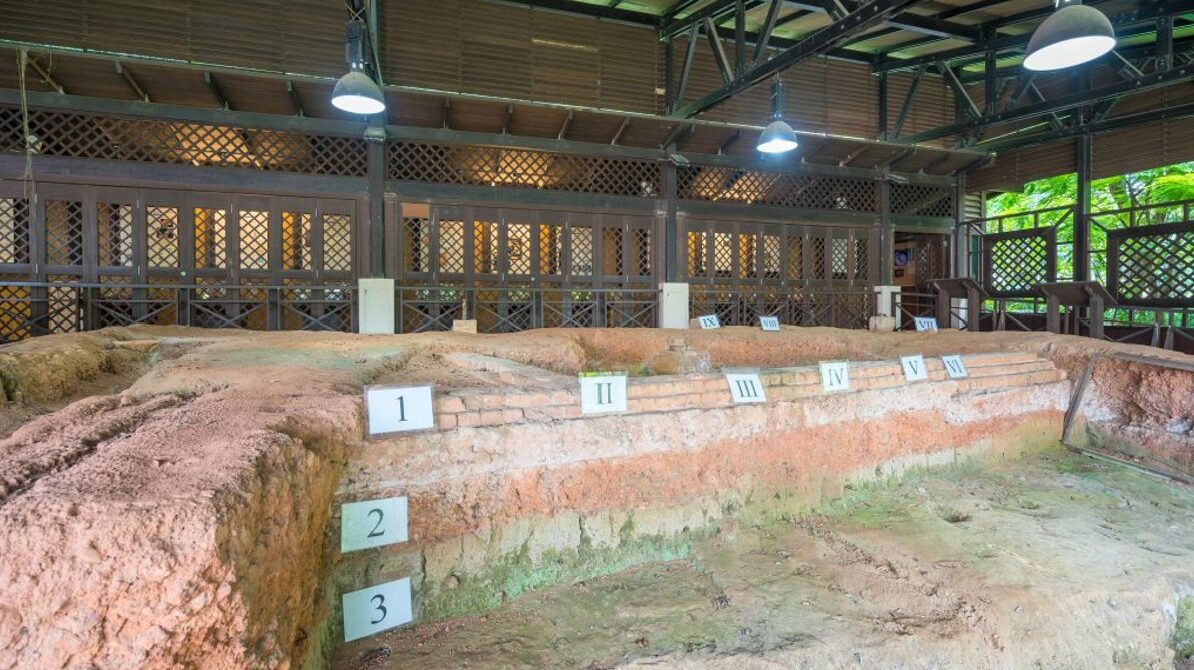
Miksic and Goh open with a concise history of Singaporean archaeology — a field that, until Miksic’s arrival in the 1980s, did not quite exist. His 1984 Fort Canning excavation marked the beginning of a new intellectual tradition, one that connected the study of history with physical evidence and collective participation. Yet Miksic’s intent was never limited to uncovering artifacts; he envisioned archaeology as a bridge between the humanities and the lived environment. By involving students, teachers, and even families in excavations, he turned archaeology into a communal form of inquiry, where learning emerged not from textbooks but from application.
At the core of the chapter lies Miksic and Goh’s argument for object-based learning. They posit that tangible artifacts serve as entry points for abstract reasoning — evidence that invites students to hypothesize, interpret, and reconstruct narratives from fragments. In this way, archaeology mirrors the broader goals of the humanities: to question, to infer, and to connect. These reflections anticipate contemporary calls for interdisciplinary education, showing how archaeological practice fosters not only historical understanding but also critical and empathetic thinking.
The essay’s most distinctive contribution is its articulation of experiential learning as the foundation of archaeological pedagogy. Citing the seminal work of John Dewey and David Kolb, Miksic and Goh describe fieldwork as a “total visceral immersion” that engages all the senses — sight, touch, and intuition. Fieldtrips, they argue, should not be scripted performances but open-ended explorations that nurture intellectual curiosity. Whether in simulated excavations or overseas field schools, students learn not only to handle artifacts but to handle uncertainty — to think critically amid ambiguity.
In later sections, Miksic and Goh illustrate how this philosophy translated into concrete teaching practice. At both NUS and NTU, archaeology became a mode of learning that crossed disciplinary boundaries — linking history, geography, and anthropology. One of the most vivid examples was the Southeast Asia in Context (SEAiC) summer programme, which Miksic founded and taught for over a decade. Designed for both local and international students, SEAiC combined classroom study with fieldwork across Southeast Asia — from Singapore to Malaysia, Thailand, and Indonesia — enabling participants to experience heritage sites firsthand and engage directly with local communities. In doing so, it embodied Miksic’s conviction that education is most powerful when students encounter history in situ, tracing the continuities between ancient networks and modern societies.
The chapter concludes with a forward-looking vision. Anticipating the challenges of the digital era, Miksic and Goh advocate integrating technology, heritage policy, and continuing education, yet caution that digital tools must never replace the immediacy of fieldwork. Knowledge, they remind readers, begins with touch.
Viewed in retrospect, the chapter stands as both a scholarly milestone and a legacy of thought. It encapsulates Miksic’s defining synthesis of precision and humanity. For him, archaeology was less a science of relics than a practice of connection — linking evidence with imagination, past with present, student with teacher. Miksic’s influence endures in how Singapore and the region conceive of history: not as buried and gone, but as a living presence just beneath our feet.
Read the chapter here.