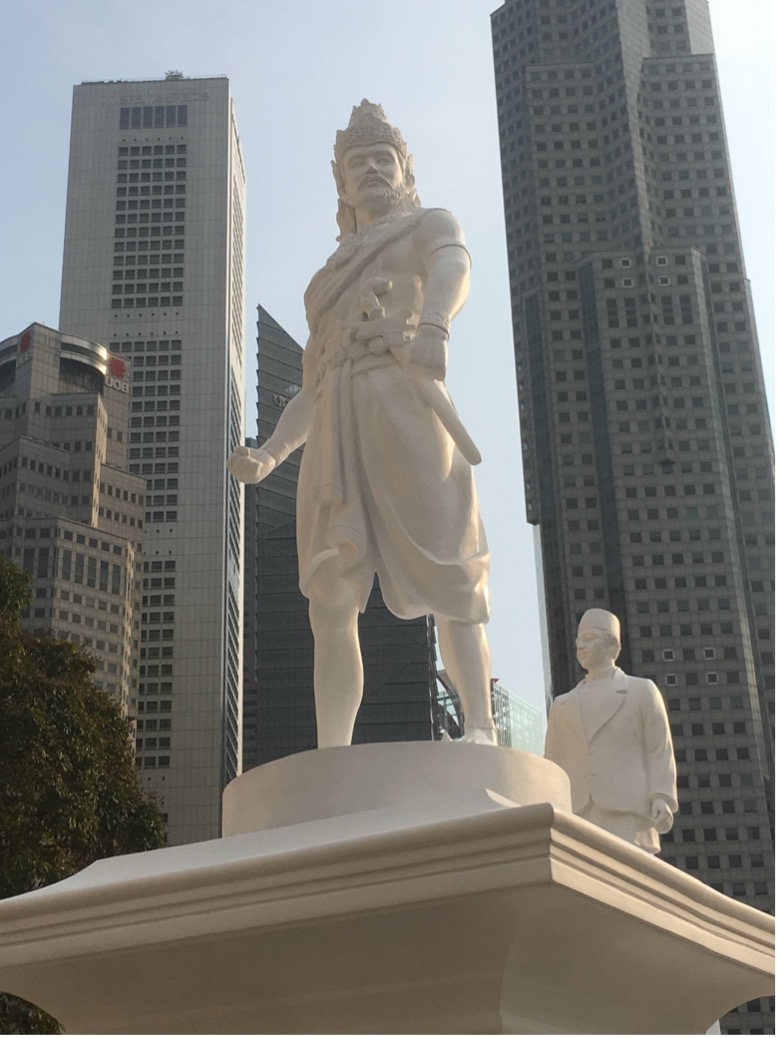

Sang Nila Utama and the Court of Indra
March 8, 2026
Sang Nila Utama is widely remembered in Singapore as the legendary founder of a pre-colonial kingdom, yet the origins of his name — and what it reveals about early ideas of kingship — are far less commonly understood. In his article “Sang Nila Utama and the Court of Indra,” Assistant Professor Sureshkumar Muthukumaran (NUS History) explores the mythological and cultural layers behind Sang Nila Utama’s name, showing that it is deeply connected to South and Southeast Asian cosmology, particularly the court of the Hindu god Indra.
The article begins by explaining a surprising detail: Sang Nila Utama’s name is derived from Tilottamā, a celestial woman or nymph in Indian mythology. Tilottamā, along with her sisters Menakā and Suprabhā, belongs to a class of divine female beings known as apsarases, who inhabit Indra’s heavenly realm. In the Malay Annals, Sang Nila Utama and his brothers bear names that correspond directly to these celestial figures. This naming choice is not accidental but would have been recognised by contemporary audiences familiar with Indic literary traditions circulating in the Malay world.
Muthukumaran argues that by taking on the names of these celestial women, the princes symbolically inherit the supernatural power (kesaktian) associated with Indra’s court. Rather than being a historical name used in everyday life, “Sang Nila Utama” functions as a mythic title that signals divine legitimacy. This is reinforced by descriptions in the Malay Annals of the brothers descending from the heavens, appearing youthful and radiant, wearing gem-studded crowns, and riding white elephants — imagery closely associated with Indra himself, who is traditionally depicted riding the white elephant Airāvata.
The article situates this symbolism within a broader regional pattern. Across South and Southeast Asia, rulers were often portrayed as earthly equivalents of Indra, the celestial king and bringer of rain, fertility, and prosperity. Inscriptions and texts from Java, Sumatra, and the wider Nusantara world show kings explicitly aligning themselves with Indra through names, rituals, and imagery. Sang Nila Utama, therefore, fits into a longstanding tradition in which political authority is legitimised through divine association.
Importantly, the article also highlights the central role of powerful female figures in these narratives. Tilottamā is not a passive character but a potent mythological figure whose beauty and agency shape the outcomes of cosmic conflicts, such as the destruction of the demon brothers Sunda and Upasunda. Within the Malay Annals, this pattern continues through figures like Wan Seri Beni, the Queen of Bintan, whose actions are crucial to Sang Nila Utama’s success. The use of a celestial woman’s name to legitimise a male ruler thus reflects a cultural landscape in which female supernatural power was deeply respected.
In conclusion, Muthukumaran suggests that while Sang Nila Utama may not have existed as a historical individual with that exact name, the legend preserves important insights into 14th century Singapore’s royal culture. The blending of myth, religion, and kingship reveals how early societies understood authority, identity, and power. Rather than reading the Malay Annals simply as history, the article encourages readers to see it as a palimpsest of cultural memory — one that embeds Singapore’s origins within a wider Indic and Southeast Asian cosmological world.
Read the article in a forthcoming issue of Friends of the Museum magazine here.