
Predicting public opinion, preserving historical texts: New NUS centre marries humanities with AI
March 5, 2026
What if policymakers could test how society might react to new policies before they are implemented? Researchers are developing an AI-driven platform to simulate how different segments of society might respond to policy proposals, helping to stress-test ideas before they are rolled out in public.
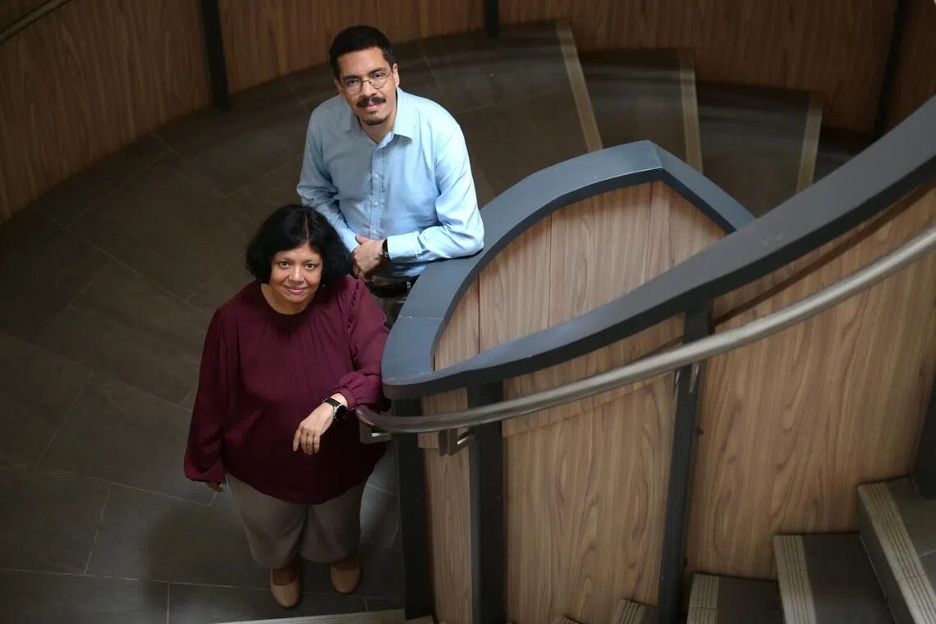
This initiative is one of the flagship projects of the newly established NUS Centre for Computational Social Science and Humanities (CSSH), which officially launched on 4 March. Led by Associate Professor Miguel Escobar Varela (NUS English, Linguistics and Theatre Studies), Professor Peter Millican (NUS Philosophy), Provost’s Chair Professor Atreyi Kankanhalli and Associate Professor Dandan Qiao (both NUS Information Systems and Analytics), CSSH brings together 105 researchers across disciplines to combine computational methods with social science and humanities research, tackling issues such as inequality, addiction and polarisation.
Powered by large language models (LLMs), the platform will model how different groups might react to policies related to heritage conservation, sustainability and health, complementing traditional surveys and field studies. The five-year project, Computational Social Simulations for Aiding Policy Design, is funded by the Ministry of Education’s Social Science Research Council (SSRC) and involves a myriad of collaborators from tertiary institutions and the public sector.
Separately, CSSH is also applying artificial intelligence to cultural preservation. In collaboration with the National Library Board, researchers are developing tools to transliterate pre-1970s Malay-language newspapers written in Jawi into searchable Malay text, making these historical archives more accessible to researchers and the public. Other projects include analysing more than one million divorce judgments using large language models to study how reasons for marital dissolution have evolved over the past four decades, linking these trends to demographic and social changes.
By combining large-scale data analysis with the critical perspectives of social and cultural scholarship, the centre looks to unlock new insights within complex challenges society faces today. With the SSRC committing $556 million over the next five years to social science and humanities research, it will certainly be exciting to see how CSSH pushes the frontiers of interdisciplinary research.
Read the Straits Times article on the newly launched NUS CSSH here.
Find out more about NUS CSSH on its website here.