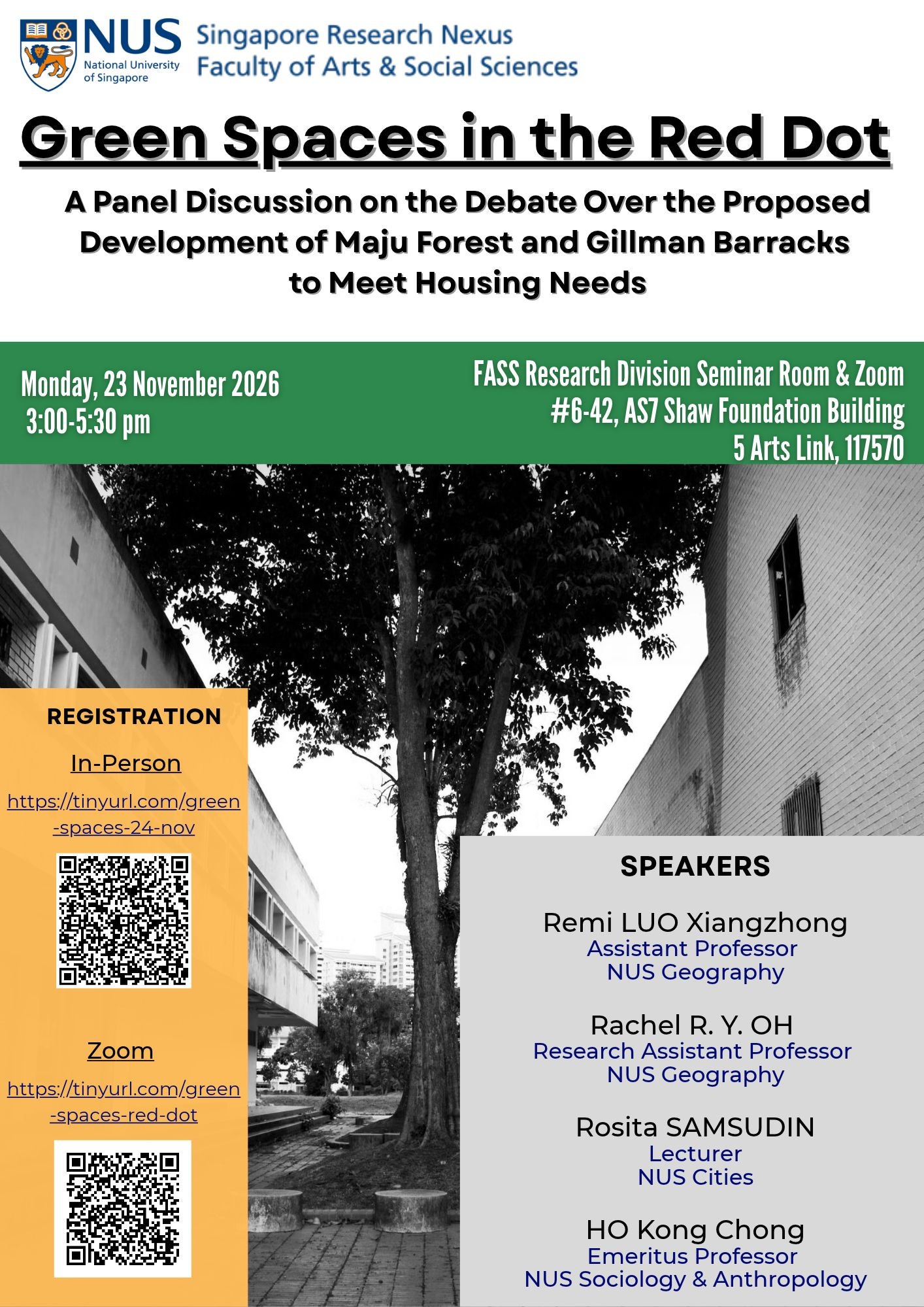

Green Spaces in the Red Dot: A Panel Discussion on the Debate Over the Proposed Development of Maju Forest and Gillman Barracks to Meet Housing Needs
Green Spaces in the Red Dot:
A Panel Discussion on the Debate Over the Proposed Development of Maju Forest and Gillman Barracks to Meet Housing Needs
Date & Time: 3:00-5:30 pm, Monday, 23 November, 2026
Venue: FASS AS7 Research Division Seminar Room (6-42)/Zoom
Venue Address: NUS AS7 Shaw Foundation Building, 5 Arts Link, 117570
Directions: To get to the Research Division Seminar Room, go to Level 6 of the AS7 Shaw Foundation Building and turn right after exiting the lift, going around the corridor past the washrooms. Turn left and you will see the Research Division Seminar Room directly ahead.
About the Event
The announcement of plans for new public housing at Gillman Barracks and Sunset Way, involving the clearing of parts of Maju Forest and surrounding areas, has renewed public discussion about how Singapore can balance housing needs with the conservation of green and heritage spaces. In land-scarce Singapore, these questions raise broader considerations about biodiversity, climate resilience, human wellbeing, and the relationships that communities develop with natural environments.
Bringing together researchers from geography, urban studies, and sociology, this panel examines the ecological and social value of urban green spaces, the challenges of maintaining climate-resilient environments, and the competing demands of housing provision and environmental and heritage conservation. Drawing on scientific research, interdisciplinary perspectives, and historical examples of land-use debates in Singapore, the discussion will weigh how these different factors can inform urban planning and Singapore’s continuing aspirations as a City in Nature.
Registration
In-person: Eventbrite

Online: Zoom

Programme document available here.
PANELLISTS & PRESENTATIONS
Remi LUO Xiangzhong | PYP Assistant Professor, NUS Department of Geography
Rachel R. Y. OH | Research Assistant Professor, NUS Department of Geography
Rosita SAMSUDIN | Lecturer, NUS Cities
HO Kong Chong | Emeritus Professor, NUS Department of Sociology and Anthropology
Finding the most climate-resilient trees in Singapore
Remi LUO Xiangzhong
NUS Department of Geography
| Singapore’s vision of a City in Nature is reflected in the lush green canopies of trees across our forests, parks, and streets. However, these trees are increasingly facing stress from climate change (e.g., the ongoing El Niño) and urbanization. Working closely with the National Parks Board (NParks), our research team is deploying monitoring systems across the island to track tree health and identify the most climate-resilient species, supporting future planning of Singapore’s green spaces. In this talk, I will introduce our tree monitoring network and share preliminary findings on how climate change and urbanization might affect trees in Singapore. |
Dr Remi LUO Xiangzhong joined the NUS Department of Geography as a Presidential Young Professor (PYP) in 2020. He is a global change ecologist whose work centres on exploring the interactions between terrestrial ecosystem functions (i.e., the carbon and water cycles) and global changes (i.e., climate change, land use and land cover changes) across spatial and temporal scales. He integrates ground observations (e.g., eddy covariance, leaf traits), Earth system models, remote sensing, and machine learning, guided by hypotheses derived from ecological theories, to develop a mechanistic understanding of the physical and biological processes that regulate ecosystem functions.
Biodiverse ecosystems are crucial for human health and social wellbeing
Rachel R. Y. OH
NUS Department of Geography
| Biodiversity conservation is increasingly recognised as essential not only for ecological resilience, but also for human health and wellbeing. Drawing on interdisciplinary research across diverse urban and sociocultural contexts, my work reveals how nature promotes physical activity, reduces heat stress, alleviates psychological distress, and strengthens social cohesion. Crucially, these benefits are not universal: they depend on ecosystem characteristics, types of nature experiences, and people’s connection with nature. These findings challenge the assumption that all green spaces provide the same benefits, and highlight the importance of conserving biodiverse, functional ecosystems and integrating ecological quality, public health, and social equity into urban planning and conservation decisions. |
Dr Rachel R. Y. OH is an interdisciplinary scientist whose research bridges biodiversity conservation, climate change, and human health and wellbeing. Her work investigates how natural ecosystems support physical and mental health, strengthen social cohesion, and build community resilience. Drawing on ecological and social sciences, she examines how biodiversity loss and environmental change affect people, and how biodiversity conservation and restoration can deliver equitable benefits for both ecosystems and society. Working across diverse geographical and sociocultural contexts, she seeks to advance evidence-based solutions that position biodiversity conservation as an integral component of public health and sustainable urban development.
Growing Together: Building a Life with Nature
Rosita SAMSUDIN
NUS Cities, College of Design and Engineering
| Urban pressures have altered the people-nature relationship, leading to leading to a view of nature as a functional resource rather than a companion in everyday urban life. Meanwhile, nature connectedness among urban dwellers continues to decline. Appeals are emerging for a paradigm shift toward ‘relational values’, one that moves beyond instrumental frameworks to re-examine the meanings embedded in the relationships between people and nature, and the bonds that form amongst people through nature. This paradigm shift can offer a more holistic, cross-disciplinary approach to decision-making that recognises people’s attachment to nature and place alongside the ecological processes that sustain life. |
Dr Rosita SAMSUDIN is a Lecturer at NUS Cities, College of Design and Engineering. Her research bridges urban ecology, architecture/urban design, environmental psychology, public health, and social science. She has worked on several research projects in Singapore and Japan, investigating how the availability, design, and perceptions of the natural environment, particularly in urban settings, shape social capital and overall health and well-being.
Contesting Housing Provision?
Kong Chong HO
NUS Department of Sociology and Anthropology
| My take on this issue is to approach it from the point of view of housing provision and the imperative of finding new spaces for housing the nation. The talk examines the state narrative of housing provision and how this connects to the “City in Nature” and the older “Garden City” narrative. I will also examine the issue of Maju Forest and Gillman Barracks by referring these to the more visible case of Bukit Brown and the lessons which can be learnt from this case. |
Dr Kong Chong HO trained as an urban sociologist at the University of Chicago. His research interests are in neighbourhood and community development, heritage and place-making, the political economy of cities as well as a more recent interest in higher education.
Much of his published work is on East Asian (Hong Kong, Seoul and Taipei) and Southeast Asian (Bangkok and Singapore) cities. Recent publications include “The Neighbourhood Roots of Social Cohesion: Notes on an exceptional case of Singapore” Environment and Planning C (2018, with Chua) and Neighbourhoods for the City in Pacific Asia (University of Amsterdam Press, 2019).
His research projects include: the Ministry of National Development (MND) funded “Study of Mixed Housing Typologies” (Lead Researcher), SSRTG grant “In Work Poverty and Challenges of Getting by among the Young” (Co Lead), USPC_NUS grant “Governing Diverse Cities in Europe and Asia”, MND funded “PLAB: A Research and Design Investigation of the Redevelopment of the Paya Lebar Airbase” (Co-Lead) and SSHR grant “Fostering Positive Community Behavior (Co-Lead).