
Between Scientific and Sensory Knowledge: Exploring the Enactment of Clay Sensibilities Among Clay Artists in Singapore
December 3, 2025
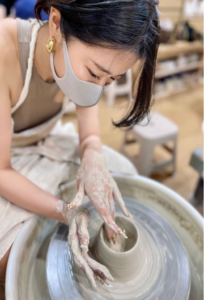
Clay-making is often acknowledged for its profound sensory experience, where skilled potters engage in meticulous moulding and refinement. In ‘Between Scientific and Sensory Knowledge: Exploring the Enactment of Clay Sensibilities Among Clay Artists in Singapore’ (American Behavioral Scientist, 2024), Professor Kelvin E.Y. Low (NUS Sociology and Anthropology) and Dr. Suriani Suratman (NUS Malay Studies) illuminate the dual nature of this craft. Alongside the tactile aspects of clay art, scientific thermoreceptive knowledge – such as precise control over firing processes, temperatures, and glazing – plays an equally crucial role in the creation of fine pottery.
The researchers highlight a dynamic interplay between activity and receptivity, as well as dominance and submission, in the relationship between the potter and the clay. They observe that the potter’s movements and perception-action loops are intricately linked with the physical qualities and affordances of the clay.
The article draws on a combination of primary and secondary data, including semi-structured interviews with local clay artists as well as media archives, clay exhibition booklets, and online texts. The artists interviewed varied widely in their experience, and their methods for acquiring clay knowledge differed significantly. Architect Daphne Pok discovered her passion for pottery during her time in Hong Kong. She has since become a strong advocate for using clay as a medium in both art therapy and education. Meanwhile, glaze chemist Seng Khoon and his family practised wood firing for over 50 years. Seng Khoon honed his craft by learning essential sensory techniques from his father to master the intricate processes involved.
In general, the researchers found that sensory knowledge in clay making is closely linked with scientific understanding through two main themes – the technical skills required for firing and glazing clay, and the shared experiences between artists and teachers. Seng Khoon, despite not considering himself as an “art person”, integrates technical knowledge with their sensory insights to perfect his firing process. Teachers also blend sensory and technical knowledge when guiding beginners, emphasising that recipes and formulas are essential for mastering glazing and firing, which then makes sensory practice more intuitive in the long term.
The article concludes with a discussion of the concept of kairos, a Greek term meaning the opportune moment. In pottery, this involves using intuition to seize critical moments in the crafting process. Despite the apparent sensory nature of pottery, experts recognize kairotic moments by combining scientific and sensory knowledge, such as assessing flame colour with the naked eye. Ultimately, artists must balance their technical and sensory approaches, allowing the clay to guide the process, to truly master the art of pottery.
Read the article here.