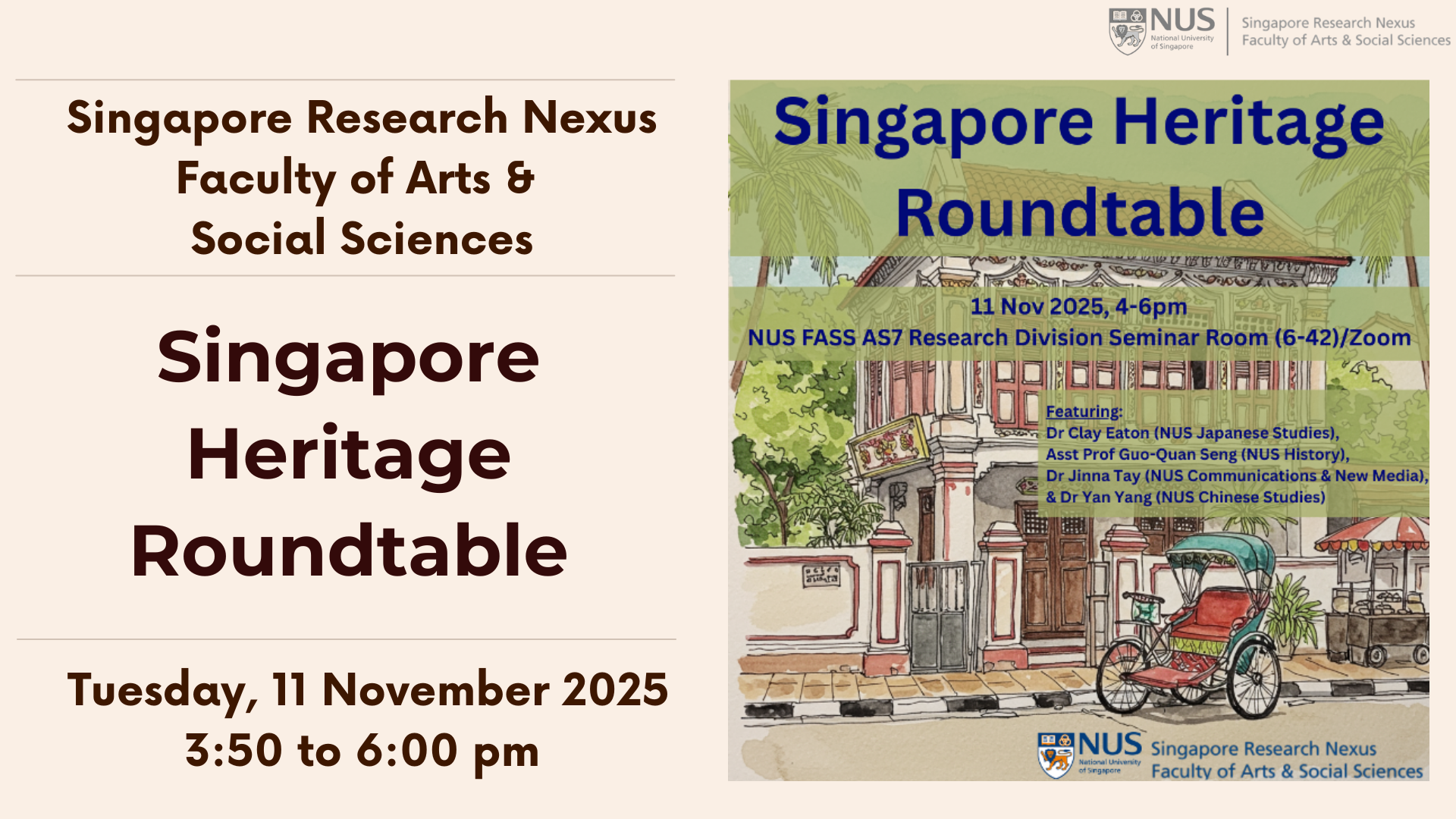

Recording now available: Singapore Heritage Roundtable (11 November 2025)
December 5, 2025
As part of the “Celebrating Singapore Studies: Sixty Years of Nationhood” campaign, the Singapore Research Nexus hosted a richly informative Heritage Research Roundtable that featured four National Heritage Board Heritage Research Grant recipients from FASS and brought fresh scholarly light to lesser-known chapters of Singapore’s past. The full video recording is now available here.
Programme
- Welcome Remarks and Chair: Assoc Prof Jack Meng-Tat Chia (NUS History & Assistant Dean of Research, FASS)
- Opening Remarks: Ms Melissa May Tan (Director, Heritage Policy & Research, National Heritage Board)
Presentations
- Dr Yang Yan (Research Fellow, NUS Chinese Studies)
In Their Own Ways: Identification and Documentation of Singapore’s Chinese Medicine
Explores how Singapore’s Chinese medical tradition diverged from mainland TCM, developing distinctive doctrines, diagnostics, and formulae shaped by local climates, migration patterns, and everyday clinical practice.
- Dr Clay Eaton (Lecturer, NUS Japanese Studies)
Mapping Middle Road: Prewar Japanese Community in Singapore
Reconstructs the vibrant yet largely forgotten “Little Japan” centred on Middle Road – home to merchants, photographers, dentists, schoolchildren, and karayuki-san – and its place within colonial Singapore’s cosmopolitan society.
- Dr Jinna Tay (Senior Lecturer, NUS Communications and New Media)
Re-Interpreting Fashion Narratives in Singapore: De-colonising the Modern
Draws on decades of newspaper archives (1950s-1990s) to reveal how fashion became a site where colonial ideas of modernity persisted, and how contemporary research can help deconstruct those inherited frameworks.
- Asst Prof Guo-Quan Seng (Assistant Professor, NUS History)
Small Businesses and Shops of Chinatown, 1819-1980s
A social history of the modest shophouses and enterprises that formed the backbone of Chinatown’s economy, tracing flows of textiles, rubber, remittances, and credit across regional Chinese networks.
We invite researchers alumni, heritage enthusiasts, and the wider public to watch the recording and discover how NUS FASS scholars are uncovering the diverse, lived textures of Singapore’s past.