

News

On 17 February 2020, Associate Professor Peter Borschberg (NUS History) addressed the fellows and members of the Royal Geographical Society-Institute of British Geographers (RGS-IBG) on the topic of “Singapore’s Longer History”. Most visitors to Singapore will know about Sir Thomas Stamford Raffles and how he established a British trading post on the island in 1819. […]

In recent years, mangrove forests have been propelled into the limelight as researchers and academics extol their potential in mitigating climate change. Some critical benefits include protection from coastal erosion, filtering pollution and sediment, and carbon sequestration – helping to store large amounts of atmospheric carbon dioxide. Thankfully, mangrove conservation efforts so far have paid […]

109 years ago, on 19 March, International Women’s Day (celebrated 8 March) was honoured for the first time in Austria, Denmark, Germany, and Switzerland. This would come to be an important milestone in the arena of female representation, in a time when society on a global scale was still overwhelmingly patriarchal. Today, a little closer […]
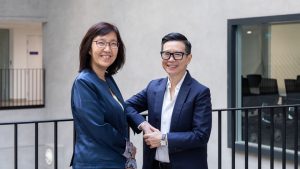
With increasing concerns over issues such as data privacy, freedom of expression, and misinformation due to the rise of the Internet and popularity of social media, NUS is establishing a new Centre for Trusted Internet and Community (CTIC). Professor Lee Mong Li (NUS School of Computing) and Professor Audrey Yue (NUS Department of Communications and […]

In late February 2003, three young women returned to Singapore from Hong Kong, subsequently displaying symptoms of an ‘atypical pneumonia’. This atypical pneumonia turned out to be the highly infectious disease known as the Severe Acute Respiratory Syndrome (SARS). The introduction of the virus to Singapore kickstarted a nationwide SARS epidemic beginning in March, which […]
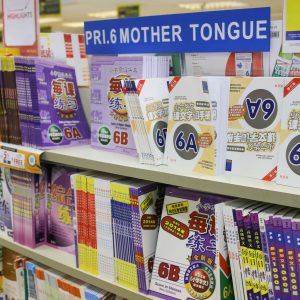
International Mother Tongue Day, observed every 21 February, celebrates linguistic and cultural diversity, as well as multilingualism. How does language-switching affect our attentional control, our capacity to choose what we pay attention to and ignore)? In ‘From Bilingualism to Bilingualisms: Bilingual experience in Edinburgh and Singapore affects attentional control differently’ (Bilingualism: Language and Cognition, 2018), […]
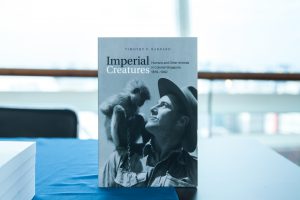
Here are some of the highlights from the book launch of Imperial Creatures: Humans and Other Animals in Colonial Singapore (NUS Press, 2019) by Associate Professor Timothy Barnard (NUS Department of History)!
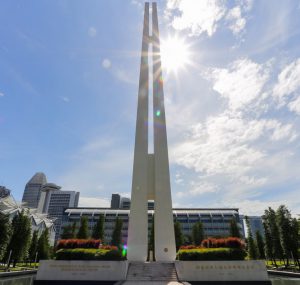
The Former Ford Factory is historically significant – its boardroom was where the British surrendered Singapore over to Japan on 15 February 1942. Decades later, on 15 February 2006, the factory was gazetted as a national monument. Subsequently, the National Archives of Singapore (NAS) established a World War II exhibition there titled ‘Memories at Old […]

In an editorial in Yahoo! News, Associate Professor Bertha Henson (NUS Department of Communications and New Media) writes about Class Notes. It is a website conceptualised together with her students in her module, Election Reporting, to showcase their reporting, writing, and research work. Class Notes became a way for A/P Henson to fulfil her desires […]
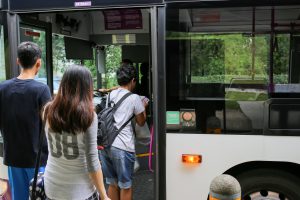
As part of the ‘ASK: NUS Economics’ series by The Straits Times, Dr Timothy Wong (NUS Department of Economics) addresses whether public transport subsidies in Singapore are economically justified. His research findings suggest that public transport subsidies in Singapore can increase supply- and demand-side economies of scale, and lower auto externalities. However, the drawback is […]