

Theatre and Performance Studies Courses
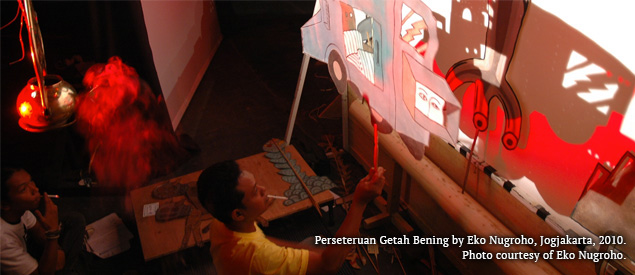
Theatre and Performance Studies offers a wide range of courses in contemporary approaches to thinking about performance, as well as thinking through practice. Undergraduate courses are grouped in three strands:
- Framing Histories
- Cultures in Practice
- Researching Performance
Courses focus on specific theatre and performance cultures, histories, movements, practices and ideas, such as pre-modern Asian theatres, cinematic and digital practices, popular culture, cultural performance in Asia and applied theatre. Across the range from introductory courses (including General Education courses) to more specialised topics, the courses share a common commitment to understanding how theatre is made and the contexts in which it has significance for its communities.
One of the most distinctive things about Theatre and Performance Studies is the range of activities it entails. At NUS, these diverse kinds of learning include:
• Lectures and seminars
• Workshops, practical sessions and group projects
• Working on productions and creating performances
• Field trips to the theatre and other events
• Independent study and thesis writing
• Practice research with staff members
• Internships with professional companies and arts institutions
Unless otherwise stated, all level 1000–6000 courses carry 4 units.
For more information on the courses below, please consult Canvas and NUSmods.
Courses offered in AY2026/2027 Semester 1
Robin LOON
This course will provide students with foundational knowledge of the different aspects of, approaches and discursive contexts relating to the study and praxis of theatre and performance. The course will also introduce students to the various forms of classical and contemporary performance practices and their attendant modes of analyses: combining play analysis, theatre history & theory. Using complementary content-centred lectures and practice laboratory, the course creates an environment where students simultaneously engage with course content while investigating its relations to the creation of theatre and performance.
Strand: Non-stranded
Pre-requisite: Exempted from NUS Qualifying English Test, or passed NUS Qualifying English Test, or exempted from further CELC Remedial English courses.
THONG Pei Qin
This course focuses on key figures and aspects of contemporary performance as a means of learning about innovative approaches to theatre practice. Taking the works of a significant dramatist, director, theorist or theatre/performance genre as their starting point, students will investigate the resulting aesthetic and conceptual innovations, and explore their implications for current approaches to performance making more generally. As such, the course combines creative and critical practice, and features a variety of reflective, analytical and practical assessment tasks, including a group performance project.
Strand: Framing Histories
THONG Pei Qin
This course looks at how one’s voice is made and how one can modulate it. Students will get an understanding of the physiological processes that produce voice and the relationship between mind and body in vocal communication. Hence this is also a very practical workshop using techniques developed by actors and singers that will improve the resonance and musicality of the speaking voice and also vocal strength and endurance. Using verse, prose and dramatic text, students will work on vocal characteristics - pitch, intonation patterns, pace and pausing, placement - and so improve their oral delivery.
Strand: Researching Performance
Jean TAY
“Where Stories Reside: Sites, Histories and Memories” explores the relationship between theatre, place, and memory. Students will investigate how stories are rooted in specific sites and learn how these can inspire narratives and be brought to life through performance. Through readings and case studies, students will learn about the concept of site-specific theatre and get to respond creatively to the spaces around them – through prose, poetry, or performance. Field visits and guest lectures with industry professionals, like curators and directors, will also allow students to learn how these concepts are applied to real-world projects in the heritage and arts sector.
Strand: Framing Histories
Edna LIM
This course explores the many ways in which theatre and film are distinct but closely inter-related mediums. The bulk of the course focuses on close analysis of texts that have been adapted from the stage to the screen, examining performativity within those texts and how the essential properties that define the stage and the screen contribute to and facilitate particular ways for performing such texts. Notions of theatricality and the cinema will be interrogated, especially in relation to how cinema can be ‘theatrical’ and the theatre ‘cinematic’. Teaching and assessment modes include lectures, seminars, workshops and guided practical coursework.
Strand: Researching Performance
A UROP involves the student working with a supervisor, and usually in a team, on an existing research project. It has relevance to the student’s Major, and involves the application of subject knowledge, methodology and theory in reflection upon the research project. UROPs usually take place within FASS, ARI, and partners within NUS, though a few involve international partners. All are vetted and approved by the Major department. All are assessed. UROPs can be proposed by supervisor or student, and require the approval of the Major department.
Prerequisite: Students must have declared a Major, completed a minimum of 24 units in that Major, and have a GPA of at least 3.20.
For updates on UROP, please refer to the FASS Student Portal.
Douglas EACHO
This course considers popular contemporary screen-mediated culture as and through performance. Emerging digital platforms have turned out to be remarkably theatrical devices. TikTok remains obsessed with dance, Twitch with solo monologists, YouTube with stunt-like performance artists. K-pop groups and stars like Taylor Swift make more money from live stage shows than music. Even the unprecedented rise of AI chatbots relies on dramatic structures of dialogue and character. We will learn how ideas from theatre and performance studies help us understand today’s spectacular, celebrity-driven, and stubbornly presence-obsessed world: from social media to populist politics, plastic surgery to deepfakes.
Strand: Cultures in Practice
Pre-requisite: Cohort 2021 onwards: Completed 80 units, including 20 units in TS.
Preclusion: TS4219HM
YONG Li Lan
This course provides a study of how the literary and performance traditions associated with Shakespeare’s work are mobilised and transformed by the visual cultures of contemporary cinema. Through the intersections between the mediums of the dramatic text, theatre and film, the course examines central issues that shape Shakespeare’s currency and circulation in the cinema: the values attached to authenticity and performance traditions, the Shakespearean actor, the appropriation and parody of the “universality” of Shakespeare, and the transformation of the meaningfulness of his plays through visuality and spectacle.
Strand: Researching Performance
Pre-requisite: Cohort 2021 onwards: Completed 80 units, including 20 units in TS or 20 units in EN
Preclusion: TS4220HM
TS4401 (8 units)
The Honours Thesis is usually done in the second semester of a student’s registration in the Honours Degree Programme.
Strand: Non-stranded
Pre-requisite: Cohort 2021 onwards: Completed 110 units including 40 units of TS major requirements with a minimum SJAP of 4.00 and GPA of 3.50, or with recommendation by the programme committee.
Preclusion: TS4660, TS4401HM, TS4660HM
Note: Please register for the Honours Thesis manually with the Department.
Documents containing important information on the Honours Thesis should be downloaded from “Documents and Forms”.
The Independent Study course is designed to enable the student to explore an approved topic within the discipline in depth. The student should approach a lecturer to work out an agreed topic, readings, and assignments for the course. A formal, written agreement is to be drawn up, giving a clear account of the topic, programme of study, assignments, evaluation, and other pertinent details. Head’s and/or Honours Coordinator’s approval of the written agreement is required. Regular meetings and reports are expected. Evaluation is based on 100% Continuous Assessment and must be worked out between the student and the lecturer prior to seeking departmental approval.
Strand: Non-stranded
Pre-requisite: Cohort 2021 onwards: Completed 100 units, including 40 units in TS, with a minimum GPA of 3.20.
Preclusion: TS4401, TS4660HM, TS4401HM
Note: Please register for the Independent Study manually with the Department.
Documents containing important information on the Independent Study should be downloaded from “Documents and Forms”.
CHEW Suyin and THONG Pei Qin
Through interactive seminars, students will gain more insights about the performing arts industry and the necessary transferrable skills to navigate artistic projects. They will critically reflect on the relevance to their own artistic identities while exploring potential career pathways. There will also be a chance to collaborate with peers from different artistic backgrounds towards a creative output at the end of the course.
Preclusion: MUA3163
Host department: YST Conservatory of Music
(This course is run jointly between YST, CFA and ELTS. It counts towards the “Researching Performance” strand for Theatre and Performance Studies in FASS.)
Graham WOLFE
This course provides a broad-based critical and theoretical foundation for advanced study of theatre and performance. Engaging with scripts, live theatrical performances, media performances and cultural performances, the course trains students to examine and compare the critical positions and questions posed by a range of theoretical texts with different approaches, priorities and methodologies. Core topics are the mutually transformational modalities of textuality and performativity, live and mediated performance, and non-traditional critical and performance practices. Students are guided in formulating research questions and writing analytically about theatre and performance.
Sonya WONG
This course critically examines the relationship between theatre-making and civil engagement through site-specificity and public anthropology and docudrama. This practice-centred course will also explore the different genres and modalities of theatre as tools to materialise visions of social and cultural histories and changes.
Category: Creative Practices in Performance
Edna LIM
In recent years, the vitality and currency of Asian cinema has resulted in texts that can no longer be viewed as merely artefacts of a particular culture or nation. This course looks at how film industries in Asia have engaged with global cinema through various forms of negotiations that assert, compromise or consume national, cultural or conventional distinctions. We assess the implications of a conglomerate Asian cinema by examining the current trend of transnational Asian films, the translatability of conventions and adaptability of ideas within Asia itself as well as between Asia and dominant cinemas like Hollywood.
Preclusion: TS5212
Category: Theatre, Film and Literature
Graham WOLFE
This course asks how we can better understand theatre through the lens of novels and vice versa. It explores the complex relationships between theatre and prose fiction in different eras and parts of the world. Often competing for audiences and defining themselves through antagonism, theatre and novels have also influenced each other’s development, drawing upon each other’s techniques, mimicking each other’s affordances, at times collaborating or even seeking to dissolve apparent boundaries. Focusing on several authors who have straddled theatre-making and novel-writing, the course investigates topics such as adaptation, transmodalization, theatricality, anti-theatricality, intermediality and parody.
Category: Theatre, Film and Literature
LIANG Peilin
How do societies use performance to mediate between the past and the present? This course addresses the question by considering the place of performance in the forging of history, the use of performance analysis as a means of gaining insights into historical events, and the function of performance as a process of remembering. Combining historical case studies and contemporary performances from local, regional and international contexts from colonial encounters and memorial rituals to trauma plays historiography is studied alongside the ways in which theatrical and other performances play a role in both reinforcing and challenging prevailing cultural memories.
Preclusion: TS5232
Category: Theatre, Film and Literature
Alvin LIM
This course introduces key aspects of the field of digital archiving in relation to the performing arts. It will discuss topics on digital media, preservation principles, policy, organisation, curation, translation and subtitling, access and copyrights. Students will learn to work with both material objects (manuscripts, posters, scripts, programmes, photographs, etc.) and digital objects (audio-visual files, text documents, databases, etc.). Theories of digital archiving and their socio-cultural meanings will also be introduced. Students will develop a prototype digital archive with the use of existing website development tools and explore the challenges and issues that archivists face when developing a digital performance archive.
Category: Digital Skills in the Arts and Humanities
YONG Li Lan
How did visualising travel disseminate orientalism as part of colonialism and thereafter? This course looks at panoramas of foreign locales in the early nineteenth century, travel photography, plays and travelling troupes to examine how visually performing the going or coming from abroad has shaped artistic paradigms. Students gain competence in researching and assembling visual materials. They discuss the modes by which viewers enact movement across geographical locations and connect cultural terrains. A digital project equips students with the reflexive skills for scaffolding, designing and presenting a journey through the visual mediums of theatre, film, photography and digital media.
Category: Digital Skills in the Arts and Humanities
HOU Yumeng
Theatre performances are increasingly advertised, documented and discussed online. Scholars have a new opportunity to gather this digital data to better understand the history and current trends of theatre performances. This course provides an introduction to data analysis and visualization, and does not require a technical background. Our objective is to understand how data can complement more traditional modes of scholarship, such as historical and ethnographic research. While the examples will mostly come from theatre studies, the techniques learned in the course are applicable to the analysis of all types of cultural data, such as literature, film and popular culture.
Category: Digital Skills in the Arts and Humanities
LIANG Peilin
This course provides a broad-based critical and theoretical foundation for advanced study of theatre and performance. Engaging with scripts, live theatrical performances, media performances and cultural performances, the course trains students to examine and compare the critical positions and questions posed by a range of theoretical texts with different approaches, priorities and methodologies. Core topics are the mutually transformational modalities of textuality and performativity, live and mediated performance, and non-traditional critical and performance practices. Students are guided in formulating research questions and writing analytically about theatre and performance.
This course is for MA (Research) and PhD students.
Independent research plays an important role in graduate education. The Independent Study course is designed to enable the student to explore an approved topic in Theatre Studies in depth. The student should approach a lecturer to work out an agreed topic, readings, and assignments for the course. A formal, written agreement is to be drawn up, giving a clear account of the topic, programme of study, assignments, evaluation, and other pertinent details. The Head's and/or Graduate Coordinator's approval of the written agreement is required. Regular meetings and reports are expected. Evaluation is based on 100% Continuous Assessment and the balance of written and other components must be worked out between the student and the lecturer prior to seeking departmental approval.
Note:
(1) Word limit: 4,000 – 6,000 words, the lower limit being permissible only where the project involves a substantial amount of practical work, and is agreed with the supervisor.
(2) Workload: Minimum 10 hours per week. The precise breakdown of contact hours, assignment and preparation is to be worked out between the lecturer and the student, subject to Departmental approval.
Independent research plays an important role in graduate education. The Independent Study course is designed to enable the student to explore an approved topic in Theatre Studies in depth. The student should approach a lecturer to work out an agreed topic, readings, and assignments for the course. A formal, written agreement is to be drawn up, giving a clear account of the topic, programme of study, assignments, evaluation, and other pertinent details. The Head’s and/or Graduate Coordinator’s approval of the written agreement is required. Regular meetings and reports are expected. Evaluation is based on 100% Continuous Assessment and the balance of written and other components must be worked out between the student and the lecturer prior to seeking departmental approval.
Note:
(1) Word limit: 6,000 – 8,000 words, the lower limit being permissible only where the project involves a substantial amount of practical work, and is agreed with the supervisor.
(2) Workload: Minimum 10 hours per week. The precise breakdown of contact hours, assignment and preparation is to be worked out between the lecturer and the student, subject to Departmental approval.
Courses offered in AY2026/2027 Semester 2
THONG Pei Qin
This course will provide students with foundational knowledge of the different aspects of, approaches and discursive contexts relating to the study and praxis of theatre and performance. The course will also introduce students to the various forms of classical and contemporary performance practices and their attendant modes of analyses: combining play analysis, theatre history & theory. Using complementary content-centred lectures and practice laboratory, the course creates an environment where students simultaneously engage with course content while investigating its relations to the creation of theatre and performance.
Strand: Non-stranded
Pre-requisite: Exempted from NUS Qualifying English Test, or passed NUS Qualifying English Test, or exempted from further CELC Remedial English courses.
Jeffrey TAN
This practical introduction to the comprehensive range of concepts, principles and practices in marketing focuses on arts and culture-related products, services and industries. Besides drawing attention to vital distinctions in the marketing of for-profit versus not-for-profit organisations, the latter of which characterises the majority of arts agencies in Singapore, the political, sociological and economic factors which influence those working in the arts will also be examined. This course is targeted at students interested in arts administration or Theatre students wishing to hone their skills in the managerial aspects of the arts.
Strand: Cultures in Practice
Douglas EACHO
This course focuses on the close reading of dramatic texts in order to study the dynamic relationship between text & performance. Through the examination of 4 major modern playwrights working in different historical, geographical and cultural contexts, this course will explore the development of modern drama in the twentieth-century, the significance of text as the basis of theatrical realisation, the variety of staging possibilities engendered by the dramaturgy of the play-text, and the synergistic partnership of word and action in creating the huge variety of text-based theatre in the twentieth-century.
Can be read by EN students in fulfilment of EN major requirements at Level-2000, as a recognised course
Pre-requisite: TS1101E or EN1101E
Strand: Framing Histories
Edna LIM
This course focuses on the conventions of a variety of film genres and styles, ranging from Hollywood and Chinese cinemas to Bollywood and animation. It traces the development of each genre, examining its defining characteristics, the role and influence of the star system and individual stars such as actors and directors, and its relations to other film styles and industries. Through a group creative project, students will make a film that involves the practical application of critical ideas.
Strand: Framing Histories
THONG Pei Qin & Celine THIO
Units: 8
The final practical project in the Theatre Studies curriculum provides students with a structured and guided opportunity to research, develop and produce an original performance piece. Working in a group under the supervision of a guest director, students conduct independent contextual research and contribute creatively to the collaborative process. The performance will be shown to a public audience, and each student will offer a research presentation analysing the process, choices and outcomes of individual work in the context of the group project. This is an essential course for Theatre Studies major students, taken in Year 3 of a student’s enrolment.
Pre-requisite: TS major students who have completed a minimum of 80 units.
Strand: Researching Performance
A UROP involves the student working with a supervisor, and usually in a team, on an existing research project. It has relevance to the student’s Major, and involves the application of subject knowledge, methodology and theory in reflection upon the research project. UROPs usually take place within FASS, ARI, and partners within NUS, though a few involve international partners. All are vetted and approved by the Major department. All are assessed. UROPs can be proposed by supervisor or student, and require the approval of the Major department.
Prerequisite: Students must have declared a Major, completed a minimum of 24 units in that Major, and have a GPA of at least 3.20.
For updates on UROP, please refer to the FASS Student Portal.
Jean TAY
This course aims to train students in the art and practice of play-writing while simultaneously offering them the opportunity to role-play the professional responsibilities and disciplines of a playwright. Topics to be covered include dramatic structure, dramatic action, the relationship between dialogue and action, characterisation, setting, the use of physical objects to create meaning, and different treatments of time on stage. Students will be assigned research and writing exercises throughout the course culminating in a full-length play. Students will also be expected to act in and direct other students’ scenes and plays as part of the continuous re-drafting and critique process.
Strand: Researching Performance
Pre-requisite: Cohort 2021 onwards: Completed 80 units, including 20 units in TS.
Preclusion: EN3271, TS4212HM
LIANG Peilin
This course trains students to become independent performance-based researchers in applied theatre. Students will develop their creative and critical skills in designing, facilitating applied theatre workshops, and in using applied theatre as a research methodology. To consolidate students’ skills in integrating practice with theory, students will undertake Practice as Research projects of considerable scope with the social and cultural complexity of specific communities and contexts in mind. Applied theatre as a form of social intervention, problem solving, community engagement, and knowledge production will be examined.
Strand: Researching Performance
Pre-requisite: Cohort 2021 onwards: Completed 80 units, including 20 units in TS.
Preclusion: TS4222HM, TS4222A, TS4222AHM
TS4401 (8 units)
The Honours Thesis is usually done in the second semester of a student’s registration in the Honours Degree Programme.
Strand: Non-stranded
Pre-requisite: Cohort 2021 onwards: Completed 110 units including 40 units of TS major requirements with a minimum SJAP of 4.00 and GPA of 3.50, or with recommendation by the programme committee.
Preclusion: TS4660, TS4401HM, TS4660HM
Note: Please register for the Honours Thesis manually with the Department.
Documents containing important information on the Honours Thesis should be downloaded from “Documents and Forms”.
The Independent Study course is designed to enable the student to explore an approved topic within the discipline in depth. The student should approach a lecturer to work out an agreed topic, readings, and assignments for the course. A formal, written agreement is to be drawn up, giving a clear account of the topic, programme of study, assignments, evaluation, and other pertinent details. Head’s and/or Honours Coordinator’s approval of the written agreement is required. Regular meetings and reports are expected. Evaluation is based on 100% Continuous Assessment and must be worked out between the student and the lecturer prior to seeking departmental approval.
Strand: Non-stranded
Pre-requisite: Cohort 2021 onwards: Completed 100 units, including 40 units in TS, with a minimum GPA of 3.20.
Preclusion: TS4401, TS4660HM, TS4401HM
Note: Please register for the Independent Study manually with the Department.
Documents containing important information on the Independent Study should be downloaded from “Documents and Forms”.
CHEW Suyin, MIAO Kaiwen and THONG Pei Qin
Through interactive seminars, students will gain more insights about the performing arts industry and the necessary transferrable skills to navigate artistic projects. They will critically reflect on the relevance to their own artistic identities while exploring potential career pathways. There will also be a chance to collaborate with peers from different artistic backgrounds towards a creative output at the end of the course.
Preclusion: MUA3163
Host department: YST Conservatory of Music
(This course is run jointly between YST, CFA and ELTS. It counts towards the “Researching Performance” strand for Theatre and Performance Studies in FASS.)
LIANG Peilin
Without movement, there would be no performance. The way we move is shaped by prevailing ideologies, sociocultural beliefs and material conditions. Treating human movement on the stage as a mode of critical inquiry, we will examine the way movement has shaped performance style and practice. In addition, students will learn the fundamentals of the moving body, conduct physical assessment, and formulate safe movement strategies for the stage. The practical components of the course are conceived as interventions that respond to discourses relating to capitalism, efficiency and aesthetics.
Category: Creative Practices in Performance
YONG Li Lan
Shakespeare is by far the most produced and adapted western playwright in East Asian theatre cultures. Approaches to translating, performing and re‐writing his plays have changed over time, and are now at their most diverse and experimental. Correlatively, connections and relationships between Asian and Anglophone performance histories have also matured. Using translated and annotated archival recordings, this course examines the historical contexts and theatrical concerns of East Asian Shakespeare performances, relating them comparatively to Anglophone and European textual and performance histories. It is jointly taught by NUS and The Shakespeare Institute, University of Birmingham as a distance learning course.
Preclusion: TS5213
Category: Theatre, Film and Literature
Alvin LIM
Covering a spectrum of theories, practices, and methods of performance ethnography, students will encounter and engage in the process of translating experience into text, audio, photography or video. This graduate course invites students to engage with ethnography as a mode of inquiry that facilitates cultural exchange and engagement with all involved—participants, audiences, and ethnographers. Beyond textual descriptions of performance, this course introduces students to innovative approaches to translating performative exchanges into a different medium. Through the process of documentation, narration, location recordings, critiquing the process, and interpretation, this course will consider the ethics and politics of ethnographic representation.
Category: Theatre, Film and Literature
Graham WOLFE
This course asks how we can better understand theatre through the lens of novels and vice versa. It explores the complex relationships between theatre and prose fiction in different eras and parts of the world. Often competing for audiences and defining themselves through antagonism, theatre and novels have also influenced each other’s development, drawing upon each other’s techniques, mimicking each other’s affordances, at times collaborating or even seeking to dissolve apparent boundaries. Focusing on several authors who have straddled theatre-making and novel-writing, the course investigates topics such as adaptation, transmodalization, theatricality, anti-theatricality, intermediality and parody.
Category: Theatre, Film and Literature
Edna LIM
This course explores the rich and dynamic process of adaptations and remakes across various forms of storytelling, including drama, theatrical production, literary and graphic novels, film and television. We study source texts and their adaptations and/or remakes as acts of transforming and performing the same stories through the codes, conventions and formal qualities of each medium or genre, as well as the creative, cultural and/or commercial motivations that drive the changes between them. Through critical analysis, students will understand how adaptations and remakes can both preserve and reinvent narratives as overlapping but unique performances.
Category: Theatre, Film and Literature
Independent research plays an important role in graduate education. The Independent Study course is designed to enable the student to explore an approved topic in Theatre Studies in depth. The student should approach a lecturer to work out an agreed topic, readings, and assignments for the course. A formal, written agreement is to be drawn up, giving a clear account of the topic, programme of study, assignments, evaluation, and other pertinent details. The Head's and/or Graduate Coordinator's approval of the written agreement is required. Regular meetings and reports are expected. Evaluation is based on 100% Continuous Assessment and the balance of written and other components must be worked out between the student and the lecturer prior to seeking departmental approval.
Note:
(1) Word limit: 4,000 – 6,000 words, the lower limit being permissible only where the project involves a substantial amount of practical work, and is agreed with the supervisor.
(2) Workload: Minimum 10 hours per week. The precise breakdown of contact hours, assignment and preparation is to be worked out between the lecturer and the student, subject to Departmental approval.
Independent research plays an important role in graduate education. The Independent Study course is designed to enable the student to explore an approved topic in Theatre Studies in depth. The student should approach a lecturer to work out an agreed topic, readings, and assignments for the course. A formal, written agreement is to be drawn up, giving a clear account of the topic, programme of study, assignments, evaluation, and other pertinent details. The Head’s and/or Graduate Coordinator’s approval of the written agreement is required. Regular meetings and reports are expected. Evaluation is based on 100% Continuous Assessment and the balance of written and other components must be worked out between the student and the lecturer prior to seeking departmental approval.
Note:
(1) Word limit: 6,000 – 8,000 words, the lower limit being permissible only where the project involves a substantial amount of practical work, and is agreed with the supervisor.
(2) Workload: Minimum 10 hours per week. The precise breakdown of contact hours, assignment and preparation is to be worked out between the lecturer and the student, subject to Departmental approval.
YONG Li Lan
This is a required course for all research Masters and PhD students admitted from Sem 1 of AY2009/2010. The course provides a forum for students and faculty to share their research and to engage one another critically in discussion of their current research projects. The course will include presentations by faculty on research ethics and dissertation writing. Each student is required to present a formal research paper. Active participation in all research presentations is expected. The course may be spread over two semesters and will be graded "Satisfactory/Unsatisfactory" on the basis of student presentation and participation.
This course is for MA (Research) and PhD students.