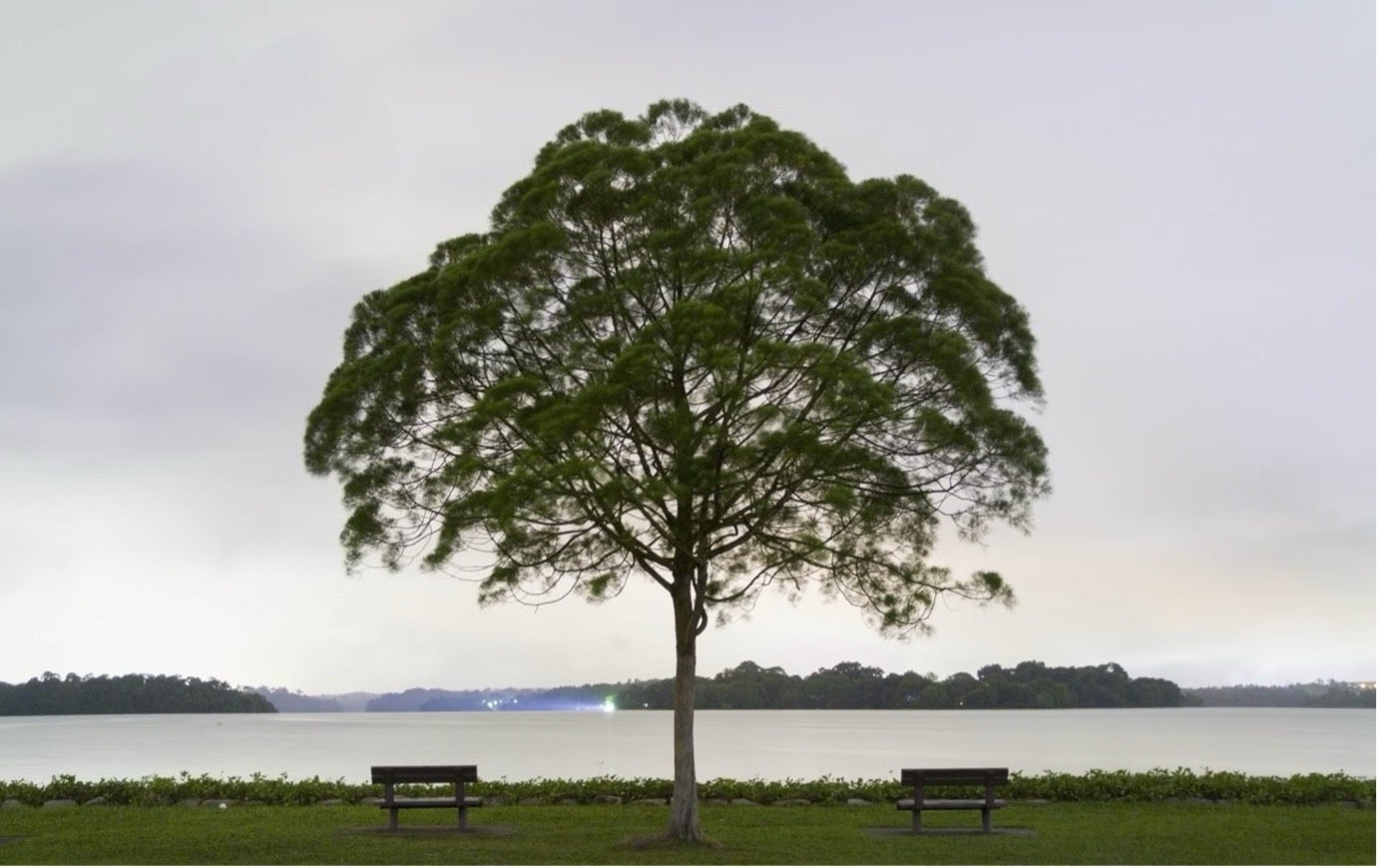

Variations in the Temperature Response of Photosynthesis Among Nine Common Tree Species Planted in Singapore
October 12, 2026
How should a city choose which trees to plant in a warming climate?
In ‘Variations in the Temperature Response of Photosynthesis Among Nine Common Tree Species Planted in Singapore’ (Frontiers in Forests and Global Change, 2026), Li Ming Rachel Teo, Liyao Yu (both NUS Geography), and Assistant Professor Remi Xiangzhong Luo (NUS Geography & NUS Centre for Nature-based Climate Solutions) examine how common tree species in Singapore respond to rising temperatures.
Tree planting is often seen as a cost-effective way to mitigate climate change, as trees absorb carbon dioxide through photosynthesis and store carbon in biomass. In Singapore, this is especially relevant given the One Million Trees movement and the country’s wider urban greening efforts. However, the climate benefits of tree planting depend not only on how many trees are planted, but also on which species are selected and how well they continue to photosynthesise under hotter conditions.
The study focuses on nine tree species commonly planted in Singapore: Rain Tree, Tembusu, Sea Almond, Pink Poui, Sea Hibiscus, African Mahogany, Tall-stilt Mangrove, Fish Poison, and Cannonball Tree. The researchers measured key photosynthetic traits, including maximum carboxylation rate, which is the maximum rate at which a plant can fix carbon dioxide (CO₂) during photosynthesis, and maximum electron transport rate, across a temperature range of 30°C to 34°C.
They found substantial differences between species. Photosynthetic capacity varied more than threefold across the trees studied. Sea Hibiscus had the highest photosynthetic capacity, while species such as Tembusu, Pink Poui, Tall-stilt Mangrove, Fish Poison, and Cannonball Tree generally showed lower values.
They also found that species responded differently to rising temperatures. Photosynthesis in some species, such as Tembusu and Sea Almond, was more sensitive to temperature changes. Others, including Tall-stilt Mangrove and Fish Poison, were more resistant to warming, though their overall photosynthetic rates were lower. Sea Hibiscus stood out because it combined relatively high photosynthetic performance with low temperature sensitivity.
The study therefore helps fill a major knowledge gap in tropical Asian plant science. It offers practical insights for urban greening and climate adaptation, showing that planting trees is not only about increasing numbers, but also about choosing species that can thrive in a hotter future.
Read the article here.