

NUSEconDigest (SCAPE)
Is a Fourth “Honours” Year Worth It? Evidence from NUS
February 2026
Is a fourth year of university a wise investment, or just a way to delay adulthood? A study published in the Journal of Public Economics (2023) examines this by looking at a unique "natural experiment" at the National University of Singapore (NUS).
Many university systems offer a three-year bachelor’s degree with an optional fourth “honours” year, but there is surprisingly little causal evidence on what that extra year yields in the labour market. In “The returns to an additional year of education for college graduates,” Jie Gong and Jessica Pan study this policy-relevant margin using data from the National University of Singapore (NUS), where students in several faculties can graduate after three years with a regular bachelor’s degree or complete a fourth, more advanced honours year.
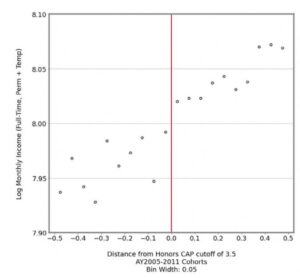
The paper exploits a sharp institutional rule: in selected faculties, eligibility to enrol in the fourth (honours) year is governed by a third-year Cumulative Average Point (CAP) threshold. Students just above the cutoff are much more likely to complete the honours year than students who narrowly miss it, yet they are otherwise comparable in academic performance and background characteristics. This creates a fuzzy regression discontinuity design.
Using NUS administrative student records linked to Graduate Employment Survey (about six months after graduation), and for some cohorts, to tax records, the authors estimate the earnings payoff to the additional year of advanced undergraduate study. The main result is economically meaningful: completing the fourth year raises monthly earnings by about 12% around six months after graduation. These gains do not appear to be short-lived; administrative tax data show that the earnings premium persists for at least four years after graduation.
What drives the return — human capital or signalling? While disentangling these channels is difficult, the paper offers suggestive evidence against a “pure signalling” story. First, if honours status were merely a signal that fades as employers learn, returns should decline with experience. However, the
Using NUS grade cutoffs, an extra honours year raises graduates’ earnings about 12%, with gains persisting for several years.
estimated returns remain substantial over the early career window observed in tax data. Second, when NUS later lowered the eligibility threshold to encourage more students to enrol in the honours year, the estimated return remained sizable rather than being “diluted,” which is hard to square with a model where the payoff is primarily the scarcity value of an honours label.
- Summarised by Jingyuan Guo
Reference:
Gong, Jie, and Jessica Pan. “The returns to an additional year of education for college graduates.” Journal of Public Economics 218 (2023): 104796:
https://www.sciencedirect.com/science/article/abs/pii/S0047272722001980