

Creating Images of ‘Professional’ Noh Theatre – Kurokawa Noh as a Means of Distinction
Eike Grossmann, Hamburg University
Contemporary Tradition – Japanese Performance Genre Today: Session One
Abstract (download PDF)
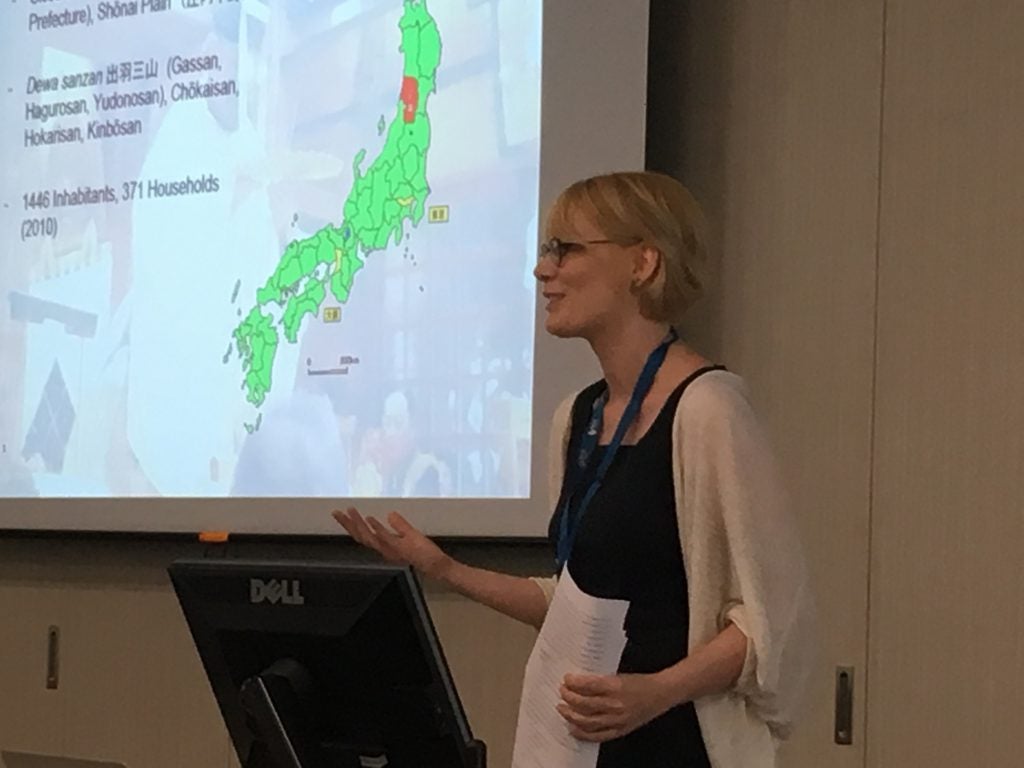
Today a clear distinction is often drawn between the so-called professional schools and folk performing arts traditions of noh theatre. One example of the latter category, Kurokawa noh (Yamagata Prefecture), will be the topic of my presentation. While raising the question of what professional and amateur noh might mean, I will outline different contexts – historical, geographical, political, and social – where their relationship is discussed.
Kurokawa noh, was considered almost equal to the ‘professional’ schools during the Edo period. The farmers were able to draw large audiences to their performances in the cities of the Shōnai domain, performed for the Sakai Daimyō in Tsuruoka, and even taught noh to villagers living in their vicinity. With the Meiji period and the emergence of the new nation-state, Kurokwawa noh was ‘discovered’ by noh performers and critics from Tōkyō, who labelled it as an archaic tradition, which did not complete its development into a professional art form. For them, Kurokawa noh became the counterpart to ‘noh in the centres’ (chūō no noh) and was used to stress the professional aspects of a new ‘professional’ noh theatre. The various discourses on Kurokawa noh thus show the creation of a supposedly coherent image of noh theatre as performed by the five schools and its relocation within the cultural framework of the young Meiji nation, pushing minor traditions to the realm of folk traditions.
This development is similar to the ‘consolidation process’ of noh during the fifteenth and sixteenth centuries, when wandering noh troupes were marginalized and referred to as tesarugaku, amateur noh theatre. In combination with an analysis of the perception of Kurokawa noh between the eighteenth and twentieth centuries, it can be argued that a professional-amateur dichotomy was constantly used by different groups to create and recreate images of noh theatre.