

Two Admission Routes
| Direct Admission Route | Stackable Route |
| For all applicants
Apply directly to the MSW and complete 40 units. |
For Singapore Citizens & Permanent Residents only
|
*Eligible courses that can be stacked towards the MSW programme:
- Credits from these courses must not already have been used toward the award of another degree programme and;
- Each course must be read and completed within the last 4 years prior to admission into the MSW programme and;
- The average Grade Point Average (GPA) of all stackable courses must be at least 3.0.
Application
| Admission Route | Intake | Application Period | Application Outcome |
| Direct Admission Route
See here for application details. |
Semester 1 (August intake) |
15 October to 15 December (the year before the intake) | From January onwards of the intake year. Most applicants can expect to receive the outcome of their application by end March of the intake year. |
| Stackable Route
See here for application details. |
Semester 1 (August intake) |
15 October to 15 December (the year before the intake) | From January onwards of the intake year. Most applicants can expect to receive the outcome of their application by end March of the intake year. |
| Semester 2 (January intake) |
1 May to 15 July (the year before the intake) | By 30 November of intake year | |
| Application for standalone courses | Semester 1 (August intake) |
May | July |
| Semester 2 (January intake) |
October | December |
Academic Year (AY) at NUS:
- Semester 1: August–December
- Semester 2: January–May
Admission Requirements
Admission Requirements for the Programme
| Applicants with a Bachelor of Social Work | Applicants with a Graduate Diploma in Social Work | Applicants without a Graduate Diploma in Social Work or a Bachelor in Social Work |
| NUS Bachelor’s degree in Social Work (with Honours) | A Bachelor’s degree (with at least an average grade of B or equivalent) and a Graduate Diploma in Social Work (with at least an average grade of B+ or equivalent) | NUS Bachelor’s degree in a related field (with Honours) and a minimum of 5 years of relevant work experience in the human services sector |
| A 4-year Bachelor’s degree in Social Work (with at least an average grade of B or equivalent) | A 4-year Bachelor’s degree in a related field (with at least an average grade of B or equivalent) and a minimum of 5 years of relevant work experience in the human services sector | |
| A Bachelor’s degree in Social Work (with at least an average grade of B or equivalent) and a minimum of 2 years of relevant work experience in the human services sector |
Admission Requirements for Standalone Courses (without admission into the MSW programme)
- A Bachelor’s degree in any discipline and
- Three years of work experience as a social service practitioner
Other Admissions Information
| Graduate Record Examination | The Graduate Record Examination (GRE) General Test report is optional but can be used to strengthen your application. GRE scores are valid for five years from the test date and score reports are valid only if our University receives them directly from the Educational Testing Service. Our University Code is 0677. More information: http://www.ets.org/gre |
| English Language | Applicants whose native tongue is not English
or
Note: TOEFL / IELTS scores are valid for two years from the test date and should not have expired at the point of application. Expired scores will not be considered for the application. Our Faculty’s TOEFL Institution Code is 9081. More information for TOEFL: https://www.ets.org/toefl.html and for IELTS: https://ielts.org/ |
Note: Applicants are responsible for ensuring that application information and all supporting documents are truthful and correct. NUS reserves the right to verify information provided as part of an application. False or misleading information in an application (including but not limited to test scores, resumes, certificates, transcripts, etc.) is grounds for admission rejection, revocation and/or dismissal from the University.
Programme Candidature
| Typical Duration | Maximum Candidature | |
| Full-time | 1.5 years | 3 years |
| Part-time | 2.5 years | 4 years |
Note: International applicants must be accepted into an approved full-time course in Singapore to apply for a Student’s Pass. For more information, refer to the Singapore Immigration & Checkpoints Authority (ICA) website.
Programme Structure
40 units comprising:
- 3 core courses (4 units each) and
- 2 practice research capstone courses (4 units each) and
- 5 elective courses (4 units each)
The 10 courses must include at least one course from each of the following baskets:
- Direct Practice
- Policy & Legislation
- Research & Evaluation
- Leadership
Note: Courses are subject to change. See here for details on the curriculum and here for the course list.
Graduation Requirements
| Course Requirements | Complete a total of 40 units, comprising:
The 10 courses must include at least one course from each of the following baskets: Direct Practice, Policy & Legislation, Research & Evaluation, Leadership. |
| Grade Point Average (GPA) | Minimum 3.0 (out of maximum 5.0)
Please see also the University’s minimum standards for Continuation and Graduation Requirements. Specific programmes may implement stricter or additional requirements. |
Fee and Scholarships
| Tuition Fee | For students admitted in AY2027:
|
| Application Fee | S$54.50 (including 9% GST)
|
| Acceptance Fee | S$5,450.00 (including 9% GST)
|
| Miscellaneous Student Fees | As published by Office of the University Registrar
|
| Scholarships | Students in this programme may be eligible to receive funding support from some of the following scholarships*:
*Subject to terms and conditions. Kindly refer to respective bodies offering the scholarship for more information. NUS makes no representation or warranty of any kind, express or implied, regarding the accuracy, adequacy, validity, reliability, availability, or completeness of the information provided here. |
The University reserves all rights to review and adjust fees as necessary, without prior notice.
 The NUS Master of Social Work programme offered rigorous training in critical thinking, analytical, and advocacy skills. Among the many enriching courses, I especially enjoyed Poverty and Asset Building with Prof. Irene Ng, Theory and Practice of Social Work Supervision with Yoges and Kumar, and Management of Human Social Services with Prof. Corinne Ghoh. Every professor brought in sector leaders, creating ample opportunities to learn from their varied experiences and to be challenged in our thinking. We were encouraged to examine literature and practices from within the region and beyond, and to engage in discussions that honed our ability to strengthen arguments, challenge viewpoints, and build compelling cases. The Poverty and Asset Building course, in particular, pushed me beyond my comfort zone to explore how macro-level and economic perspectives intersect with social work, and I grew significantly as a result.
 The capstone courses allowed me to experience first-hand using practice research methodologies to guide my practice, which contributed to better patient care at the hospital where I work as a Medical Social Worker.
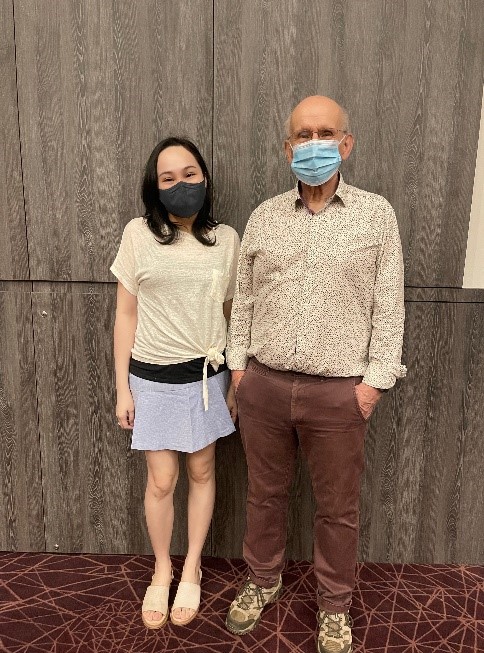 Embarking on the practice research is one of the most impactful and challenging journey that helped me reflect on the epistemologies of knowledge in a critical manner. As a moral, ethical and social endeavor, the reflexive process of practice research surfaces multiple complex issues which provokes the thinking and doing of my work professionally and personally. It is also an important contribution to the advancement of social work knowledge, understanding and context which we live in.