

Why The Centre for
Language Studies?
The Centre for Language Studies was established in 2001 to serve the foreign language needs of the Faculty of Arts and Social Sciences.
Today, it has over 80 full-time and part-time faculty members who teaches thirteen different languages - Arabic, Bahasa Indonesia, Chinese, French, German, Hindi, Japanese, Korean, Malay, Spanish, Tamil, Thai and Vietnamese - to approximately over 3,300 students per semester.
Having produced numerous teaching award winners in recent years, the Centre is firmly committed to excellence in teaching and seeks to maintain, and improve, its high teaching standards by engaging in research and facilitating professional development in foreign language teaching.

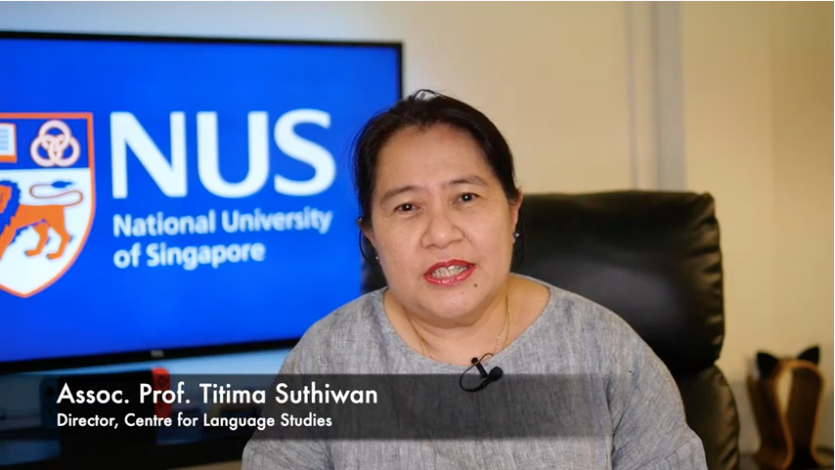
Message from our
Head of Department
Dr Titima Suthiwan holds a BA (Hons) in Thai language and literature from Chulalongkorn University, Thailand, and a PhD in Linguistics from University of Hawaii, U.S.A.. She was recruited by the Southeast Asian Studies Programme at NUS in 1998 to set up and coordinate the Thai language program, which is now a part of the Centre for Language Studies, and the world's largest and fastest growing Thai as a foreign language program. Prior to joining NUS, she taught in and coordinated Thai language program at various universities in the U.S., including University of Hawaii, University of Washington, Arizona State University, as well as University of Oregon where she also coordinated the Laos and Khmer language programs. Her publications are in the areas of Southeast Asian historical linguistics research, poetry, and translation.
Curriculum
For students admitted from AY2021-2022 onwards, to graduate with a Minor from Centre for Language Studies, students have to accumulate 20 modular credits (MC). Students who declare the Minor in Language Studies can choose one of the following options:
- 5 CLS language modules of the same language, including the sixth level language module or higher*, OR
- 4 CLS language modules of the same language, including the sixth level language module or higher, and 1 recognized module for that language track
* Sixth level language module or higher is compulsory (i.e. core module). Offer of sixth level language module or higher is subjected to the Centre for Language Studies discretion.
Note:
- In order to take the lowest level 1000 CLS language module, the student must not have any prior knowledge of the language concerned.
- Students who have prior knowledge in a language and have been placed directly in the fourth language module or any higher level will not be able to minor in that language as they will not be able to obtain the required number of modular credits from eligible language modules in that language. Such students are encouraged to work towards a minor in another language offered by the Centre.
- Department Exchange Module will not be counted towards fulfillment of Minor in Language Studies.
For queries relating to Minor in Language Studies, contact our programme convenors.
Under the Continuing Professional Education (CPE) initiative, graduating students who have completed ONLY some of the module requirements before graduating may also return to take up the sixth and higher level modules and to stack it to what they had previously completed in order to obtain a "Specialist Certificate".
Admissions
Each individual language concentration has a different set of entry requirements and eligibility conditions. They are depicted below in order of their language concentrations.
Students with previous knowledge of the language that they intend to study must declare this. They are required to take a test for advance placement and may be admitted into a module at a higher level. Students may contact the CLS for further information on the placement tests.
*Click on the specific language to view admission requirements and eligibility conditions.
Job Ready
(MISSING, CURRENT CLS WEBSITE DOES NOT HAVE)
Why CHS?
The College of Humanities and Sciences (CHS) is the enhanced undergraduate experience for students of the Faculty of Arts & Social Sciences (FASS) and the Faculty of Science (FOS) at the National University of Singapore.
Scale of Impact
Taps and builds on the research expertise of two of the largest and most established faculties in Singapore.
Deliberate Curriculum Curation
A distinct interdisciplinary approach that emphasises the ability to draw connections, discover links and connect insights across disciplines.
Unparalleled Flexibility
Offers greater choice and unparalleled flexibility to pursue breadth and depth from more than 1,000 modules per academic year.
Testimonials
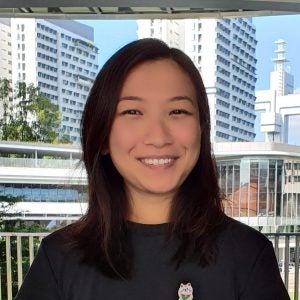
Phoebe Ong Bee Ping
Southeast Asian Studies and Political Science '22 + Thai
Why learn a new language?
As a Southeast Asian Studies major, it is part of my graduation requirements to study a Southeast Asian language and I can definitely see why this is so. Language is an important part of one's culture and identity, and for me, learning a language is also an effective way to better understand the target culture of my research work during my course of study. Moreover, after learning about my heritage and ancestry, I also felt that learning a language that my forefathers spoke would be a meaningful way to connect with my identity and relate to my understanding of the Southeast Asian region. Hence, I decided to learn Thai with CLS to complement my academic learning at school and gain a deeper understanding of world cultures.
Cheryl Lin
Senior Journalist, Channel NewsAsia
Communications and New Media '17 + French and Spanish
Currently a familiar face as a journalist on Channel NewsAsia, Cheryl majored in Communications and New Media but also studied French and Spanish at the NUS Centre for Language Studies.
What started as a casual interest in French language and culture became a major part of her undergraduate studies, as she took the language all the way up to level 6. For Cheryl, French lessons were her favourite ones in university, as they were always structured, well-paced and interactive. It is no surprise that her foreign language skills proved useful when she was producing international news, as there would sometimes be soundbites and information coming in in French. "Knowing the language meant I was able to help translate if needed."
Cheryl's wildest dream is to be an international correspondent in a foreign country…, or to gather enough experience to become a media trainer or consultant. Perhaps one day Cheryl would become a familiar face on TV in France or some other French speaking country!

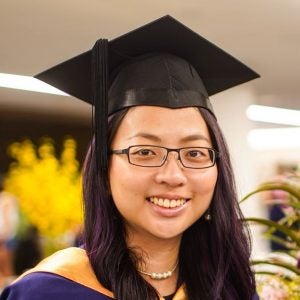
Khoo Choon Yen
Asia Research Institute
Sociology '13 + Bahasa Indonesia
Choon Yen picked up Bahasa Indonesia at the Centre for Language Studies, and the acquired linguistic skills perfectly complemented her studies in BSocSci (Hons) in Sociology (2013) and MSocSci in Geography (2018).
Her knowledge of Indonesia and its language proved all the more useful when Choon Yen seized an opportunity to work full-time, upon graduation, at the NUS Asia Research Institute (ARI), on a research project that allowed her to dive deeper into the lives of migrant workers and their migration journeys. "I was quickly provided an extension of my contract as my Indonesian proficiency proved useful in the new projects that were commissioned under the Consortium." Her involvement in the project (commissioned by the Migrating out of Poverty Research Programme Consortium) led her to pursue a part-time Masters in Geography to complement her foray into migration studies at work. By the end of her time at ARI, she had completed four research projects related to Indonesia, gender, migration, poverty alleviation, intra-household dynamics and youth aspirations.
Majoring in Sociology was an eye-opener to the workings of the world for her, while the regional perspective offered by her immersion in the Indonesian language and culture further enriched her perspectives. She fondly remembers Project Day, an essential component of the elementary module of Bahasa Indonesia (LAB1201), during which students were tasked to put up performances and serve homemade foods that they learnt from the teachers. She was introduced to the richness of Indonesian way of life through song, dance, drama and food. "That night, I fell in love with lemper (chicken stuffed sticky rice roll) whilst listening to beautiful music from the angklung ensemble."
Tan Seng Chai
Chief Corporate and People Officer, CapitaLand Group
"It's a new normal we live in, and there are critical attributes the next-generation workforce must possess in order to thrive, including the willingness to learn, ability to innovate, and high adaptability. CapitaLand recognises this and proactively collaborates on opportunities that encourage the development of these traits. That is why we're supportive of the curriculum at NUS College of Humanities and Sciences. Its focus on interdisciplinary education coupled with experiential and problem-based learning will allow future-ready CHS graduates to handle a variety of workplace scenarios across different disciplines better, and put them in good stead to ride the waves of the future of work."

The Faculty of Arts and Social Sciences, National University of Singapore (NUS) is committed to environmental sustainability.
This e-brochure is part of our sustained effort to reduce waste and foster a culture of care for the environment among the NUS and broader community.