

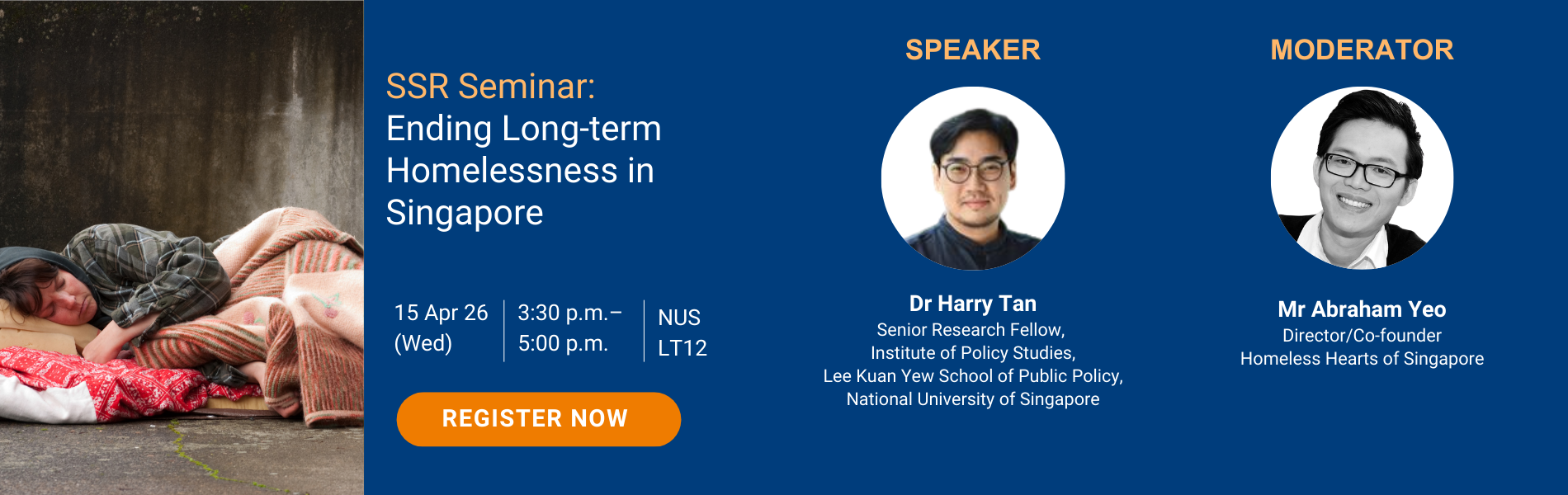
SSR Seminar Series: Ending Long-term Homelessness in Singapore
Register here
Click here to register:
- This is a physical seminar event.
- Registration slots will be assigned on a first-come, first-served basis.
- Please register by 12 April 2026. Successful registrants will be informed by 13 April 2026 via email.
- If you cannot make it after receiving the email confirmation, please let us know as soon as possible via email.
Seminar Details
People experiencing long-term homelessness in Singapore do not follow a single pathway. Some spend extended periods rough sleeping, while others move repeatedly through shelters and temporary accommodation. Drawing on a three-year qualitative study of long-term homelessness in Singapore, this seminar adopts a life course approach to reconstruct and analyse the life biography pathways of 41 participants through, into and out of homelessness, from childhood to old age.
Three key findings emerge. First, long-term homelessness broadly took two dominant forms: rough sleeping-dominant experiences and sheltered-homelessness-dominant experiences. Participants with sheltered-homelessness-dominant experiences tended to fare better in terms of their housing outcomes by the end of the study, as well as in the overall duration of time they spent homeless.
Second, the experience of long-term homelessness cuts across different life stages. Within each life stage, key life transitions associated with long-term homelessness were identified. In childhood, these included early school dropout, family instability, youth delinquency and childhood homelessness. In adulthood and older adulthood, marital union and separation, long-term work inactivity, irregular income, debt and bankruptcy, and multiple incarcerations constituted key life transitions shaping pathways into homelessness.
Third, homelessness in old age often represents the extension of long-standing patterns established earlier in the life course. These findings suggest that homelessness prevention is most effective when targeted earlier in the life course—particularly through interventions in adulthood or earlier—to prevent a downward spiral into long-term homelessness.

Senior Research Fellow,
Institute of Policy Studies,
Lee Kuan Yew School
of Public Policy
National University of Singapore
Dr Harry Tan is a Senior Research Fellow at the Institute of Policy Studies, National University of Singapore. His research work are broadly in the areas of homelessness, housing insecurity, social vulnerability, and community empowerment.

Director/Co-founder
Homeless Hearts of Singapore
Abraham co-founded Homeless Hearts of Singapore (HHOS) with a fellow Christian brother in Jul 2014, after volunteering in a Tokyo homeless ministry. Prior to serving full-time with HHOS since Nov 2019, he worked as a technologist. Now, as a dad of three young children, he and his wife, Cheng Yu, continue to volunteer with HHOS to befriend and host homeless people, especially fellow parents. Abraham is currently working on the #CityOfRefuge system to improve local statistics for homelessness research and advocacy. He also enjoys partnering with fellow community builders to help build Singapore into a city of refuge where every person in need can find a safe refuge to be.