

SSR Snippet - March 2026 Issue 1
Experiences and Impacts of Bullying among Young Persons with Disabilities in Singapore
David Puvaneyshwaran (University of Toronto), Tan Ai (National University of Singapore), and Lee Jungup (National University of Singapore)
Keywords: Bias-based Bullying; Young Persons with Disabilities; Social Exclusion; Cyberbullying; Mental Health Impacts; Resilience
Introduction
Bullying remains a pressing concern in school environments globally. Yet, the impact of bullying is not experienced equally among all students. Young persons with disabilities (YPWDs) often encounter bullying that is deeply intertwined with stigma, perceptions of difference, and broader societal attitudes toward disability. While global scholarship has documented the vulnerability of YPWDs to bullying, there remains limited research capturing how these experiences unfold within Singapore’s educational and social milieu.
Singapore has made strides in advancing inclusive education and strengthening anti-bullying responses within schools. Anti-bullying campaigns at school do not always account for intersecting identities shaping students’ experiences. Additionally, programmes to foster inclusion does not automatically translate into belonging. For many YPWDs, school can remain a space where subtle and overt forms of exclusion persist despite formal commitments to equity.
Drawing from qualitative interviews with 22 YPWDs in Singapore who reflected on their schooling experiences, this article explores how bullying was experienced, how it affected students’ emotional, mental, and developmental trajectories, and what these insights mean for educational practices and mental health interventions.
Bullying and Disability in Singapore
Bullying refers to behaviour that stems from an imbalance of power between the perpetrator and victim (Smith et al., 2013). This can take various forms, including physical, verbal, exclusionary, and increasingly, cyber (Lee et al., 2024; Smith et al., 2013). When bullying targets aspects of an individual’s identity—such as disability—it is considered bias-based bullying, which tends to lead to more severe psychological and social consequences than general bullying (Killen et al., 2013; Walton, 2018).
YPWDs face increased vulnerability to bias-based bullying due to societal perceptions that frame disability as deviant from normative standards of functioning or participation. Research shows that YPWDs experience multiple forms of victimization—including verbal taunts, physical aggression, social exclusion, and cyberbullying—which contribute to emotional distress and social marginalization (Dammeyer & Chapman, 2018; McNicholas et al., 2020). In Singapore, emerging literature highlights growing concerns regarding bullying among students with special education needs, including increased reports of cyberbullying and persistent social isolation (Begum & Nair, 2023; Khong et al., 2020). However, these studies remain largely quantitative and do not fully capture how disability stigma within Singapore’s school culture shape YPWDs’ lived experiences of bullying.
Our study (Puvaneyshwaran et al., in press; Tan et al., in press) addresses this gap by centering retrospective narratives from YPWDs in Singapore, providing insight into how bullying is experienced and internalized.
Methodology
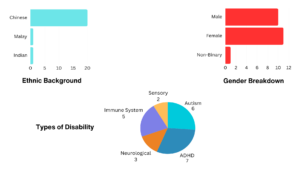
We used a phenomenological approach—where participants lived experiences shape the understanding of an issue—and invited 22 young adults with diverse disabilities (see Fig. 1) to reflect on the experiences and impacts of being bullied during their schooling years. We purposively recruited participants through disability organizations, including the Disabled People’s Association (DPA), and social media platforms. Participants (aged 21—35) reflected on bullying during childhood and adolescence and its emotional and psychological impacts over time. Ethics approval was received from the Institutional Review Board of the National University of Singapore. We used thematic analysis (Braun & Clarke, 2006) to interpret the meanings that participants assigned to their experiences and the impact on their emotional and mental wellbeing.
Importantly, none of our research team members identify as having a disability, despite bringing relevant professional and research experience. We acknowledged our outsider positionality explicitly and maintained ongoing reflexivity through memo writing and open dialogue, where we interrogated our biases in interpreting data (Tufford & Newman, 2012).
Figure 1: Demographic breakdown of participants
Experiences of Bullying
Bullying often became embedded within daily school interactions, shaping how participants understood themselves and their place among peers. Three dominant forms of bullying emerged through participant narratives: humiliating experiences, relational exclusion, and cyberbullying.
Humiliation
Participants described experiences of bullying that were direct, visible, and often humiliating. These encounters involved verbal taunts, name-calling, and physical aggression that targeted disability-related characteristics. One participant shared how she was often targeted:
A bunch of girls came out of the toilet and I think they were laughing at me already. ‘Eh elephant legs waiting to use the toilet’… That nickname was commonly used around a lot of people as well. (A11, with arthritis)
Another participant shared how he was publicly ridiculed in the classroom:
The first time I was bullied was in Primary 5. I was in a group of 3-4 classmates, they were a little bit rowdy and chatty, mostly because I was quieter and more introverted and so they started picking on me…There was one girl in particular that said mean words and along with the rest, they called me “Dustbin”. The girl actually kicked me in the back, her shoe print was all over my shirt. (A01, with Aspergers Syndrome)
Such experiences were often normalized within peer environments and occurred without peer or adult intervention. These repeated public humiliation reinforced feelings of difference and vulnerability, particularly when bullying targeted visible aspects disability such as mobility, physical appearance, or outward expression.
Relational Exclusion
While overt bullying was deeply distressing, participants emphasized that relational exclusion could be equally or even more painful. Participants reflected being left out of social interactions, group work, and peer activities, reinforcing feelings of invisibility and rejection.
A participant shared how exclusion was not overtly expressed, yet felt deeply:
So secondary school is the worst in terms of exclusion. They won’t say anything, but they would just exclude you, like for projects, they wouldn’t choose you to be their member… although they are still polite to you, but when it comes to choice, they would rather choose the people whom they think can do better. (A02, with dyslexia)
Another participant reflected on how unstructured moments of socialization often became sites of exclusion particularly due to physical mobility barriers:
When teacher say, “okay you’re free to go do your own things” then everybody would go “yay” and stand up and have fun, but actually that’ll be the most lonely for me because everyone would go to their friends’ tables and all, but I cannot move anywhere. (A05, with cerebral palsy)
These narratives illustrate that relational exclusion was a painful reminder that YPWDs were not chosen or worth adjusting for.
Cyberbullying
In this increasingly digital age, cyberbullying was described by participants as a distinct experience that extended bullying beyond school grounds. One participant shared how cyberbullying was not immediately recognizable as harmful, especially when it occurred within relationships they perceived as friendships:
During Sec. 3, my friend posted pictures of me [on Instagram]. They anyhow take pictures of me and post. I thought at that time it was normal, it was just all for fun. I thought this person was my friend so I thought it was okay. Until my teacher informed me… that those people are making fun of [me]. (A10, with Aspergers Syndrome)
Another participant recalled receiving anonymous messages that were explicitly violent and degrading:
I just had random numbers messaging me really mean things about myself, just saying things like ‘you deserve to die’, ‘you are super fat and ugly.’ I don’t know who these people are, but they were evidently my classmates. (A23, with ADHD)
These experiences highlight how cyberbullying permeates beyond school grounds, allowing victimization to follow participants into their social spaces. Anonymity and ambiguous intent—especially when under the guise of humour—often made online harassment difficult to recognize or confront. At the same time, digital platforms enabled the rapid circulation of harmful content, magnifying anti-disability sentiments and stigma.
Impacts of Bullying
Participants’ accounts revealed that the effects of bullying were both immediate and lasting, shaping emotional, psychological, and social trajectories. These impacts influenced how participants navigated school environments, related to peers, and began to understand themselves.
Immediate Impacts
Participants described bullying as emotionally overwhelming, leaving them feeling isolated, exhausted, and distressed. These responses emerged during active bullying experiences and shaped how participants navigated social interactions and school environments in the moment. One participant recounted how bullying contributed to anticipatory anxiety:
Since I didn’t want to talk, they also don’t want to be friends with me… I mean I wanted to talk to them but I didn’t know how to actually initiate that first step. Maybe they’ll laugh at me. So a lot of negative thoughts or anxiety was in me. (A04, with selective mutism)
This anxiety functioned as a protective response, where participants withdrew socially to avoid ridicule or rejection. However, it also reinforced isolation. Another participant reflected on how they suppressed their needs in order to prioritize social acceptance:
If I go out cycling with my friends, my stamina isn’t as good or I get pains more often, I would just bear with it and not say anything, because I was embarrassed. (A22, with systemic lupus)
Together, these accounts demonstrate how bullying produced immediate psychological impacts that shaped participants’ emotional regulation, help seeking behaviours, and social participation.
Short-Term Impacts
Ongoing bullying reshaped participants’ relationship with themselves and their school environments. Rather than experiencing school environments as spaces of belonging and growth, they experienced school as a site of emotional exhaustion and isolation. Several participants described how persistent victimization contributed to disengagement from school.
When I was going through PSLE as well, it took a toll on my mental health. I didn’t want to go to school. I remember begging my mom I didn’t want to go to school. (A11, with arthritis)
Importantly, the emotional and psychological toll of bullying had also led to suicidal ideation among some of the participants.
There were number of times where I got to a point where I wanted to commit suicide you know because it got so bad. Uhm and there was like nobody I could turn. Uhm but I really don’t know what how I pulled through during that period. It was quite a dark period. (A12, with ADHD)
These narratives illuminate the profound emotional consequences bullying has on YPWDs, demonstrating how sustained peer victimization can undermine wellbeing and disrupt educational participation.
Long-Term Impacts
Bullying had enduring impacts beyond schooling years. Although bullying was framed as childhood experiences by our participants, its psychological and social consequences continued to shape adult lives. Participants described internalizing messages of inadequacy, influencing their abilities, worth, and social desirability.
I had very severely bad self-esteem, even up to my early 30s. (A14, permanent knee injury)
Others reflected how bullying influenced their willingness to form relationships and pursue opportunities later in life.
It does affect my overall self-esteem… where I don’t want to put myself out there or be too close to someone else. Because I feel that they may use this against me… the episodes repeat again. (A12)
I am very guarded and wary of new people… because I know I’m in a very powerless position. I don’t want to put myself through what I went through before. (A03, with Duchenne Muscular Dystrophy)
These accounts highlight how bullying shapes emotional wellbeing and long-term participation in social, educational, and professional spaces. Bullying experiences can have ripple effects across multiple life domains.
Resistance, Reframing, and Resilience
It’s equally important to highlight that participants did not only speak about the harm caused by bullying; they also described ongoing processes of resistance, reframing, and personal growth. Through these efforts, they shifted from internalizing negative societal perceptions of disability to actively challenging them. One participant shared how her childhood experiences fostered greater empathy and intentional emotional regulation:
I become more understanding of people with special needs. Sort of become more sensitive to um, because I still remember how my childhood actually evolved. So I sort of become more sensitive to children or youth for that matter, especially children. Then it becomes a very conscious effort…when I slip into negative emotions, that I can actually swap to positive. It is really up to me. I keep motivating myself that since I can overcome so many trials when I was younger, nothing could be more difficult now. (A02, with dyslexia)
Another participant reflected on how external validation and supportive relationships played a role in shaping their self-perceptions:
I think it’s because I realised that there’s some purpose that I can do. To me it’s having those opportunities to start giving and start doing and realising and finding the skills and strengths that I have. But it also starts from people around me that there’s something inside that they see that I don’t see about myself. That really helps and then it starts a positive reinforcement cycle. (A05, with cerebral palsy)
Resilience was also expressed through assertiveness and self-advocacy.
At the end of day, it is strength of mind like I’m stronger than them because I’m honest about my condition, I’m aware of it and if I’m aware of it means I know what to do so don’t mess with me. (A20, with ADHD)
Importantly, participants’ accounts suggest that resilience was not a linear or uniform process, nor did it erase the impacts of bullying. Instead, resilience emerged as process shaped by self-reflection and supportive relationships. These narratives highlight how YPWDs actively negotiate stigma, demonstrating agency in (re)defining their identities.
Discussion
Findings from our study highlight that bullying among YPWDs in Singapore is not limited to isolated acts of peer aggression, but is embedded within broader social norms, school structures, and cultural perceptions of disability. Importantly, YPWDs often remain positioned at the margins of peer social structures, where differences in ability, appearance, and behaviour become grounds for exclusion (Daud, 2019; Killen et al., 2013).
These narratives highlight how bullying shapes emotional wellbeing and resilience, influencing self-esteem, relationships, and willingness to pursue opportunities in adulthood. At the same time, we learnt that resilience emerges through complex and non-linear processes involving self-reflection, supportive relationships, and opportunities for self-advocacy.
In Singapore, these findings are important given the country’s emphasis on academic achievement, structured peer grouping, and increasing reliance on digital communication platforms (Begum & Nair, 2023). While national efforts have strengthened anti-bullying frameworks and inclusive education policies, our participants’ experiences suggest that disability-based bullying remain less visible within existing prevention strategies. Centering the voices of YPWDs provides important insights into how bullying manifests within and outside school environments and highlights the need for interventions that foster genuine social belonging.
Limitations
Our study has some limitations that are important to consider in understanding this phenomenon. First, given the retrospective nature of this study, participants’ recollection of events may be shaped by reinterpretation of past experiences or the passage of time. Second, all but two of our participants are of Chinese ethnicity, limiting an intersectional understanding of how bullying may be experienced by YPWDs who are marginalized across race and disability. Third, our participants ranged from 21 to 35 years old, and we did not compare across age cohorts. As educational policies, disability inclusion practices, and digital environments have evolved over time in Singapore, experiences of bullying may differ across generational contexts.
Implications for Educators
Educators play a central role in shaping whether schools become safe spaces or environments where bullying can persist. In our research (Puvaneyshwaran et al., in press; Tan et al., in press), we highlight how teachers’ attentiveness, empathy, and willingness to intervene remain among the most powerful protective factors for students with disabilities.
At the same time, educators need to be mindful of the less visible forms of bullying. Exclusion from group work, being overlooked in peer activities, or being the subject of jokes disguised as humour can be deeply harmful, even when they are not formally recognized as bullying. It is therefore crucial for teachers to identify subtle forms of social exclusion and microaggressions. That said, educators should also be cautious not to adopt overly paternalistic responses that position YPWDs as needing to be “rescued.” Gentle check-ins, consistent availability, and working alongside students to address challenges can empower YPWDs to articulate their needs while preserving their agency and autonomy.
Group-based tasks, unstructured socialization periods, and competitive performance expectations that do not account for accessibility needs can further increase isolation. Creating flexible participation options and designing activities that recognise diverse strengths can help students with disabilities feel included and valued.
Finally, educators and schools should actively involve YPWDs in conversations about anti-bullying and inclusion initiatives. YPWDs are best positioned to share what makes them feel safe, valued, and supported. Listening to their voices can help schools develop policies and practices that are more responsive and meaningful.
Implications for Mental Health Practitioners
Our findings highlight the short- and long-term effects of bullying for YPWDs, shaping emotional wellbeing, self-esteem, and relationships well into adulthood. Mental health practitioners in Singapore should remain attentive to how past bullying experiences may continue to influence clients’ confidence, social trust, and willingness to pursue opportunities.
Experiences of bullying often shaped how participants perceived themselves and their disabilities, contributing to feelings of shame, self-doubt, and social withdrawal. Mental health practitioners—including social workers, counsellors, and therapists—can play an important role in helping YPWDs process these experiences and develop healthier self-narratives that are not defined by stigma or past victimization. Practitioners should also recognise that coping strategies developed during bullying may be complex. Emotional withdrawal or suppressing physical discomfort may function as immediate survival strategies but can contribute to longer-term distress. Support services could therefore create safe spaces for individuals to explore these coping responses while supporting the development of more sustainable emotional regulation and self-advocacy.
Given the pervasive role of online spaces in young people’s social lives, mental health practitioners may also need to consider extending support into digital contexts. This may include providing accessible online counselling or check-in platforms and supporting YPWDs in developing strategies to navigate online harassment. Offering hybrid or virtual support options may also increase accessibility for YPWDs who face mobility barriers or who may feel safer disclosing experiences virtually.
Finally, mental health practitioners should work collaboratively with schools, families, and community organisations. Bullying rarely occurs within a single setting or moment in time, and recovery often requires coordinated support across multiple environments. Collaborative care may involve supporting schools in developing individualized wellbeing plans, equipping families with tools to respond to disclosures of bullying, and connecting YPWDs with community-based peer or disability support networks. Most importantly, such collaboration should center the voices and preferences of YPWDs themselves.
Note
To learn more about the findings and implications of our study, keep a look out for the following manuscripts that are currently in press.
- Puvaneyshwaran, D., Tan, A., Wah, T. H., & Lee, J. (In Press). “They keep thinking I’m bad, so I look at my strengths”: Navigating bullying as young persons with disabilities in Singapore. Journal of Child and Adolescent Trauma.
- Tan, A., Puvaneyshwaran, D., & Lee, J. (In Press). Bias-based bullying: The role of support systems for young persons with disabilities. Journal of the Society for Social Work Research.
References
Begum, M., & Nair, S. (2023). Understanding bullying experiences among SEN students: A parental perspective. Asia Pacific Journal of Developmental Differences, 10(2).
Braun, V., & Clarke, V. (2006). Using thematic analysis in psychology. Qualitative Research in Psychology, 3(2), 77–101. https://doi.org/10.1191/1478088706qp063oa
Dammeyer, J., & Chapman, M. (2018). A national survey on violence and discrimination among people with disabilities. BMC Public Health, 18(1), 355. https://doi.org/10.1186/s12889-018-5277-0
Daud, S. M. (2019). Perspectives of mainstream students with special educational needs on inclusion. Asia Pacific Journal of Developmental Differences, 6(2), 186–223. https://doi.org/10.3850/S2345734119000248
Khong, J. Z. N., Tan, Y. R., Elliott, J. M., Fung, D. S. S., Sourander, A., & Ong, S. H. (2020). Traditional victims and cybervictims: Prevalence, overlap, and association with mental health among adolescents in Singapore. School Mental Health, 12(1), 145–155. https://doi.org/10.1007/s12310-019-09337-x
Killen, M., Mulvey, K. L., & Hitti, A. (2013). Social exclusion in childhood: A developmental intergroup perspective. Child Development, 84(3), 772–790. https://doi.org/10.1111/cdev.12012
Lee, J., Ang, R. P., & Shan Cheung, H. (2024). School bullying and cyberbullying in Singapore: Prevalence, predictors, and outcomes. In J. S. Hong, H. C. Chan, A. L. C. Fung, & J. Lee (Eds.), Handbook of school violence, bullying and safety (pp. 348–362). Edward Elgar Publishing. https://doi.org/10.4337/9781035301362.00037
McNicholas, C. I., Orpinas, P., & Raczynski, K. (2020). Victimized for being different: Young adults with disabilities and peer victimization in middle and high school. Journal of Interpersonal Violence, 35(19–20), 3683–3709. https://doi.org/10.1177/0886260517710485
Smith, P. K., del Barrio, C., & Tokunaga, R. S. (2013). Definitions of bullying and cyberbullying: How useful are the terms? In Principles of cyberbullying research (1st ed., pp. 26–40). Routledge. https://doi.org/10.4324/9780203084601-5
Tufford, L., & Newman, P. (2012). Bracketing in qualitative research. Qualitative Social Work, 11(1), 80–96. https://doi.org/10.1177/1473325010368316
Walton, L. M. (2018). The effects of “bias based bullying” (BBB) on health, education, and cognitive–social–emotional outcomes in children with minority backgrounds: Proposed comprehensive public health intervention solutions. Journal of Immigrant and Minority Health, 20(2), 492–496. https://doi.org/10.1007/s10903-017-0547-y
Edited by Dr Meixi (National University of Singapore)