


Where Will You Make Your Impact?
Understand The World. Shape Your Future.
From climate resilience to global justice, NUS Geographers learn from today’s problems to design tomorrow’s solutions. Through an interdisciplinary curriculum that integrates physical and human geography, students examine real-world challenges across local, regional, and global contexts. Grounded in research and practice, NUS Geography equips learners with the critical and applied skills needed to shape more equitable and resilient futures.

Climate Change
How do we respond to a warming world?
Analyse climate impacts and adaptation strategies to drive solutions in policy, planning, and environmental consultancy.

Sustainable Development
How can we live well on a damaged planet?
Evaluate and design pathways for balancing growth, equity, and environment to shape sustainable futures across public and private sectors.

Globalisation & Inequality
Is there hope for the future?
Examine how global flows of power, trade, and culture create uneven geographies, opening pathways into public policy, urban and corporate consultancy.

Our Everyday Worlds
How do we create meaningful worlds for ourselves and others?
Explore how identities, practices, and cultures shape everyday spaces and places, building skills for careers in planning, community engagement, marketing and project management.

Geospatial Intelligence
Want to see the world in 4D?
Apply spatial analysis, mapping, and data visualisation to solve real-world challenges in industry, government, and academia.

The Geographical Sciences
Want to shape the world, literally?
Study Earth’s dynamic systems to build skills in analysis and field research, leading to careers in environmental consultancy, resource management and conservation, and sustainability planning.
Explore Our Programmes
Politics, Economies And Space
Stressor Source as a New Dimension of Emotional Political Ecologies: The Case of Corn Belt Farm Stress in the United States
Nichols, C. E. (2026).
Annals of the American Association of Geographers
Social Cultural Geographies
The spatiality of performative authenticity on social media: A geographical understanding of young African fashion microcelebrities
Xiao, A. H., & Yan, Q. (2026).
Geographical Research / Wiley
Tropical Environmental Change
Shifting paradigms: towards dynamic approaches to sustain Anthropocene lake ecosystems
Zhang, K., Gillson, L., McGowan, S., Finch, J., Liu, Z., Shen, J., Meadows, M.E. & Taylor, D. (2026)
Science Bulletin/Elsevier
Geographic Information Systems
Urban AI for a sustainable built environment: Progress and future directions
Knoblauch, S., Li, H., Biljecki, F., Li, W., & Zipf, A. (2026).
Environment and Planning B: Urban Analytics and City Science
News & Happenings
NUS Geography Now
Congratulations to Assistant Professor Nathan Green, who was recognised at this year’s American Association of Geographers (AAG) Annual Meeting with Outstanding Paper Awards from both the Cultural and Political Ecology and Development Geography Specialty Groups.
His award-winning paper, “Maximizing Finance for Sustainable Development: Microfinance, Debt-Driven Deforestation, and the Self-Regulation of Environmental Harm,” published in the Annals of the American Association of Geographers, was honoured for its impactful contribution to critical debates on sustainability, finance, and environmental harm.
The Department of Geography proudly hosted the 30th NUS Geography Challenge, a landmark edition that welcomed nearly 500 students from over 120 secondary schools across Singapore. Centred on the theme City for Tomorrow: Shaping Our Liveable Future, the event showcased the creativity and geographical thinking of the next generation.
The milestone event was also featured by Mediacorp's 8world.
Applications are now open for a funded PhD position in Urban Climate Modelling at the Urban Climate Lab, focused on advancing urban weather and climate modelling for tropical environments like Singapore.
Interested candidates can find out more here. Application deadline is 15 May 2026 for the January 2027 intake.
Upcoming Events
Seminar
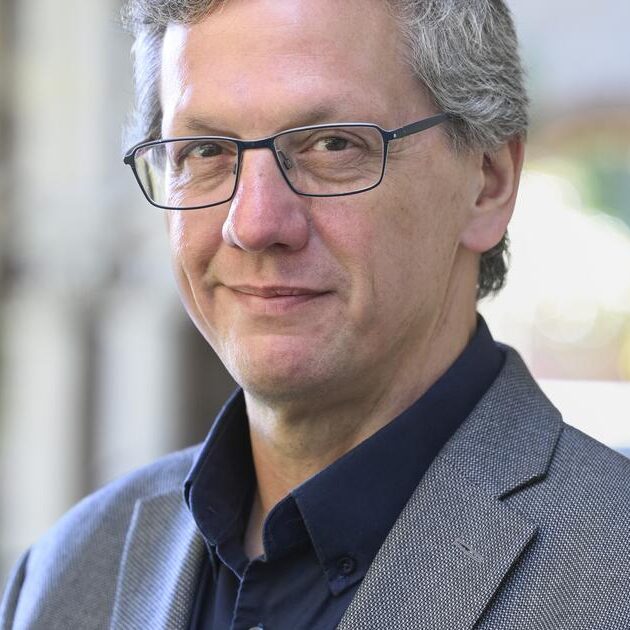
“Reckoning the urban: Cold War legacies and contemporary urban politics in Southeast Asia” by Professor Gavin Shatkin, LKCF Visiting Fellow on Tuesday, 14 April 2026, 2-3:30PM, Research Division Seminar Room, AS7 06-42.
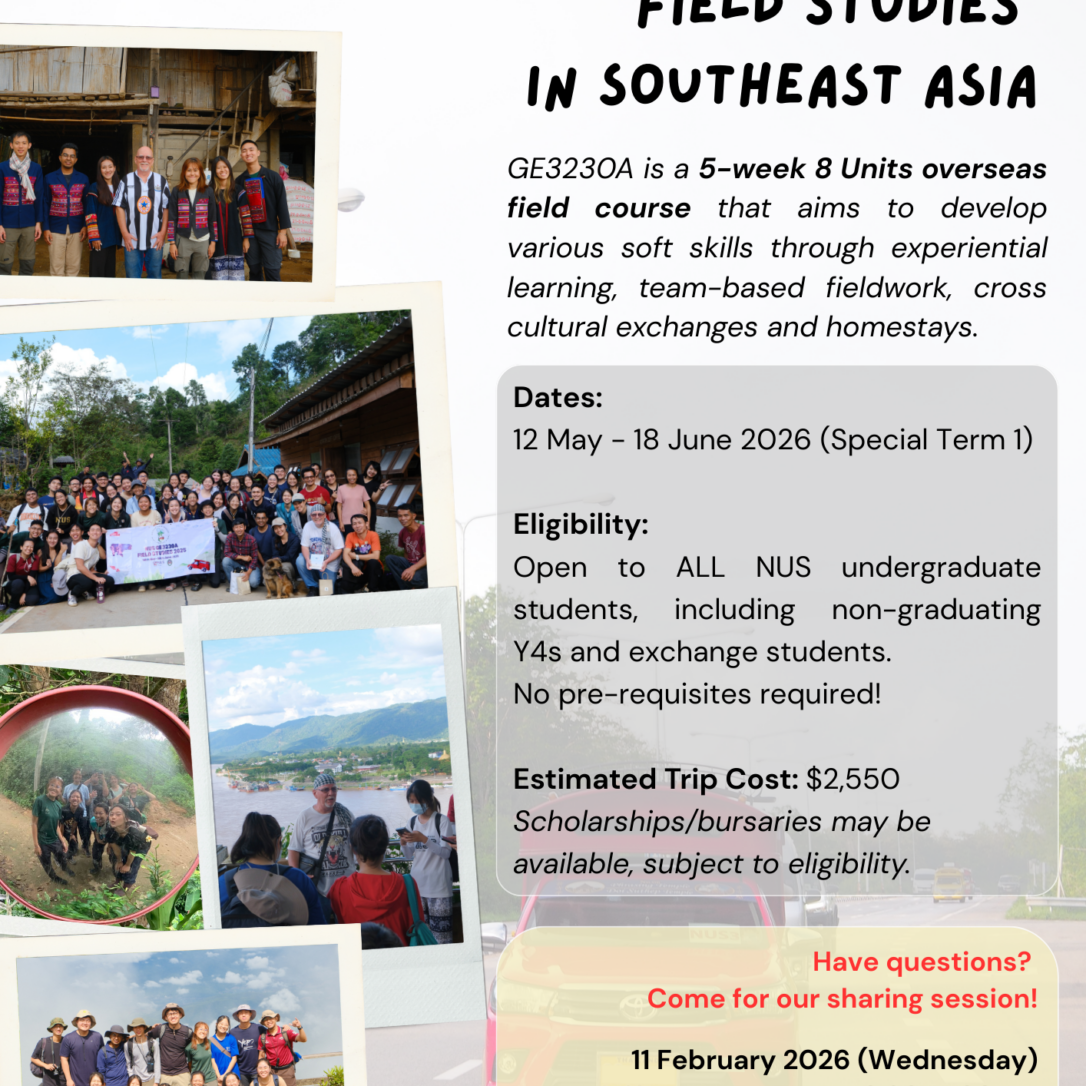
Field Studies 2026 - Official Registrations Open!
GE3230A is a 5-week, 8-unit overseas field course conducted in Southeast Asia during Special Term 1 (12 May - 18 June 2026). Students interested in enrolling can officially register for the course via the link below.
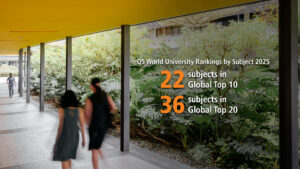
22 NUS programmes in global top 10 in QS World University Rankings by Subject 2025
History of Art, Geography, Linguistics and Politics & International Studies at NUS ranked in the Global Top 10 of the latest Quacquarelli Symonds World University Rankings (QS WUR) by Subject 2025 released on 12 March 2025.

Half of land use carbon emissions in Southeast Asia can be mitigated through peat swamp forest and mangrove conservation and restoration
Southeast Asia (SEA) is home to approximately 34% of the world’s mangrove forests, representing a crucial component of coastal ecosystems. From Singapore’s Sungei Buloh Wetland Reserve to Thailand’s Tarutao National Park, these peatlands and mangrove act as natural carbon sinks by absorbing more carbon than they release, with the excess accumulating as partially decomposed organic […]

Orang Cina Bukan Cina: being Peranakan, (not) being Chinese and the social construction of race in Singapore
Singapore’s Peranakan Museum reopened its doors on 17 February 2023, after a four-year closure for renovation. The Peranakan Museum features permanent galleries showcasing artifacts from Peranakan culture, detailing the unique history of Peranakans through their culture and craftsmanship. The museum also aims to capture an authentic glimpse into Peranakan life, as well as the struggles […]