


Where Will You Make Your Impact?
Understand The World. Shape Your Future.
From climate resilience to global justice, NUS Geographers learn from today’s problems to design tomorrow’s solutions. Through an interdisciplinary curriculum that integrates physical and human geography, students examine real-world challenges across local, regional, and global contexts. Grounded in research and practice, NUS Geography equips learners with the critical and applied skills needed to shape more equitable and resilient futures.

Climate Change
How do we respond to a warming world?
Analyse climate impacts and adaptation strategies to drive solutions in policy, planning, and environmental consultancy.

Sustainable Development
How can we live well on a damaged planet?
Evaluate and design pathways for balancing growth, equity, and environment to shape sustainable futures across public and private sectors.

Globalisation & Inequality
Is there hope for the future?
Examine how global flows of power, trade, and culture create uneven geographies, opening pathways into public policy, urban and corporate consultancy.

Our Everyday Worlds
How do we create meaningful worlds for ourselves and others?
Explore how identities, practices, and cultures shape everyday spaces and places, building skills for careers in planning, community engagement, marketing and project management.

Geospatial Intelligence
Want to see the world in 4D?
Apply spatial analysis, mapping, and data visualisation to solve real-world challenges in industry, government, and academia.

Environmental Sciences
Want to shape the world, literally?
Study Earth’s dynamic systems to build skills in analysis and field research, leading to careers in environmental consultancy, resource management and conservation, and sustainability planning.
Explore Our Programmes
Politics, Economies And Space
Agrarian Financial Ecologies
Green, W.N. (2026)
Journal of Peasant Studies
Social Cultural Geographies
From “Caring for the home” to “Caring for the environment”: Migrant Domestic Workers and Circular Household Waste Management in Singapore
Yeoh, B.S.A., Tan, Q.H., Rahadini, I.A. (2026)
Annals of the American Association of Geographers
Tropical Environmental Change
Machine-learning-based estimates of global natural vegetated wetland methane emissions (2000–2025)
Li, M., et al. (2026)
Earth System Science Data
Tropical Environmental Change
The birth of a field through a marriage of scales: urban meteorological modeling meets regional climate modeling
Georgescu, M. (2026)
Environmental Research Letters/Institute of Physics
News & Happenings
NUS Geography Now
CNA938 interviewed Dr Nawaz on 28 August 2026 about the role of climate change and human activity in the Nepal–Tibet disaster.
From 2–4 September, our Social Cultural Geographies (SCG) researchers will be at the RGS-IBG Annual Conference. Explore the presentations and sessions featuring our faculty and students under Our Research Activities.
Discover more of SCG’s research, events and activities here.
8world News featured an interview with Dr Muhammad Nawaz on the recent earthquakes in Japan, published on 29 July 2026.
Upcoming Events
Seminar
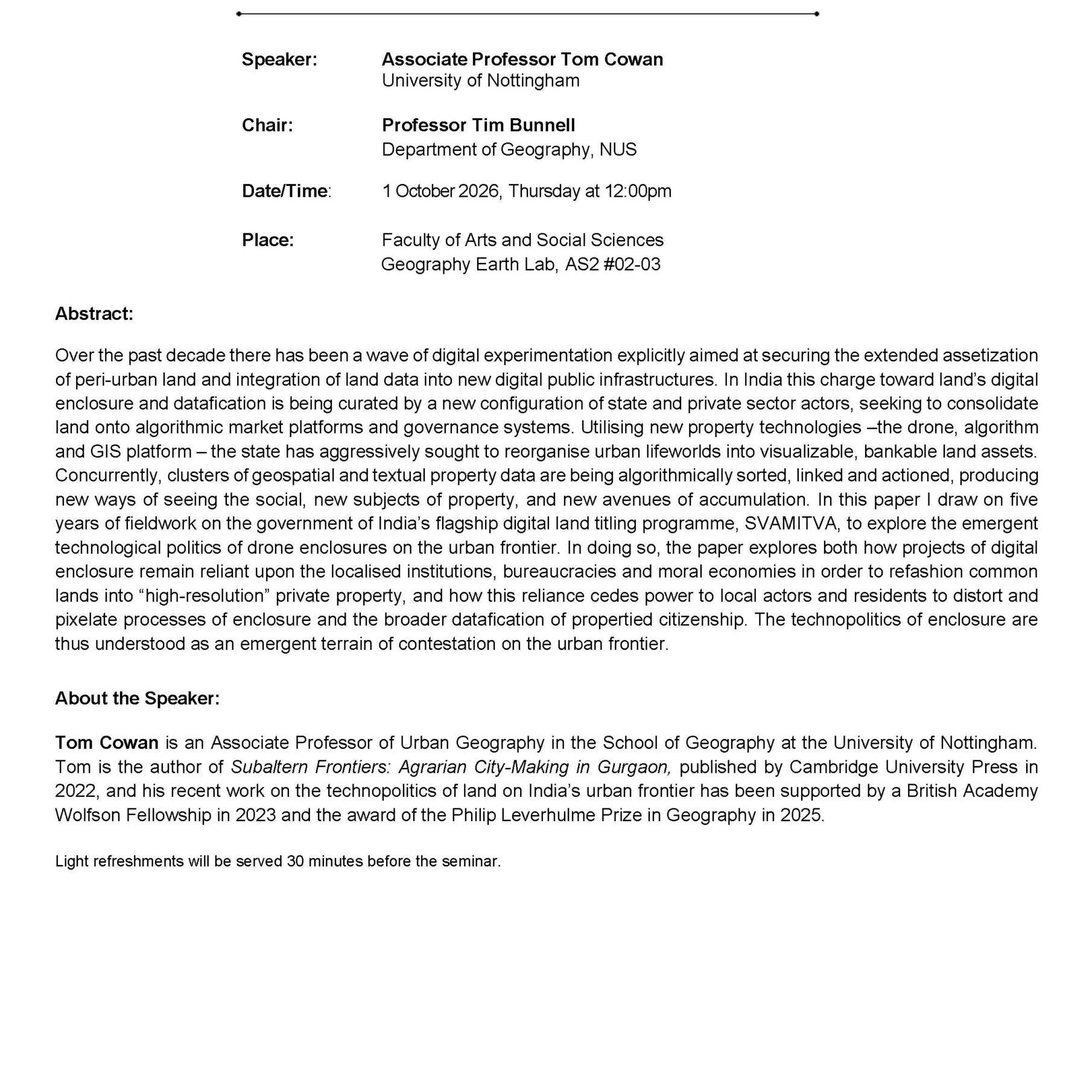
“High-resolution property: Digital enclosures on the urban frontier” by Associate Professor Tom Cowan, University of Nottingham on Thursday, 1 October 2026, 12PM, Geography Earth Lab, AS2 02-03.

Seminar
“Spectrum Geographies: Signal, Territory, and Electromagnetic Space” by Associate Professor Mia Bennett, University of Washington, 16 September 2026, at 3.30pm, Geography Earth Lab, AS2 02-03.

Seminar
“The Post-Global City: Rethinking Urban Interconnectedness in the 21st Century” by Associate Professor Katrien Pype, KU Leuven, 26 August 2026, at 3.30pm, Geography Earth Lab, AS2 02-03.
Students examine what makes a liveable city at 30th NUS Geography Challenge
The milestone 30th NUS Geography Challenge brought together close to 500 students from more than 120 secondary schools across Singapore – the largest participation to date – to examine this year’s theme, “City For Tomorrow: Shaping Our Liveable Future.”
A Living Classroom
For Samuel Loh, an interest in Singapore’s coastal ecosystems quickly evolved into a journey in sustainability that led him to pursue a Major in Environmental Studies and a Minor in Geographical Information Systems — a combination that lets him blend life sciences with geography, humanities and policy.

NUS leads Asia in the QS World University Rankings by Subject 2026
Achieves strongest performance to date, with all-time high of seven NUS subjects ranked among the global top three and a record 28 subjects in the global top 10.