

AI Futures at FASS — Brown Bag Session #1 | A/P Kokil Jaidka & Dr Nick Huang
Dear all,
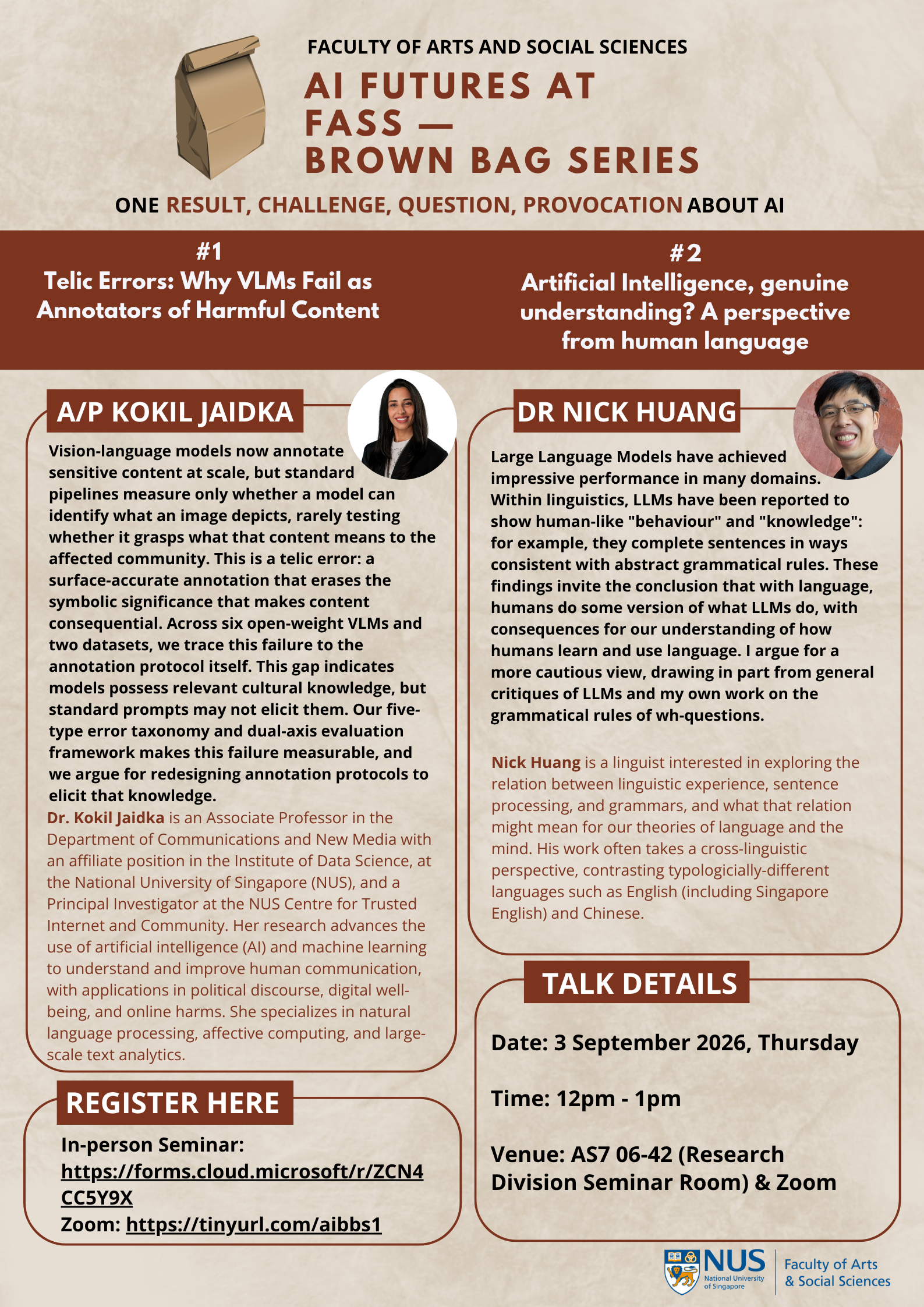
You are cordially invited to the first session of the AI Futures at FASS — Brown Bag Sessions series in Semester 1 of AY26/27. Speakers will share one result, challenge, question or provocation about AI in relation to their work. A/P Kokil Jaidka (NUS Communications and New Media) and Dr Nick Huang (NUS English, Linguistics and Theatre Studies) will be presenting on "Telic Errors: Why VLMs Fail as Annotators of Harmful Content" and "Artificial Intelligence, genuine understanding? A perspective from human language" respectively.
AI Futures at FASS — Brown Bag Session #1
Date: 3 September 2026, 12pm-1pm
Venue: Zoom and in-person (FASS Research Division Seminar Room AS7 06-42)
Lunch will be provided for in-person attendees.
Talk #1: "Telic Errors: Why VLMs Fail as Annotators of Harmful Content"
Vision-language models now annotate sensitive content at scale, but standard pipelines measure only whether a model can identify what an image depicts, rarely testing whether it grasps what that content means to the affected community. This is a telic error: a surface-accurate annotation that erases the symbolic significance that makes content consequential. Across six open-weight VLMs and two datasets, we trace this failure to the annotation protocol itself. This gap indicates models possess relevant cultural knowledge, but standard prompts may not elicit them. Our five-type error taxonomy and dual-axis evaluation framework makes this failure measurable, and we argue for redesigning annotation protocols to elicit that knowledge.
Talk #2: "Artificial Intelligence, genuine understanding? A perspective from human language"
Large Language Models have achieved impressive performance in many domains. Within linguistics, LLMs have been reported to show human-like "behaviour" and "knowledge": for example, they complete sentences in ways consistent with abstract grammatical rules. These findings invite the conclusion that with language, humans do some version of what LLMs do, with consequences for our understanding of how humans learn and use language. I argue for a more cautious view, drawing in part from general critiques of LLMs and my own work on the grammatical rules of wh-questions.
Dr. Kokil Jaidka is an Associate Professor in the Department of Communications and New Media with an affiliate position in the Institute of Data Science, at the National University of Singapore (NUS), and a Principal Investigator at the NUS Centre for Trusted Internet and Community. Her research advances the use of artificial intelligence (AI) and machine learning to understand and improve human communication, with applications in political discourse, digital well-being, and online harms. She specializes in natural language processing, affective computing, and large-scale text analytics.
Nick Huang is a linguist interested in exploring the relation between linguistic experience, sentence processing, and grammars, and what that relation might mean for our theories of language and the mind. His work often takes a cross-linguistic perspective, contrasting typologicially-different languages such as English (including Singapore English) and Chinese.