

Graduate Programmes in Applied GIS
MSc in Applied GIS
Master of Science in Applied GIS

NUS has adopted three new academic terminologies since 1 August 2023:
“Module” has been renamed “Course”, “Modular Credit (MC)” has been renamed “Unit”, and “Cumulative Average Point (CAP)” has been renamed “Grade Point Average (GPA)”. The definitions of a Module/Course and MC/Unit remain the same, and there has been no change to the computation of the CAP/GPA.
The programme of Master of Science in Applied Geographic Information Systems (hereafter MSc in Applied GIS), a single-degree coursework Master’s programme hosted in Department of Geography at NUS, is designed to reflect the cutting-edge technologies and latest developments in GIS and its applications with the reputation of NUS Geography as one of the top 10 geography departments around the world. This innovative programme provides an exciting opportunity for the prospective students to study at NUS, the top university in Asia, as a pathway to a PhD or further practical career in applied GIS or related disciplines.
We offer two tracks of training (Thesis Track and Coursework Track). The Thesis Track includes a research thesis component, which covers thesis preparation (GE5225) and the GIS research thesis itself (GE6225). It aims to attract students with interests in applied GIS research and developing their research skills. The Coursework Track allows students to obtain the MSc entirely through coursework (without the need to complete a thesis) and is designed to attract those who require more practical GIS skills or a more substantial upgrade to their existing expertise to advance their careers.
Those who currently use or who wish to use GIS and its applications to their full extent will find the programme useful. Applications cover, but certainly not limited to, spatial assessment and management of natural resources, environmental/disaster monitoring and assessment, demographic analysis, public health, forensic sciences, transportation and urban planning, and business marketing.
The MSc in Applied GIS has one intake per year (August).
Applicants seeking admission must have obtained either:
- a Honours degree (Merit/Second Class and above) or the international equivalent (e.g., a four-year Bachelors degree with at least an average grade of B or equivalent) in the subject or related fields; or
- a good Bachelors degree (at least an average grade of B or equivalent) in the subject or related field, and with a minimum of one year of relevant work experience; or
- such other qualifications and experience subject to approval by the Board of Graduate Studies.
Overseas applicants who do not have a degree from an English-speaking university, evidence that they have attained the basic level of English language proficiency is required [TOEFL score of at least 85 for the internet-based test (with a minimum score of 22 for the writing section) or 6.5 for IELTS or equivalent]. The test must have been taken no longer than two years prior to the proposed date of admission.
Full-time students will study over three semesters, which start in Semester 1 (August–November), continue in Semester 2 (January–April), and end in Semester “3” (comprising the two Special Terms and running from May to July). Students will take courses during the first two semesters and produce a thesis (for Thesis Track) or a project report (for Project Track) during the third semester.
Under normal circumstances, the period of candidature is 12 months of full-time study or 24 months of part-time study from the date of commencement of the course. The maximum period of candidature is 24 months of full-time study or 36 months of part-time study from the date of commencement of the course, inclusive of approved leave of absence and medical leave. Leave of absence of up to one year will not be counted towards a candidate’s maximum candidature. Subsequent leave will be considered as part of the candidature.
The curriculum of the MSc in Applied GIS programme consists of core compulsory courses and elective courses. Core courses will be offered every academic year. Elective courses may not necessarily be offered in the same academic year. Courses will be arranged flexibly, with some offered in the evening. All courses carry 4 modular credits (Units), except for GE6225 (12 Units, equivalent to 3 taught courses) and GE6226 (8 Units, equivalent to 2 taught courses). The list of elective courses will be expanded as new, relevant courses become available.
Students are required to complete 40 Units before graduation.
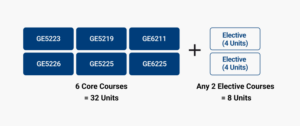
Thesis Track
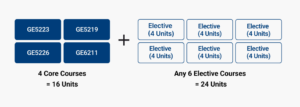
Coursework Track
Core Courses
*GE5223: Introduction to Applied GIS
GE5226: GIS Applications
GE5219: Spatial Programming
GE6211: Spatial Data Science
GE5225: Thesis Planning and Implementation
GE6225: GIS Research Thesis
*Candidates from the following background may sit for a proficiency test to waive GE5223:
- Former NUS students who have taken GE2215 Introduction to GIS and GE3238 GIS Design and Practices, and obtained at least B for both courses; or
- Non-NUS graduates who have taken GIS courses equivalent to GE2215 and GE3238, and obtained at least B or equivalent for both courses; or
- Applicants who do not have prior academic training in GIS but have 2 years of working experience in GIS-related industries; or
- Applicants who have obtained the NUS Professional Certificate (PC) in Applied Geographic Information Systems (GIS).
Elective Courses (Geography)
GE4211: Advanced Hydrology and Water Resources Management
GE4212: Environmental Modeling
GE4214: Remote Sensing of Environment
GE4240: Spatial Decision-Making
GE4241: Spatial Health
GE5211: Dynamic Environments
GE5212: Cities and Global Connections
GE5216: Geography and Social Theory
GE5217: Research Methods in Environmental Sciences
GE5218: Research Methods in Human Geography
GE5227: Internet GIS
GE5228: Spatial Big Data & Analytics
GE5230: Geospatial Statistics and Visualization
GE5231: Geospatial Machine Learning and Artificial Intelligence
GE5880: Topics in Geography I
GE6212: Mapping Global Economic Change
GE6213: Tourism Geographies
GE6221: Discussing Human-Environment Interactions
GE6222: Transnationalism and Society: Comparative Spaces
GE6223: Navigating the Boundaries between Science and Policy
GE6224: Political Geography
CCS5104: Methods and Practice in Sustainability
CCS5201: Introduction to Climate Modelling
Elective Courses (non-Geography)
For more information on the Elective Courses (non-geography), please email Eiffel.
BL5233: Data Analysis for Conservation Biology with R
BL5323: Spatial Modelling for Environmental Sustainability
BT4015: Geospatial Analytics
BPS5229: Data Science for the Built Environment
CE5310: Hydroinformatics
CS5346: Information Visualisation
ECA5372: Big Data Analytics & Technologies
DEP5105: Urban Infrastructure & Mobility Systems
ST5201: Statistical Foundations of Data Science
ST5226: Spatial Statistics
TP5025: Intelligent Transportation Systems
The assessment for each course will be based on a combination of examination and continuous assessment, specified in each course. A candidate who fails a core course, defined as receiving a F for the course, must retake the same core course during the period of candidature. A candidate is allowed to retake the same core course once. Failure to pass the core course after the second attempt will result in termination of the candidature. A candidate who fails an elective course may be permitted to either retake the same elective course once, or replace the failed course by taking another elective course in a subsequent academic year. Failure to pass the elective course after the second attempt will result in termination of the candidature.
A candidate may withdraw from an elective course within the first two weeks of a semester. A candidate who does not withdraw from a course within the said timeframe must be examined in that course unless granted leave of absence by the Head of Department or his/her nominee. The Head, or his/her nominee, will consider each application according to the circumstances of the case.
A candidate who is not granted leave of absence but who withdraws from any course of an examination after a given deadline will be deemed to have sat and failed in that course of the examination. No extension of the maximum period of candidature will be permitted as a result of such failure.
The graduation requirements for Coursework Track, Thesis Track and Project Track are as follows:
Coursework Track: Students are required to complete 40 units before graduation including 4 core courses (GE5223. GE5219, GW5226, GE6211, sub-total = 16 Units) and any 6 elective courses (sub-total = 24 Units). Students must pass all courses with a minimum Grade Point Average (GPA) of 3.0 to graduate.
Thesis Track: Students are required to complete 40 Units before graduation, including six core courses (GE5223, GE5219, GE6211, GE5226, GE5225, and GE6225, sub-total = 32 Units) and any two elective courses (sub-total = 8 Units). Students wishing to continue to the GE6225 GIS Research Thesis course (third semester) must have passed all courses with a minimum Grade Point Average (GPA) of 3.0. In order to graduate, students must also pass the course GE6225 GIS Research Thesis with at least a grade B- to maintain a minimum GPA of 3.0 at the end of the course of study.
Project track: students are required to complete 40 Units, including five core courses (GE5223, GE5219, GE6211, GE5226, and GE6226, sub-total = 24 Units) and any four elective courses (sub-total = 16 Units). Students wishing to continue to GE6226 GIS Research project (third semester) must have passed all courses with a minimum GPA of 3.0. In order to graduate, students must also pass the course GE6226 GIS Research Project with at least a grade B- to maintain a minimum GPA of 3.0 at the end of the course of study.
*The Project Track will no longer be offered to new intakes from AY2026/2027 onwards. Current part time students will still be eligible to do so. The Project Track will be replaced with a 100% coursework track, under which all degree requirements will be fulfilled through coursework without the requirement of a research thesis or project.
The tuition fee for AY2026/2027 intake is S$53,150 (including GST)1.
Payment should be made in equal instalments over 2 regular semesters for full-time students and 4 regular semesters for part-time students. There will be a 40% tuition fee rebate if the student is a Singapore Citizen or Singapore Permanent Resident (regardless if they are NUS alumni2 or non-alumni). There will also be a 20% tuition fee rebate for international students if they are NUS alumni2. If there is a company sponsorship, then full fees apply. The rebate only applies if the student is self-financed.
Fees are programme-based: the full programme tuition remains payable even if completed ahead of the normal schedule (assuming the required 40 units are not exceeded).
Candidates shall pay a S$10,900 (including GST) non-refundable deposit upon acceptance of the offer of admission, which will subsequently be used to offset part of the tuition fee. Starting from AY2025/2026, the program has set up an MSc in Applied GIS Scholarship for applicants from ASEAN countries, for details please refer to the Scholarship Tab of this webpage. Tuition fee for the previous intake, please refer to here.
Tuition Fee Payable
| Full-Time Students | Part-Time Students | |
| Acceptance Fee (upon acceptance of offer) | $10,900 | $10,900 |
| Year 1 – Semester 1 | $21,125 | $10,563 |
| Year 1 – Semester 2 | $21,125 | $10,563 |
| Year 2 – Semester 1 | Not Applicable | $10,562 |
| Year 2 – Semester 2 | Not Applicable | $10,562 |
| Total Tuition Fee | $53,150 | $53,150 |
1 The University reserves all rights to review fees as necessary and adjust accordingly without prior notice. GST is charged at a prevailing rate of 9% from year 2024.
2 “NUS alumni” refers to those who obtained from NUS, a full qualification in Bachelor, Graduate Diploma, Master’s or PhD.
Students who wish to take additional courses or who need to retake a course will be charged a per-course rate equivalent to 10% of the tuition fee based on the cohort admitted.
With effect from cohort 2021/2022: Students who wish to take additional courses or retake a course will be charged based on the workload of a course. The fee will be pro-rated for each course based on the Unit requirement for the programme and the prevailing programme fee for the respective cohort of students. As the full workload requirement for the programme is 40 Units, each 4-Unit course will work out to 10% of the programme fee. With this revision, a student who reads an additional or repeated course in Geography with 4, 8, and 12 Units will be charged 10%, 20%, and 30% of the programme fee, respectively.
There is no late thesis submission unless under special circumstances approved by the Head of Department and the same applies if approved.
MSc in Applied GIS Scholarship
- There are two merit-based MSc in Applied GIS Scholarship open to successful full-time applicants who demonstrate academic excellence. The scholarships will be awarded to two applicants from ASEAN countries (excluding Singapore Citizens and Singapore Permanent Residents, for whom fee rebates are available; please refer to the main tab of this webpage).
- Each scholarship includes a 50% tuition fees waiver. No separate scholarship application is required. Applicants accepted to the programme who are interested in the scholarship may be asked to provide additional information (e.g., a personal statement).
- The scholarship is subject to renewal on a semester-basis. Recipients of this scholarship must obtain a GPA of at least 3.0 in semester 1 in order to continue to enjoy the 50% tuition fees waiver in semester 2.
- For any inquiries, please contact geobox1@nus.edu.sg
NUS ASEAN Master's Scholarship
The NUS ASEAN Master’s Scholarship is a continuation of the DiscoverNUS scheme. It is an exclusive bond-free scholarship that covers full tuition fees for the normal candidature period of a Master’s degree programme at NUS. The scholarship may be offered only to candidates who have met all the following requirements:
- Hold citizenship in Brunei, Cambodia, Indonesia, Laos, Malaysia, Myanmar, the Philippines, Thailand or Vietnam,
- Have completed an undergraduate semester at NUS under the DiscoverNUS scheme,
- Have earned an undergraduate degree from one of the partner universities in their country, and
- Have been offered a place in one of the designated Master’s Degree programmes at NUS.
A separate application to be considered for the scholarship is not necessary.
Recipients of the scholarship may not concurrently hold any other scholarship, fellowship, bursary, grant, award or allowance without notifying NUS. If a recipient withdraws from the University and/or terminates the scholarship prematurely, NUS reserves the right to impose repayment of all scholarship monies disbursed.
Find out more about the scholarship here.
- The ISEAS-Yusof Ishak Institute will consider to award a scholarship to successful applicants of the MSC in Applied GIS Programme offered by NUS Geography.
- Students with geography background and interests in GIS are strongly encouraged to apply for both the ISEAS scholarship and the MSc in Applied GIS Programme.
Singapore Geospatial Scholarship
- The Singapore Geospatial Scholarship is a collaboration among nine public service agencies (BCA, HDB, JTC, LTA, NEA, NParks, PUB, SLA and URA) to offer local and overseas undergraduate and postgraduate scholarships in geospatial-related courses.
- Students interested in GIS are encouraged to apply for both the Singapore Geospatial Scholarship and MSc in Applied GIS Programme.
Application Management Portal (nus.edu.sg)
The online application for the August 2026 admission opens from 1st November 2025 to 15th March in 2026. Early applications are encouraged.
Please check and review your uploaded materials carefully before submitting your application. It is not necessary to email to find out if the materials are uploaded. Your applications will be reviewed in due course.
Please refer to the user guide on the application process. If you need clarification during the application process, please drop an email to geobox1@nus.edu.sg.
Graduate Certificate
Graduate Certificate in Applied GIS
The Department of Geography has put together the Graduate Certificate in Applied GIS programme, which seeks to promote continuing education and lifelong learning in the field of GIS and its versatile interdisciplinary applications. The programme is suitable to applicants who already have a Bachelor’s degree, which can be undertaken full-time and part-time. Such an arrangement enables qualified candidates from various walks of life to enrol in the programme and gain targeted training in the use and application of GIS, which is becoming a wide-spread analytical tool across the private and public sectors. It is proposed that full-time candidates can complete the courses in at least one semester. Part-time students can arrange to pursue graduate study while remaining employed in their professions.
The Graduate Certificate in Applied GIS is a Continuing Education and Training (CET) programme that articulates to the Master of Science in Applied GIS. The grades and course units that candidates earned in the Graduate Certificate may be transferred to the MSc coursework programme subject to approval by the faculty. Click here for more details.
Enquiries
MSc GIS Enquiry Form
For other enquiries, please contact the Graduate Administrator.
Graduate Administrator
Department of Geography
National University of Singapore
1 Arts Link, AS2, Singapore 117570