

Graduate Programme in Climate Change and Sustainability
Introduction
The Department of Geography is excited to accept applications for our interdisciplinary graduate programme in Climate Change and Sustainability for the 2026-2027 academic year.
Please discover below the rationale for this innovative programme and our possible degree options.
Responding to the Global Challenge
Climate change threatens lives and livelihoods on a global scale, including current patterns of economic growth and poverty reduction. Climate change also provides motivation to deal with its causes, many of which are rooted in unsustainable forms of development that also drive ever greater global injustices, wealth disparities and vulnerabilities, and the opportunity to create a fairer world and more sustainable ways of living. The strength of links between climate change and sustainability is reflected in the UN’s 2030 Agenda for Sustainable Development, which identifies climate change as “one of the greatest challenges of our time” with the power to “undermine the ability of all countries to achieve sustainable development” and to threaten the life-support systems of our planet.
The challenges posed by climate change have risen to the top of global agenda. The same is true in Asia, the world’s most rapidly changing continent, where concern is focused on the challenges posed by a myriad of complex interactions between climate variability, humans and economic, political and biophysical-ecological systems. Growing demands to integrate adaptation, sustainability and climate-resilience into the plans and activities of governments, development agencies, businesses, NGOs and the general publics across a range of geographic scales have created a pressing need for suitably trained individuals across a broad range of careers.
Responding to the global challenge, the graduate programme in Climate Change and Sustainability will produce the next generation of environmental and industry leaders who have advanced knowledge of the complexities of climatic change and impacts on society, and are interdisciplinary and analytical in their approach to climate change and sustainability issues and solutions.
The Climate Change and Sustainability graduate programme is taught in person at NUS (not online) and provides students with:
- an interdisciplinary training about the physical and social dimensions of climate change and current sustainability trends and interventions.
a thorough conceptual framework and the skills necessary to effectively analyse the relationships between climate change, other pressing environmental and social challenges, and sustainability and to make informed judgments about policies and their implementation. - an understanding of the physical, ecological, social, cultural, and political-economic drivers and effects of climate change and sustainability, to inform critical analysis and effective action.
- critical insights into the key strategies, policies, and practices currently employed to promote and finance climate change adaptation, mitigation, and sustainability.
- the skills needed to formulate, investigate, and implement a variety of approaches aimed at ensuring future climate-resilient and sustainable policies and practices.
- opportunities to develop personalised areas of specialist expertise within the fields of climate change and sustainability.
We provide a flexible range of programme options including the possibility to stack qualifications toward the MSc in Climate Change and Sustainability. To learn more about the structure and requirements of specific requirements and structure of each programme please click on the options below.
Growing demands to integrate adaptation, sustainability and climate-resilience into the plans and activities of governments, development agencies, NGOs, and the private and public sector, across a range of geographic scales have created a pressing need for suitably trained individuals across a broad range of careers. The future job market in climate change and sustainability related fields is rapidly evolving and will extend beyond traditional job roles and designations. The demand for knowledge and skills in climate change and sustainability solutions has become a mainstream set of expectations across the private and public sectors with everyday decisions expected to be cognisant of climate change, the impacts of climatic change and how future decisions should be made in a sustainable manner.
The programme is targeted at both the international and domestic students. At both scales there is escalating demand across the private and public sector for knowledge and skills in climate change and sustainability that can support transformations in business processes and operations.
The MSc in Climate Change and Sustainability (CCS) program at NUS Geography differs from other programs offered in NUS such as the MSc in Environmental Management (MEM) by its concentrated focus on climate change, sustainability practices, and policy development. While the MEM program is broader, covering multidisciplinary aspects of environmental management including law and economics, the CCS program delves deeper into climate science, mitigation strategies, and socio-economic impacts. CCS students also have the option of undertaking a research project, enabling a more specialized approach to climate-related issues
The online application for the August 2026 admission opens from 1 November 2025 to 31 January 2026.
Applications to the MSc and Graduate Diploma programme:
Application Management Portal (nus.edu.sg)
Please make sure that you select the programme that you wish to be considered for (MSc or Graduate Diploma) and check and review your uploaded materials carefully before submitting your application.
Please ensure that you have also uploaded the following:
- Official or up-to-date academic transcripts,
- Degree scroll (if applicable),
- TOEFL/IELTS result (if any - for international applicants); &
- Only one reference is required for this programme. The referee could be from a university advisor (in the case of recent graduates) or an employer (in the case of those who graduated from university several years ago). Referee will upload the report, having been assigned by the applicant. Applicants to refer to the online user guide for applicants (found in application system) for instructions on how to add a referee.
Applications to the Graduate Certificate programme:
Online Application Portal (nus.edu.sg)
Please ensure that you upload the following:
- Official or up-to-date academic transcripts;
- Degree scroll (if applicable); &
- TOEFL/IELTS result (if any - for international applicants).
Please email geobox1@nus.edu.sg to notify the Geography officer once the application is submitted.
Master of Science
Master of Science in Climate Change and Sustainability
The Master of Science in Climate Change and Sustainability (MSc CCS), is a new one year single-degree coursework MSc programme based in Department of Geography at NUS.
This innovative programme provides an exciting opportunity for the prospective students to study at NUS, a top university in Asia, as a pathway to a PhD or to further industry career prospects as a leader in climate change and sustainability practices.
Those who are curious and passionate about climate change and it threats to society, and are interested in discovering sustainable solutions to climate threats.
The MSc in Climate Change and Sustainability has one intake per year (August).
Applicants seeking admission must have obtained either:
- A Honours degree (Merit/Second Class and above) or the international equivalent (e.g., a four-year Bachelors degree with at least an average grade of B or equivalent) in the subject or related fields; or
- A good Bachelors degree (at least an average grade of B or equivalent) in the subject or related fields; or
- A Bachelor's degree with a relevant Graduate Diploma with a minimum GPA of 3.00; or
- Other qualifications and professional experience in relevant fields subject to approval by the Graduate Studies Division, Faculty of Arts and Social Sciences.
- Applicants who do not have a degree from an English-speaking university, must present evidence that they have attained the basic level of English language proficiency either a TOEFL score of 100 (for the internet-based test) or IELTS score of 7.0. The test must have been taken no longer than two years prior to the proposed date of admission. Exceptions may be allowed on an individual basis.
International applicants are asked to submit evidence of financial support in the form of a letter of confirmation from a sponsor and a bank statement, or documentary evidence of scholarship or other award obtained. The financial statement should reflect a minimum sum of SGD 50,000.
Full-time students will study over a 12-month period that spans three semesters, which start in Semester 1 (August–November), continues in Semester 2 (January–April), and ends in Semester “3” (comprising the two Special Terms and running from May to July). Students will take courses during the first two semesters and undertake a research project during the third semester.
Under normal circumstances, the period of candidature is 12 months of full-time study or 24 months of part-time study from the date of commencement of the course. The maximum period of candidature for the MSc Programme is 24 months of full-time study or 36 months of part-time study from the date of commencement of the course, inclusive of approved leave of absence and medical leave. Leave of absence of up to one year will not be counted towards a candidate’s maximum candidature. Subsequent leave will be considered as part of the candidature.
The curriculum of the MSc in Climate Change and Sustainability programme consists of four core compulsory courses, four elective courses, and a 2-course equivalent research project Core courses will be offered every academic year. Elective courses may not necessarily be offered in the same academic year. All courses are worth 4 Units, except the research project which is equal to 8 course Units. Students must complete 40 Units to complete the MSc programme.

With effect from the 2025/2026 cohort, students of this programme may also opt for a full coursework programme as follows, and they must make the decision in semester 1:

CCS Timetable
CCS Course Description
Core Courses
CCS5101: Climate Change the Science and the Policy
CCS5102: Sustainability and Climate Change
CCS5103: Political Economy of Climate Change & Sustainable Development
CCS5104: Methods and Practice in Sustainability
Elective Courses
CCS5201: Introduction to Climate Modelling
CCS5202: Climate Hazards, Risk and Uncertainty
CCS5203: Resilience of Socio-Ecological Systems
CCS5204: Water, Food and Energy Insecurities
CCS5205: Sustainable Finance
CCS5206: How to Live Well on a Damaged Planet
CCS5207: Coastal Vulnerability, Risk and Adaptation
Students may also select one of the following courses as an elective course:
GE5211: Dynamic Environments
GE5223: Introduction to Applied GIS
GE5229: Political Ecology: People, Power, and Nature
Research Project
CCS5301: Research Project in Climate Change and Sustainability
The assessment for each course will be based on a combination of examination and continuous assessment, specified in each course. A candidate who fails a core course, defined as receiving a F for the course, must retake the same core course during the period of candidature. A candidate is allowed to retake the same core course once. Failure to pass the core course after the second attempt will result in termination of the candidature. A candidate who fails an elective course may be permitted to either retake the same elective course once, or replace the failed course by taking another elective course in a subsequent academic year. Failure to pass the elective course after the second attempt will result in termination of the candidature.
Students who wish to take additional courses or retake a course will be charged based on the workload of a course. The fee will be pro-rated for each course based on the Unit requirement for the programme and the prevailing programme fee for the respective cohort of students. As the full workload requirement for the programme is 40 Units, each 4-Unit course will work out to 10% of the programme fee. With this revision, a student who reads an additional or repeated course in Geography with 4, 8, and 12 Units will be charged 10%, 20%, and 30% of the programme fee, respectively.
A candidate may withdraw from an elective course within the first two weeks of a semester. A candidate who does not withdraw from a course within the said timeframe must be examined in that course unless granted leave of absence by the Head of Department or his/her nominee. The Head, or his/her nominee, will consider each application according to the circumstances of the case.
A candidate who is not granted leave of absence but who withdraws from any course of an examination after a given deadline will be deemed to have sat and failed in that course of the examination. No extension of the maximum period of candidature will be permitted as a result of such failure.
Students are required to complete 40 Units before graduation, including four core courses (sub-total = 16 Units), four elective courses (sub-total = 16 Units) and the research project (sub-total = 8 Units).
Tuition fees for AY2024/2025
The tuition fee for AY2024/2025 is S$50,000 (before GST). Candidates shall pay a S$3,000 (before GST) non-refundable acceptance fee upon acceptance of the offer of admission, which will subsequently be used to offset part of the tuition fee.
Upon admission, payment should be made in equal instalments over 2 regular semesters for full-time students and 4 regular semesters for part-time students.
Tuition fees for AY2025/2026 (includes 9% GST)
The tuition fee for AY2025/2026 is S$56,150. Candidates shall pay a S$5,450 non-refundable acceptance fee upon acceptance of the offer of admission, which will subsequently be used to offset part of the tuition fee.
Upon admission, payment should be made in equal instalments over 2 regular semesters for full-time students and 4 regular semesters for part-time students.
Tuition Fee Payable
| Full-Time Students | Part-Time Students | |
| Acceptance Fee (upon acceptance of offer) | $5,450 | $5,450 |
| Year 1 – Semester 1 | $25,350 | $12,675 |
| Year 1 – Semester 2 | $25,350 | $12,675 |
| Year 2 – Semester 1 | Not Applicable | $12,675 |
| Year 2 – Semester 2 | Not Applicable | $12,675 |
| Total Tuition Fee | $56,150 | $56,150 |
In addition, candidates are also required to pay other miscellaneous student fees as decided by the University.
Applicable for cohort AY2024/2025, AY2025/2026 & AY2026/2027
Only for self-financed MSc programmes (not for stackable programme). There is a 40% tuition fee rebate if the student is a Singapore Citizen or Singapore Permanent Resident (regardless if they are NUS alumni or non-alumni). There will also be a 20% tuition fee rebate for international students if they are NUS alumni. If there is a company sponsorship, then full fees apply. The rebate only applies if the student is self-financed.
Graduate Diploma
Graduate Diploma in Climate Change and Sustainability
The Graduate Diploma in Climate Change and Sustainability (Grad Dip CCS), is a new two- semester degree coursework programme based in Department of Geography at NUS.
This innovative programme provides an exciting opportunity for the prospective students to study at NUS, a top university in Asia as a pathway to further industry career prospects in climate change and sustainability practices.
Those who are curious and passionate about climate change and its threats to society, and are interested in discovering sustainable solutions to climate threats.
The Graduate Diploma in Climate Change and Sustainability has one intake per year (August).
Applicants seeking admission must have obtained either:
- A bachelor’s degree in the subject or related fields; or
- A bachelor’s degree with a relevant Graduate Certificate with a minimum GPA of 3.00.
- Candidates with other qualifications and experience may be considered on a case-by-case basis, subject to approval by the Graduate Studies Division, Faculty of Arts and Social Sciences.
- Applicants who do not have a degree from an English-speaking university must present evidence that they have attained the basic level of English language proficiency either a TOEFL score of 100 (for the internet-based test) or IELTS score of 7.0. Exceptions may be allowed on an individual basis.
Applicants should provide one letter of reference from an academic in the case of a recent graduate (graduated in the three years prior to application) or from a recent/current employer in the case of an applicant who graduated more than three years prior to the time of application.
Please refer to instructions available via the NUS Graduate Admission System: Graduate Admission System (GDA2), National University of Singapore (nus.edu.sg).
These instructions include guidance on how to assign a referee/upload a referee’s statement.
Full-time students will study over a 12-month period that spans two semesters, which start in Semester 1 (August–November), and continues in Semester 2 (January–April).
Under normal circumstances, the period of candidature is 12 months of full-time study or 24 months of part-time study from the date of commencement of the course. The maximum period of candidature for the MSc Programme is 24 months of full-time study or 36 months of part-time study from the date of commencement of the course, inclusive of approved leave of absence and medical leave. Leave of absence of up to one year will not be counted towards a candidate’s maximum candidature. Subsequent leave will be considered as part of the candidature.
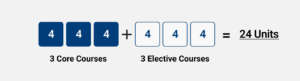
The curriculum of the Graduate Diploma in Climate Change and Sustainability programme consists of three core compulsory courses, and three elective courses. Core courses will be offered every academic year. Elective courses may not necessarily be offered in the same academic year. All courses are worth 4 Units. Students must complete 24 course Units to complete the Grad. Dip. programme.
CCS Timetable
CCS Course Description
Core Courses
CCS5101: Climate Change the Science and the Policy
CCS5102: Sustainability and Climate Change
CCS5104: Methods and Practice in Sustainability
Elective Courses
CCS5103: Political Economy of Climate Change & Sustainable Development
CCS5201: Introduction to Climate Modelling
CCS5202: Climate Hazards, Risk and Uncertainty
CCS5203: Resilience of Socio-Ecological Systems
CCS5204: Water, Food and Energy Insecurities
CCS5205: Sustainable Finance
CCS5206: How to Live Well on a Damaged Planet
CCS5207: Coastal Vulnerability, Risk and Adaptation
The assessment for each course will be based on a combination of examination and continuous assessment, specified in each course. A candidate who fails a core course, defined as receiving a F for the course, must retake the same core course during the period of candidature. A candidate is allowed to retake the same core course once. Failure to pass the core course after the second attempt will result in termination of the candidature. A candidate who fails an elective course may be permitted to either retake the same elective course once, or replace the failed course by taking another elective course in a subsequent academic year. Failure to pass the elective course after the second attempt will result in termination of the candidature.
Students who wish to take additional courses or retake a course will be charged based on the workload of a course. The fee will be pro-rated for each course based on the Unit requirement for the programme and the prevailing programme fee for the respective cohort of students. As the full workload requirement for the programme is 40 Units, each 4-Unit course will work out to 10% of the programme fee. With this revision, a student who reads an additional or repeated course in Geography with 4, 8, and 12 Units will be charged 10%, 20%, and 30% of the programme fee, respectively.
A candidate may withdraw from an elective course within the first two weeks of a semester. A candidate who does not withdraw from a course within the said timeframe must be examined in that course unless granted leave of absence by the Head of Department or his/her nominee. The Head, or his/her nominee, will consider each application according to the circumstances of the case.
A candidate who is not granted leave of absence but who withdraws from any course of an examination after a given deadline will be deemed to have sat and failed in that course of the examination. No extension of the maximum period of candidature will be permitted as a result of such failure.
Students are required to complete 24 Units before graduation, including three core courses (sub-total = 12 Units), three elective courses (sub-total = 12 Units).
The cost of each course of this programme for AY2025/2026 will be S$5,615 (including GST).
The entire cost of the Graduate Diploma (six courses in total) will be S$33,690 (including GST).
In addition, candidates are also required to pay other miscellaneous student fees decided by the University.
Graduate Cert
Graduate Certificate in Applied GIS
NUS will adopt three new academic terminologies from 1 August 2023
“Module” will be renamed “Course”, “Modular Credit (MC)” will be renamed “Unit”, and “Cumulative Average Point (CAP)” will be renamed “Grade Point Average (GPA)”. The definition of a Module/Course and MC/Unit will remain the same, and there will be no change to the computation of the CAP/GPA.
Over the years, geospatial information and technology are increasingly recognized as an enabler for making decisions, optimizing processes, and generating services for customers, translating to a strong demand for GIS professionals.
The Department of Geography has put together the Graduate Certificate in Applied GIS programme, which seeks to promote continuing education and lifelong learning in the field of GIS and its versatile interdisciplinary applications. The programme is suitable to applicants who already have a Bachelor’s degree, which can be undertaken full-time and part-time. Such an arrangement enables qualified candidates from various walks of life to enrol in the programme and gain targeted training in the use and application of GIS, which is becoming a wide-spread analytical tool across the private and public sectors. It is proposed that full-time candidates can complete the courses in at least one semester. Part-time students can arrange to pursue graduate study while remaining employed in their professions.
Applicants for the Graduate Certificate coursework programme should have the following qualifications:
- Bachelor’s degree.
- Candidates with other qualifications and experience may be considered on a case by case basis, subject to approval by the Faculty/School.
The majority of candidates will likely be able to complete the programme in 2 semesters if they read it full-time. Those pursuing it part-time are likely to complete the programme in 4 to 6 semesters.
The maximum candidature periods are as follows:
- Full-Time: 24 Months
- Part-Time: 36 Months
Core Courses
*GE5223 (Introduction to Applied GIS) – 4 Units
GE5219 (Spatial Programming) – 4 Units
GE5226 (GIS Applications) – 4 Units
GE6211 (Spatial Data Handling) – 4 Units
*Candidates from the following background may sit for a proficiency test to waive GE5223:
- Former NUS students who have taken GE2215 Introduction to GIS and GE3238 GIS Design and Practices, and obtained at least B for both courses; or
- Overseas students who have taken GIS courses equivalent to GE2215 and GE3238, and obtained at least B or equivalent for both courses; or
- Applicants who do not have prior academic training in GIS but have 2 years of working experience in GIS-related industries
Elective Courses
GE5227 (Internet GIS) – 4 Units
GE5228 (Spatial Big Data and Analytics) – 4 Units
To obtain a Graduate Certificate in Applied Geographic Information Systems:
- Candidates are required to complete 12 Units for award of certificate (all courses at Level 5000 and above).
- Candidates must complete at least 2 core courses under the MSc in Applied GIS Programme to obtain the Graduate Certificate.
- Candidates must obtain a Grade Point Average (GPA) of at least 2.50
The tuition fee is SGD$5,160 (including GST) per course for AY2025-26. The total tuition fee for the entire Graduate Certificate Programme (12 Units) is SGD$15,480 (including GST).
In addition, candidates are also required to pay other miscellaneous student fees as decided by the University.
*GST is charged at a prevailing rate of 9% from year 2024.
The online application for AY2025-26 opens on 8th May 2025.
- Intake: Semester 1 (starting on 4 August 2025)
- Application period: 8 May-8 June 2025
- Outcome: 21 June 2025
For enquiries, please email kowin.chen@nus.edu.sg
Stackable MSc
Stackable Master of Science
The Master of Science in Climate Change and Sustainability (MSc CCS), can also be obtained in a stackable manner requiring the completion of the Graduate Certificate, followed by completion of the Graduate Diploma and finally completing the requirements of the MSc, as outlined in the diagram below.
This approach provides you with the flexibility to build your MSc qualification in a staged manner.
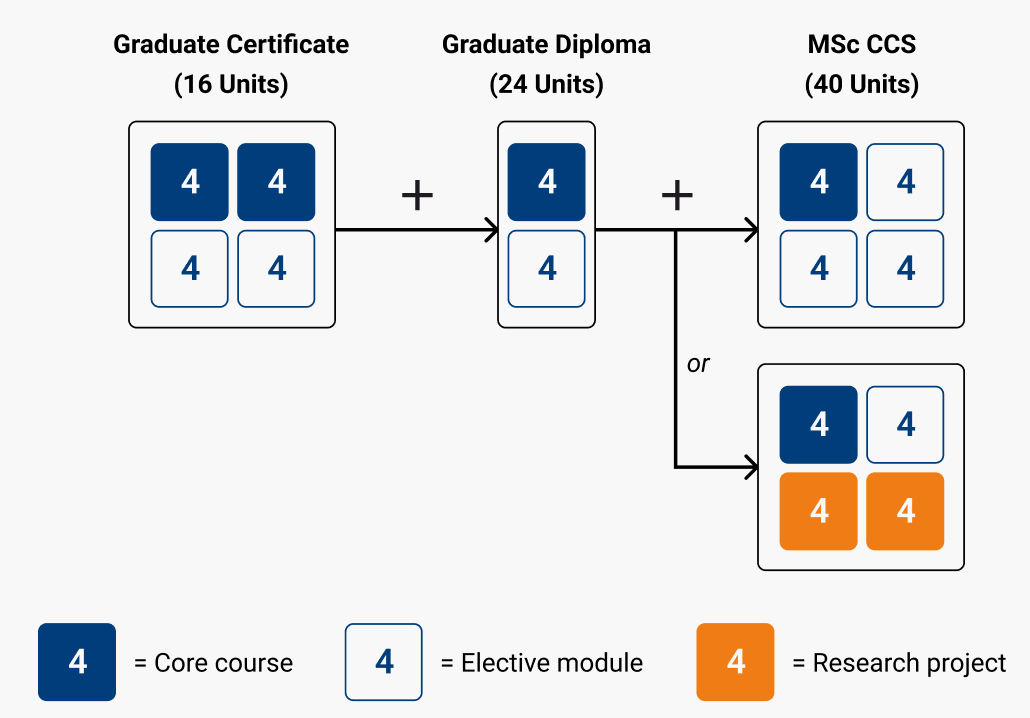
Please refer to the relevant programme link on this website for details of the structure, admission and fees of each programme. Ultimately, the MSc requires completion of 40 course Units (see above diagram).
Unique to the stackable approach we offer two pathways to completion of the MSc component.
- Pathway 1: An entirely coursework pathway where candidates take one core course, and three additional elective courses.
- Pathway 2. Includes a research component. In this pathway candidates take one core course, one elective course, and the research project (2 course equivalent).
The total tuition fee for the stackable MSc totals the fee for the MSc programme, which for the AY2025/2026 intake is S$56,150 (including GST). However, you will only pay for the relevant tuition fee amounts for the component of the stackable degree you are enrolled in as detailed below.
Tuition Fee Payable
| Fees for the Graduate Certificate (4 courses) | $22,460 |
| Additional fees for the Graduate Diploma (2 courses) | $11,230 |
| Additional fees for the MSc CCS (4 courses) | $22,460 |
| Total Tuition Fee (Stackable MSc) | $56,150 |
Enquiries
Enquiries
For any enquiries, please contact the Graduate Administrator.
Graduate Administrator
Department of Geography
National University of Singapore
1 Arts Link, AS2, Singapore 117570