

Passion on and off the field: Three NUS athletes fly high in sports and academics
July 16, 2026
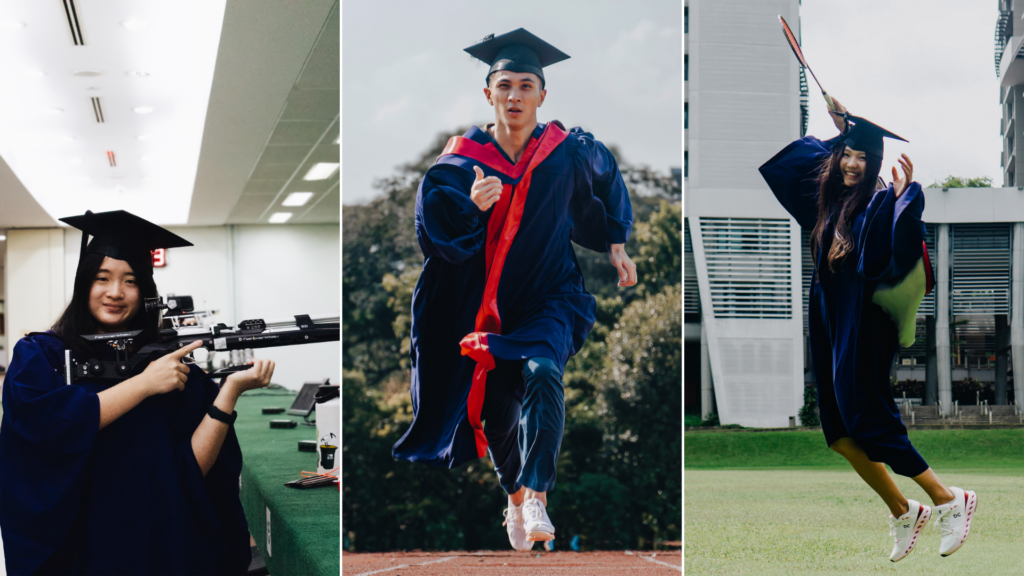
As NUS honours its newest graduates at Commencement, we spotlight three Class of 2026 student-athletes who balanced national competitions with the demands of their degrees. Through diligence and tenacity, they have excelled in their pursuits and carved out a rich university experience.
Gan Xin Chen: Shooting for the stars
National shooter Gan Xin Chen first picked up a rifle when she was only 10 years old. Intrigued by the sport, her fascination quickly blossomed into a lifelong love affair with shooting, taking her from local competitions to international events around the world.
Those experiences also shaped her academic interests. Travelling overseas exposed her to different cultures, political systems and ways of thinking, sparking a curiosity about international relations and global affairs.
That interest eventually led Xin Chen to pursue a double degree in history and political science at the NUS Faculty of Arts and Social Sciences, completing it in four years instead of the usual five, earning a place on the Dean’s List, and graduating with Honours (Highest Distinction).
While her life as a shooter and student may seem disparate at first, they overlap in many ways. “Participating in overseas competitions helped feed my interest in the world,” said Xin Chen. “History provides me with cultural context and the ability to read between the lines.”
She chose to pair political science with history in part because of NUS’ strong reputation in Southeast Asian history. Studying both subjects helped her appreciate the many dimensions of international relations, from culture and science to defence and security.
Xin Chen’s experiences as an athlete often reinforced what she learnt in the classroom. Travelling internationally for competitions gave her first-hand insights into how countries interact and cooperate.
She cited, for example, her experience of travelling overseas for competitions with the team’s air rifles, noting how the security checks varied between countries. While some allowed them to pass with minimal hassle due to diplomatic courtesies, others subjected them to more rigorous scrutiny.
“There’s a lot of undertones of diplomacy that you’ll observe in the sporting world... some things cannot be read or learnt,” she said.
While balancing academics and elite sports was demanding, Xin Chen found that the discipline she developed through shooting helped her navigate both. “Learning how to control my emotions and stay focused during competitions was good personal growth,” she said. “It helped me in other aspects of my life as well.”
The same mindset shaped her approach to her studies. When assignments did not go as planned, she sought feedback from professors and worked to improve.
It is an academic feat she has replicated in the realm of sports.
Aside from clinching a bronze medal at the 2025 Southeast Asian Games, she made her mark at the International Shooting Sport Federation World Cup in 2025, placing 16th in the mixed team event.
She has also been long-listed for the 2026 Asian Games, and will soon begin a career in public sector.
Reflecting on her journey, Xin Chen expects to draw on many of the lessons she learnt through sport.
“In a competition, you're bound to make mistakes,” she said. “Through shooting, I learned how to give myself grace and learn from them. No matter how much you train or prepare, you're still human.”
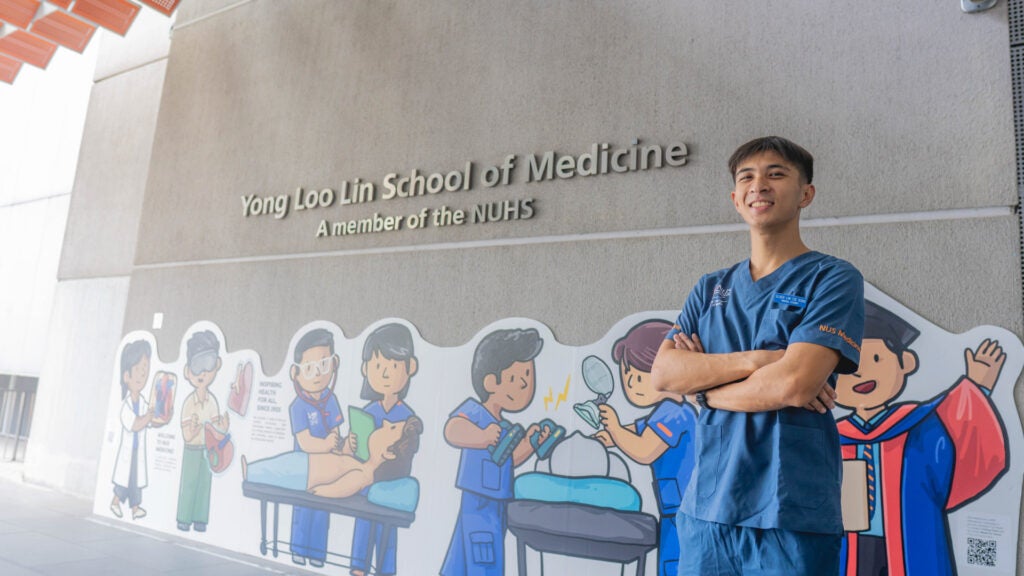
Oliver Lim: ‘Pressure is a privilege’
At 17 years old, Oliver Lim fell during a race and broke his thumb. The injury left the track and field athlete, who had inter-school competitions coming up, distraught.
But a visit to the doctor would ultimately shape his future career. “The doctor said, ‘I want to be able to help you achieve your dream,’” he recalled. Rather than simply treating Oliver's thumb, the doctor took the time to understand what the injury meant to him. Running wasn't just a sport - it was a huge part of Oliver's identity. Together, they discussed the risks and benefits of the available treatment options before making a shared decision that balanced his recovery with his hope of returning to competition.
Oliver went on to compete in the 4×400m relay wearing a protective hand guard and eventually clinched a gold medal with his team.
"What stayed with me wasn't just the decision itself," Oliver recalled. "It was that my doctor saw me as more than just a medical problem to fix. He recognised what running meant to me and took that into account when caring for me. That experience changed how I viewed medicine. I realised that being a doctor isn't just about treating a condition. It's about caring for the whole person.” In fact, Oliver was so inspired that he later applied to study medicine at the NUS Yong Loo Lin School of Medicine.
Although he was rejected on his first attempt, he reapplied the following year and succeeded on his second try. Not only that, but he was even awarded the NUS Merit Scholarship, a prestigious accolade given to top performers.
“I didn’t expect it at all,” he said. “The scholarship gave me a certain level of financial freedom, allowing me to experience living in a hall and spend more time on training. More than that, after being rejected from medicine the first time, it felt like a form of validation that encouraged me to pursue both medicine and athletics wholeheartedly.”
Indeed, Oliver continued to chase his passion for running amid his hectic schedule. “When I’m running, I enter a flow state. Time stands still,” he said, adding that he had never been a gold medal favourite throughout his track and field career.
That changed with his “breakthrough” race in 2024. At the Singapore Athletics All Comers Meet, he shaved two seconds off his personal best in the 800m race to hit a timing of 1 minute and 59 seconds. The result helped earn him a place on the national team, and later gave him the confidence to test himself in the 1500m.
“I decided, ‘Okay, I’m going to treat this as a game,’” said Oliver. “My coach gave me a very specific race plan… I executed (the race) according to how he told me to do it.”
What began as an experiment quickly proved promising. Within a year, Oliver had improved enough to qualify for the Southeast Asian Games in 2025, where he recorded one of Singapore’s fastest 1500m performances in recent years.
Oliver said his experiences in medicine have also shaped the way he views success and setbacks. During his clinical training, he encountered situations that reminded him that not everything is within one’s control.
“It made me realise that it’s important to know your limits,” he said. “In life, we’re given the guise of control, but a lot of times, that’s not true. The best we can do is focus on what we can control and make the best out of the situation when things don't go as planned.”
Although it was hard to juggle studies and training, Oliver made it to the academic finish line and will graduate with a Bachelor of Medicine and Bachelor of Surgery in July.
Looking back, Oliver believes the lessons he learnt through sport have helped him navigate both medicine and athletics. “Pressure is a privilege,” he said. “It was a challenge and I wanted to prove to myself that I could do it if I put my mind to it.”
Oliver is now working as a house officer in the Internal Medicine department at a public hospital and will continue to pursue his dual passions for sports and medicine.
oanna Wu: From mentee to mentor
When Joanna Wu first stepped into NUS, she had only one goal: try everything.
Having spent most of her life playing badminton competitively as a member of the National Intermediate Squad, Joanna graduated from junior college feeling unsure of what came next. “Other than badminton, I felt useless,” she said. “So in university, my goal was to try as many things as possible. I did not say no to any opportunity.”
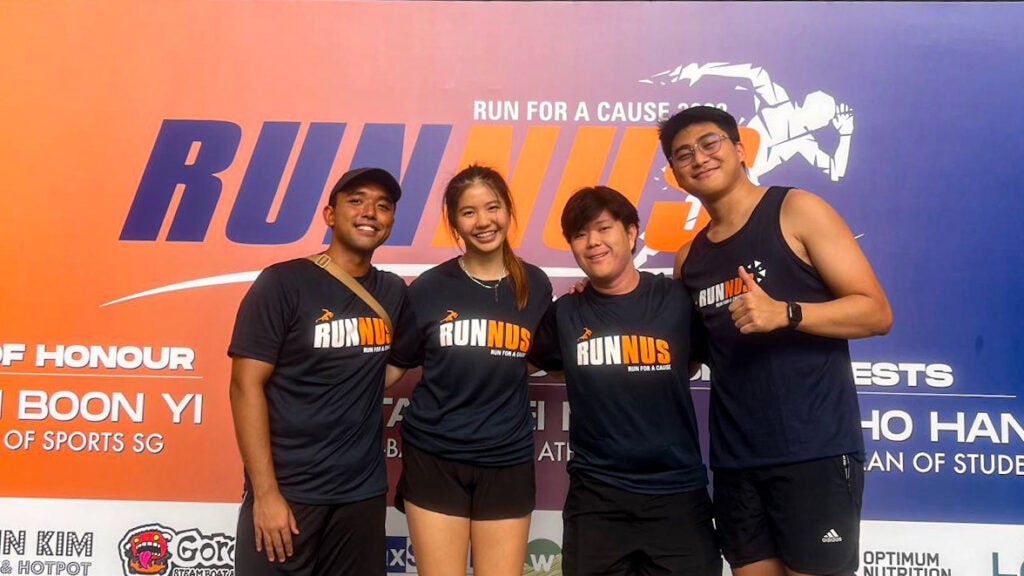
This never-say-no attitude led the Real Estate undergraduate from NUS Business School to try out squash and tennis during her stints in Temasek Hall and Eusoff Hall. She even ventured beyond the arena of sports, joining the NUS Students’ Sports Club in 2022. There, she served as Project Director for RunNUS, an annual run that raises funds for the NUS Enhanced Financial Aid Scheme.
Her experiences helped her pick up a wide range of skills, from communication and stakeholder management to project planning and leadership. The skills proved valuable during her internships with CapitaLand and the Inland Revenue Authority of Singapore, where she deepened her knowledge of Real Estate through handling placemaking initiatives and property tax.
Yet the experiences she gained outside badminton ultimately brought her back to the sport. After dedicating four years to coaching badminton, Joanna and a business partner launched Wu Badminton Academy in 2025. The venture signalled her shift from mentee to mentor.
“I wanted to help players compete at a higher level,” she said, adding that starting her own school gave her the autonomy to run lessons as she saw fit.
Looking back, Joanna credits NUS with supporting her both on and off the court. As a recipient of the NUS Sports Scholarship, she benefitted from subsidised tuition fees, while staff from NUS’ Office Student Affairs (OSA) also conducted regular check-ins and supported her throughout her university journey.
The support extended beyond campus. OSA staff even turned up to cheer her on during the 2025 Summer World University Games in Germany, which she participated in as a member of NUS’ Badminton varsity team. “Their hotel was far away, but they came down whenever they could and supported us the whole time,” she said. “I was so lucky to have all these people behind me.”
The encouragement bolstered Joanna’s confidence, both as an athlete and as a student.
As Joanna graduates with a Bachelor of Science in Real Estate with Merit this July, an exciting new journey begins, one guided by lessons from both the classroom and the court.
This story first appeared in NUSnews on 16 July 2026.