
JENNIFER YIP Jennifer Yip is Assistant Professor at the NUS Department of History. She studies China’s war against Japan/World War II in China, war, revolution, and violent struggle in modern Chinese history, global histories of financing and supplying war, and histories of the wartime everyday. Dr Yip is currently researching strategies of mass mobilization in China between the 1920s and 1950s via projects exploring conceptions of civil-military relations in Republican China, the use of mass local labour to prosecute China’s war against Japan, the New Life Movement, and violent conflict between the Nationalists and the CCP throughout the 1920s and 1930s. Jennifer Yip is Assistant Professor at the NUS Department of History. She studies China’s war against Japan/World War II in China, war, revolution, and violent struggle in modern Chinese history, global histories of financing and supplying war, and histories of the wartime everyday. Dr Yip is currently researching strategies of mass mobilization in China between the 1920s and 1950s via projects exploring conceptions of civil-military relations in Republican China, the use of mass local labour to prosecute China’s war against Japan, the New Life Movement, and violent conflict between the Nationalists and the CCP throughout the 1920s and 1930s.
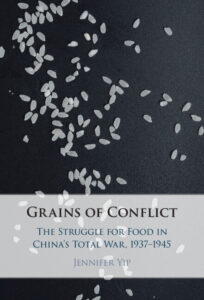 Her 2025 book Grains of Conflict: The Struggle for Food in China’s Total War, 1937-1945 (Cambridge University Press) is a pioneering study of how the Chinese government provisioned its armies during the 1937-45 war. Using Chinese-, Japanese- and English-language sources, Grains of Conflict explains how Chiang Kai-shek’s Nationalist regime survived the grueling eight-year war against all expectations and material odds by focusing on the protracted nature of the war and China’s agrarian constitution. Food – not arms – became China’s most crucial means of withstanding the Japanese onslaught and emerging victorious. Her 2025 book Grains of Conflict: The Struggle for Food in China’s Total War, 1937-1945 (Cambridge University Press) is a pioneering study of how the Chinese government provisioned its armies during the 1937-45 war. Using Chinese-, Japanese- and English-language sources, Grains of Conflict explains how Chiang Kai-shek’s Nationalist regime survived the grueling eight-year war against all expectations and material odds by focusing on the protracted nature of the war and China’s agrarian constitution. Food – not arms – became China’s most crucial means of withstanding the Japanese onslaught and emerging victorious.
Dr Yip was recently granted the FASS Award for Promising Researcher (APR). This award is presented to researchers who have produced research that shows potential impact and promise. We congratulated Dr Yip and spoke to her about her research work. 1. How did you initially become interested in researching modern Chinese history and military history? I’ve always been interested in military history–not out of any love for big guns, but because the demands of war reveal much about states, institutions, and societies. Since my undergraduate days, I’ve been intrigued by questions of strategy and mobilization, as well as by how the various levels of warmaking (strategy, operations, and tactics) influence the experience of conflict, both combatant and civilian. I don’t think those fundamental intellectual interests have changed! I grew curious about modern Chinese history when I first began researching China in World War II. From there, I gained exposure to a robust scholarship–in different languages–on a polity that has witnessed countless remarkable changes within the relatively short span of a few centuries. In many substantial ways, China’s trajectory is exceptional, and yet in many others, it is but a part of regional and global developments. I feel the same about modern Chinese history as I did when I first began reading about it: that it is so rich and so complex that I will never know even the half of it. That’s what it makes the research both humbling and exciting. 2. What motivated you to write Grains of Conflict: The Struggle for Food in China’s Total War, 1937–1945?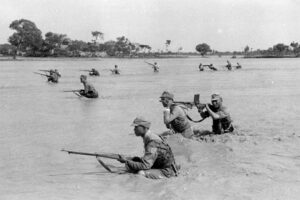 Honestly, it was the pressure of a deadline. I was due to attend a dissertation writing workshop as part of my PhD program, and when the time came to submit my first proposal, I panicked–I didn’t have any ideas! I simply scribbled down the first thing that came to mind. I knew a little bit about China’s war against Japan, and I had always wondered how China’s armies were provisioned under such difficult material circumstances. In retrospect, the topic was intuitive to me–it was the first thing that came to mind–because my core interests have always been in the details of organizing for war. How are material resources gathered, transported, and distributed? That was, and is, a primary intellectual motivation. I submitted the proposal, and even as the dissertation went through several rounds of revision, and then was rewritten as a monograph, the gist of it remained constant.
3. What challenges did you encounter when conducting research for Grains of Conflict?
Honestly, it was the pressure of a deadline. I was due to attend a dissertation writing workshop as part of my PhD program, and when the time came to submit my first proposal, I panicked–I didn’t have any ideas! I simply scribbled down the first thing that came to mind. I knew a little bit about China’s war against Japan, and I had always wondered how China’s armies were provisioned under such difficult material circumstances. In retrospect, the topic was intuitive to me–it was the first thing that came to mind–because my core interests have always been in the details of organizing for war. How are material resources gathered, transported, and distributed? That was, and is, a primary intellectual motivation. I submitted the proposal, and even as the dissertation went through several rounds of revision, and then was rewritten as a monograph, the gist of it remained constant.
3. What challenges did you encounter when conducting research for Grains of Conflict?
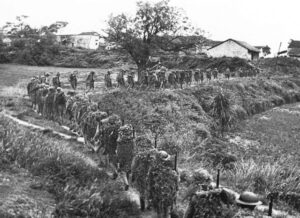 Covid happened while I was just about to embark on an ambitious yearlong, multi-country research journey. This meant that I could not visit several archives in person. It was a setback, but one that compelled me to be more resourceful and creative in my curation of primary source material. Thankfully, I had already spent time in the relevant archives the year before, and knew what I needed. I was lucky to have the support of a generous grant that enabled me to obtain materials from abroad remotely. Additionally, because I paid much more careful attention to digitized resources, I discovered several that greatly buttressed the book’s content and argument. If Covid had not compelled me to conduct exhaustive research on digital sources to complement archival ones, the book may have taken a different form. Of course, once Covid became less of a crisis, I was able to carry out even more archival research in person to revise the manuscript. But I do think the challenge of writing a dissertation/book in the middle of a pandemic led me to consult a wider range of resources that I had originally imagined.
4. What are some ways that the logistics of food production, storage, and transportation during conflict have changed since 1945, and how have these changes influenced the course and outcome of various post-World War II conflicts?
Covid happened while I was just about to embark on an ambitious yearlong, multi-country research journey. This meant that I could not visit several archives in person. It was a setback, but one that compelled me to be more resourceful and creative in my curation of primary source material. Thankfully, I had already spent time in the relevant archives the year before, and knew what I needed. I was lucky to have the support of a generous grant that enabled me to obtain materials from abroad remotely. Additionally, because I paid much more careful attention to digitized resources, I discovered several that greatly buttressed the book’s content and argument. If Covid had not compelled me to conduct exhaustive research on digital sources to complement archival ones, the book may have taken a different form. Of course, once Covid became less of a crisis, I was able to carry out even more archival research in person to revise the manuscript. But I do think the challenge of writing a dissertation/book in the middle of a pandemic led me to consult a wider range of resources that I had originally imagined.
4. What are some ways that the logistics of food production, storage, and transportation during conflict have changed since 1945, and how have these changes influenced the course and outcome of various post-World War II conflicts?
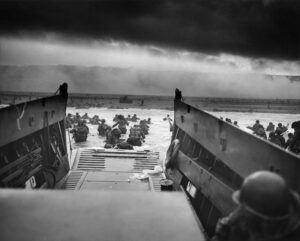 World War II was the impetus for many of the techniques and technologies foundational to modern logistics, both military and commercial. One of the most famous examples is RORO (roll-on, roll-off). This is a cargo handling method that involves rolling cargo onto vessels instead of lifting them by crane, by one by one, onto the deck. It was essential during the Normandy landings of 1944, and is now ubiquitous in global commercial logistics.
Many scholars have illustrated how post-WWII warmaking has been inextricably intertwined with capitalist infrastructures and incentives. Patrick Chung and Adam Moore show how military logistics has both benefited from and perpetuated exploitative labor practices on a global scale. The US Army, for example, has contracted out many supply tasks to contractors and what Moore calls “third-nation national” (TCN) laborers, or those hailing from nations that are not directly involved in the conflict in question. The construction of military bases, and the infrastructure needed to make these spaces liveable for the troops stationed in them, is contingent upon cheap, disenfranchised labor. They can also have significant impact on local communities, as Laleh Khalili demonstrates.
5. How important was ensuring the Chinese soldiers had sufficient drinking water in comparison to ensuring that they were adequately fed during China’s war against Japan? How similar were the logistics of quenching soldiers’ thirst versus those of satiating their hunger during this period of conflict?
That sounds like a second book! I did not pay close attention to this during my research. My suspicion is that the answer is heavily contingent on the region in which troops were stationed. In provinces blessed with waterways, it was a matter of sanitization. In more arid provinces, for example those in the northwest, the very procurement of water would have been a major challenge. I do, however, think that one similarity between food and water is extremely likely. Civilians would have been mobilized to collect, transport, or provide water for armed forces, just as they were mobilized to procure food. I have come across numerous mentions of civilians offering (or being expected to offer) “tea” to passing troops.
6. To what extent was China’s survival during China’s war against Japan unusual and unexpected?
World War II was the impetus for many of the techniques and technologies foundational to modern logistics, both military and commercial. One of the most famous examples is RORO (roll-on, roll-off). This is a cargo handling method that involves rolling cargo onto vessels instead of lifting them by crane, by one by one, onto the deck. It was essential during the Normandy landings of 1944, and is now ubiquitous in global commercial logistics.
Many scholars have illustrated how post-WWII warmaking has been inextricably intertwined with capitalist infrastructures and incentives. Patrick Chung and Adam Moore show how military logistics has both benefited from and perpetuated exploitative labor practices on a global scale. The US Army, for example, has contracted out many supply tasks to contractors and what Moore calls “third-nation national” (TCN) laborers, or those hailing from nations that are not directly involved in the conflict in question. The construction of military bases, and the infrastructure needed to make these spaces liveable for the troops stationed in them, is contingent upon cheap, disenfranchised labor. They can also have significant impact on local communities, as Laleh Khalili demonstrates.
5. How important was ensuring the Chinese soldiers had sufficient drinking water in comparison to ensuring that they were adequately fed during China’s war against Japan? How similar were the logistics of quenching soldiers’ thirst versus those of satiating their hunger during this period of conflict?
That sounds like a second book! I did not pay close attention to this during my research. My suspicion is that the answer is heavily contingent on the region in which troops were stationed. In provinces blessed with waterways, it was a matter of sanitization. In more arid provinces, for example those in the northwest, the very procurement of water would have been a major challenge. I do, however, think that one similarity between food and water is extremely likely. Civilians would have been mobilized to collect, transport, or provide water for armed forces, just as they were mobilized to procure food. I have come across numerous mentions of civilians offering (or being expected to offer) “tea” to passing troops.
6. To what extent was China’s survival during China’s war against Japan unusual and unexpected?
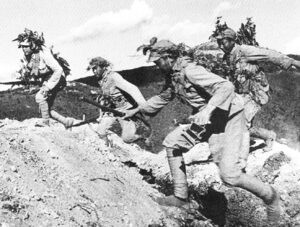 It was certainly unexpected to most people at the time! China faced major material odds: it was an agrarian economy with a rudimentary industrial core, and it suffered a Japanese blockade that was only partially alleviated by the US airlifts beginning in 1942. By 1941, it was also in the throes of a civil war. To most informed wartime observers, China’s ability to sustain total war seemed precarious indeed. Yet, in a matter of a few years, China went from a fragmented state, abandoned by the League of Nations, to one of the Allied Big Four–an official ally of global superpowers, a founding member of the United Nations, and the victor in a conflict with Japan the roots of which stretched back to the end of the 19th century. Between 1937 and 1945, China had achieved a dramatic change in fortune, one that I don’t think anyone at the time would have imagined.
7. Who are your biggest research influences and how have they shaped how you conceptualise your projects?
It was certainly unexpected to most people at the time! China faced major material odds: it was an agrarian economy with a rudimentary industrial core, and it suffered a Japanese blockade that was only partially alleviated by the US airlifts beginning in 1942. By 1941, it was also in the throes of a civil war. To most informed wartime observers, China’s ability to sustain total war seemed precarious indeed. Yet, in a matter of a few years, China went from a fragmented state, abandoned by the League of Nations, to one of the Allied Big Four–an official ally of global superpowers, a founding member of the United Nations, and the victor in a conflict with Japan the roots of which stretched back to the end of the 19th century. Between 1937 and 1945, China had achieved a dramatic change in fortune, one that I don’t think anyone at the time would have imagined.
7. Who are your biggest research influences and how have they shaped how you conceptualise your projects?
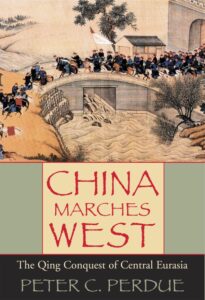 Hans van de Ven and Rana Mitter’s substantial work on war in China, of course, have been formative for me. Eugenia Lean’s Public Passions was a master class in storytelling and empathetic but critical interpretations of a vast array of primary sources. Peter Perdue’s China Marches West cemented my interest in campaigns and the importance of provisioning in determining strategy.
8. Which of your ongoing or upcoming projects are you most excited about?
I am embarking on a new project on civil-military relations in Republican China. It’s an interrogation of the relationship between civil and military spheres, and an exploration of how different ideologies conceived of the role of the military in politics and nation-building. No one has examined civil-military relations as either political theory or practice in the first half of the twentieth century, precisely a time when these relations were undergoing much transformation. I’ve presented these ideas at a few conferences and am excited to see where they take me.
9. Lastly, what are some of your most memorable teaching experiences at NUS?
I don’t have specific favorite episodes, but one of the best things about teaching is that it’s as much about learning as about instructing. Students ask great questions, and if I don’t have the answer, it’s a chance for us both to learn something new. Since I’ve begun teaching, I’ve learned so much more about fields of scholarship that I thought I was an expert in. So I guess my most memorable teaching experiences are those when students challenge me to venture beyond my own intellectual comfort zones and to keep learning new things. It’s a constant reminder that fields of historical knowledge are bigger than any single person, no matter how much of an expert they may profess to be. Hans van de Ven and Rana Mitter’s substantial work on war in China, of course, have been formative for me. Eugenia Lean’s Public Passions was a master class in storytelling and empathetic but critical interpretations of a vast array of primary sources. Peter Perdue’s China Marches West cemented my interest in campaigns and the importance of provisioning in determining strategy.
8. Which of your ongoing or upcoming projects are you most excited about?
I am embarking on a new project on civil-military relations in Republican China. It’s an interrogation of the relationship between civil and military spheres, and an exploration of how different ideologies conceived of the role of the military in politics and nation-building. No one has examined civil-military relations as either political theory or practice in the first half of the twentieth century, precisely a time when these relations were undergoing much transformation. I’ve presented these ideas at a few conferences and am excited to see where they take me.
9. Lastly, what are some of your most memorable teaching experiences at NUS?
I don’t have specific favorite episodes, but one of the best things about teaching is that it’s as much about learning as about instructing. Students ask great questions, and if I don’t have the answer, it’s a chance for us both to learn something new. Since I’ve begun teaching, I’ve learned so much more about fields of scholarship that I thought I was an expert in. So I guess my most memorable teaching experiences are those when students challenge me to venture beyond my own intellectual comfort zones and to keep learning new things. It’s a constant reminder that fields of historical knowledge are bigger than any single person, no matter how much of an expert they may profess to be.
Thank you very much for taking the time to answer these questions, Dr Yip, and congratulations again on being awarded Promising Researcher! |