

Learning to walk like an elephant Reflections on an NUS College Impact Experience project
February 5, 2026
The Impact Experience (IEx) programme is a rite of passage for all NUS College (NUSC) students, embodying the experiential learning and interdisciplinary approach that are hallmarks of the NUS honours college’s curriculum.
A service-learning and community engagement project spanning two years, IEx takes students into communities in Singapore and Southeast Asia to apply their classroom theories to real-world issues. Each team comprises six to seven students from a variety of academic backgrounds who work closely with community partners, faculty supervisors and local residents to understand the communities’ challenges and devise solutions.
Ryan Lim, a Year 4 student majoring in Southeast Asian Studies, is among the first cohort of NUSC students who recently completed their IEx projects and showcased their work at the inaugural Impact Festival in September 2025. Reflecting on his extraordinary experience living with and learning from elephant caretakers in Huay Pakkoot, Thailand, Ryan shares the impact that this incredible opportunity has had on him and his educational development.
As part of the first cohort to go through the IEx programme, what were your thoughts when you first learnt about IEx?
I felt IEx was something exciting and meaningful to look forward to as I was always keen to deepen my engagement with Southeast Asia. Also, unlike the usual university programmes, there was a lot of trust and autonomy given to students to ideate, plan, and run their IEx projects over the course of two years. For instance, IEx teams were mostly given project budgets upfront rather than on a reimbursement basis, and I felt this was very important from an equity angle, as it allowed all students to pursue regional projects if they were keen to. Since each group got to define the scope of their project, it was a good opportunity for the first NUSC cohort to bring ideas and learnings from the classroom into real life.
How did your team collectively decide on your IEx project topic and scope?
We had team members from different faculties and schools, but we were all keen on storytelling as an approach and grounding our work in lived realities. With that in mind, we approached a former NUSC anthropology lecturer, Dr Alexandra Dalferro, to be our advisor. Anthropology is about understanding people’s lives and social systems across various contexts. This shaped our approach to let our engagement with the community guide how the project developed.
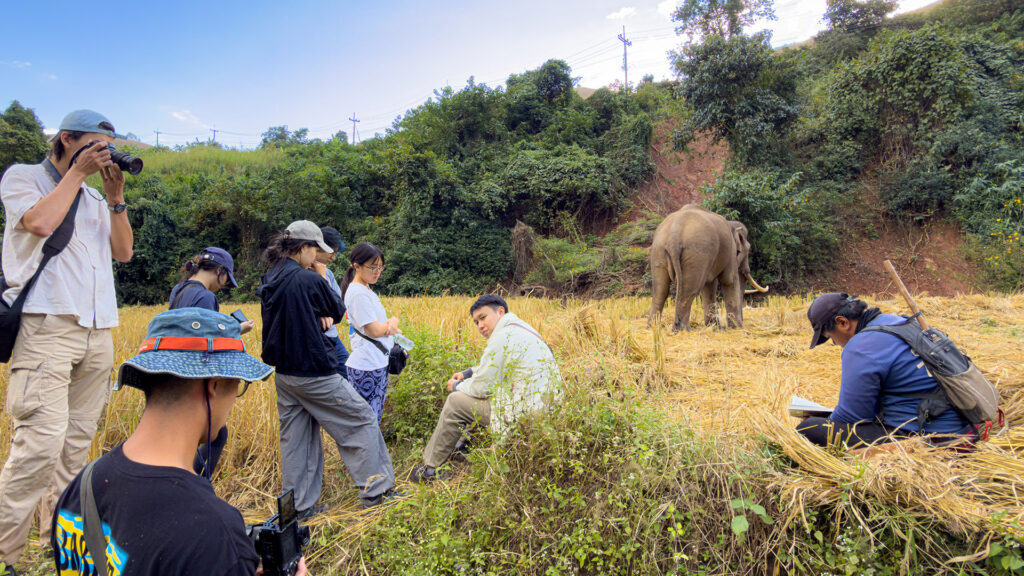
We were keen to explore the topic of human-elephant relations in Southeast Asia, inspired by Dr Dalferro’s research in Thailand, where elephants form a vital part of national culture. Another NUSC instructor, Associate Professor Peter Vail, invited us to join a trip to Chiang Mai, where we were introduced to the Thai elephant space by Chiang Mai University’s Faculty of Veterinary Medicine. Coming in as students who only had touristic experiences with elephants and speaking to the diverse set of actors involved in elephant care in Thailand such as vets, tourist camp owners, and local communities with a long tradition of living with and caring for elephants, we felt there was a gap between what outsiders thought they knew about elephant care and what the Thai insiders shared with us.
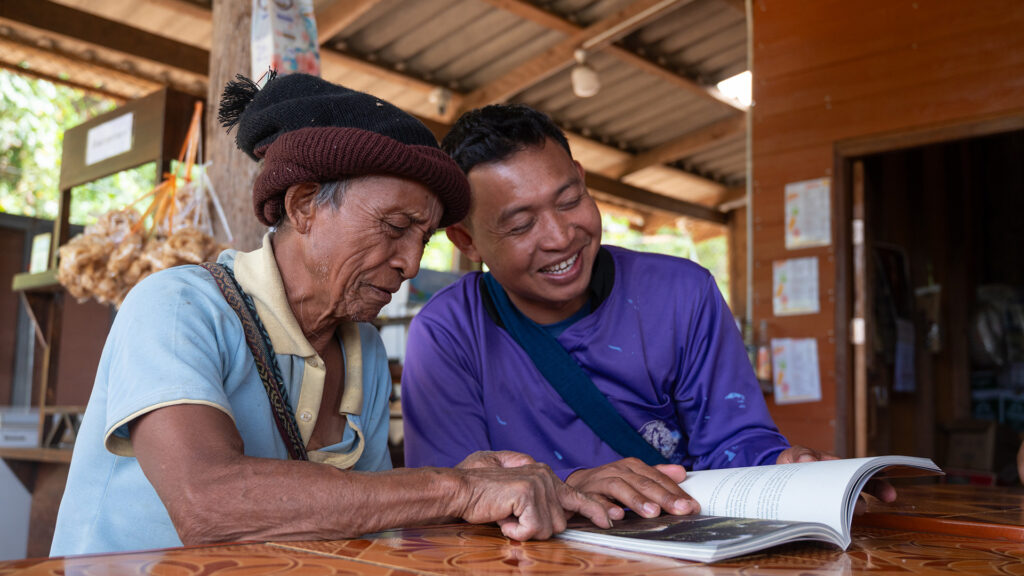
One of the moments that crystallised this for me was when we were speaking with Satit Trachookwamdee, or P’Dee, the founder of Huay Pakkoot Elephant Community Foundation. P’Dee, who comes from a Karen community that has lived and worked alongside elephants for more than 200 years, said to us that he wanted to show both the black and white of elephant care in Thailand. While he and his community loved their elephants and treated them as kin, he also wanted people to understand that caring for elephants is a resource-intensive and dangerous job.
An example of how they balance these realities daily is the practice of tethering an elephant to a tree with a chain when its carer has to leave it alone. What may seem cruel at first glance is actually a practical compromise, giving the elephant some freedom while reducing the risk of human-elephant conflict that may occur if the elephant wanders into farmland or homes.
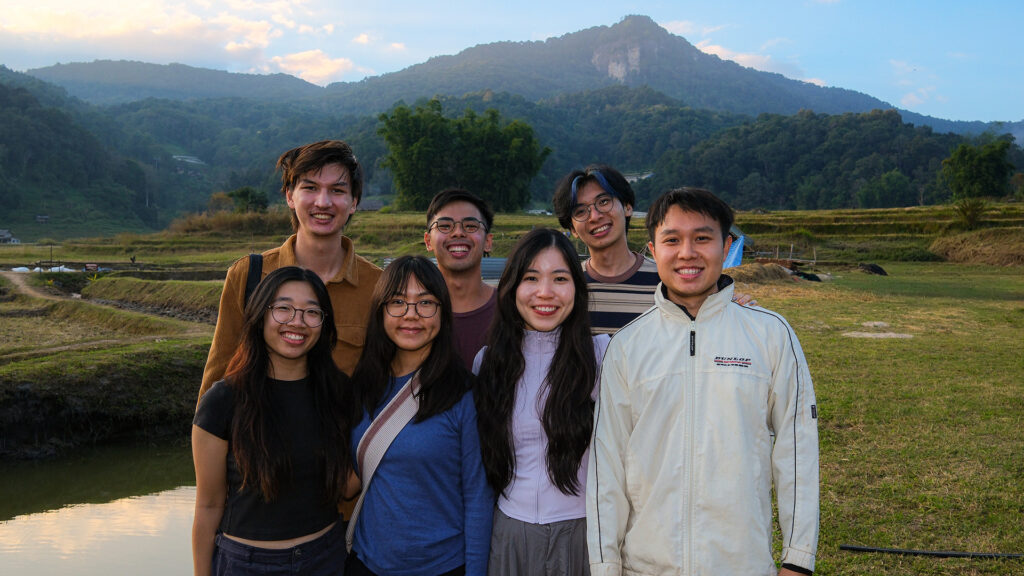
We decided to interview and follow different local people on their daily routines of caring for elephants and compiled their various stories into a photobook and companion website. Our different skillsets – Luke and Nigel’s photography and filmmaking; Chee Yan and Jia Liang’s writing; Eryn and Gillian’s design and drawing; supported by the Thai language skills I picked up to bridge the communication gap – came together nicely to create a rich and compelling final product. In curating these stories, we also sought to showcase diverse perspectives from the medical and commercial to the sociocultural.
What are some lessons you have learned, and what do you hope other NUSC students will take away from their own community projects?
This experience with managing our own project for two years taught me how much it takes to really drive something to make an impact. I was thankful that as a team, we were aligned and believed in the purpose of our project, and that how much we wanted to do was never a function of academic requirements but really grew out organically from what engaged and interested the team.
One of our interviewees gave us this advice, which I think would be helpful to students now thinking about or working on their own IEx projects: He told us that since we are working on a project about elephants, we must also learn to ‘walk like an elephant’. Elephants, he said, use their trunks to sense the ground before them before taking the next step. His advice reminded us to be humble and come in with an open, curious attitude to listen intentionally before thinking about impact.
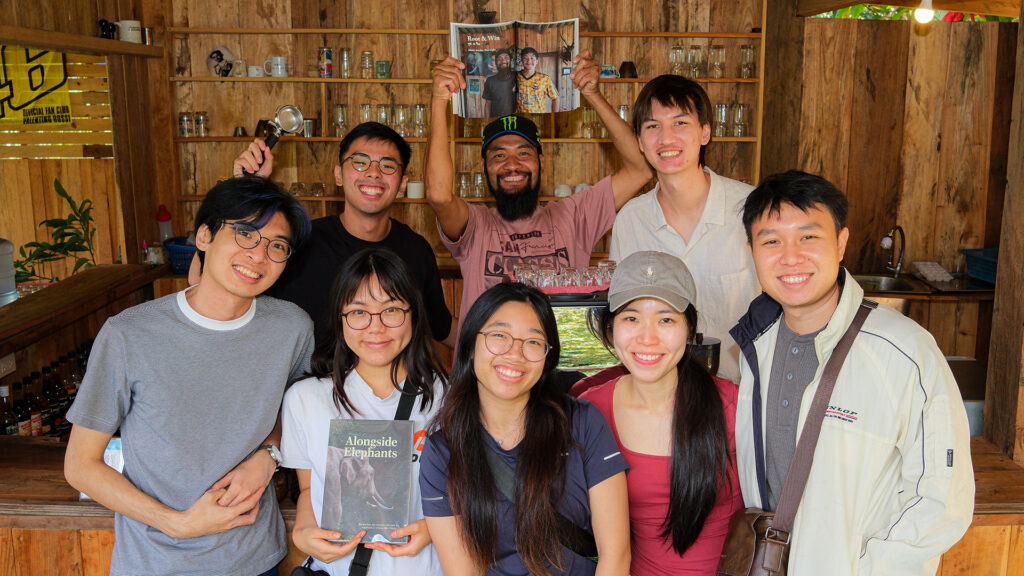
In December 2025, we made one final trip to Huay Pakkoot to deliver copies of the photobook back to the community who helped to create it. It is now on display in several local institutions, like a coffee shop and the Huay Pakkoot Elephant Community Foundation, where we hope it will be used to deepen understanding of elephant care among visitors. Even though the project has now come to an official close, we are trying to continue it in our personal capacity, such as by producing a Thai version so the community can read the stories in their own language and distributing more books in Thailand. Please reach out to us if you are interested to collaborate!
How has the IEx experience shaped your educational development?
This experience ended up shaping my educational path more deeply than I initially expected. Working on the project taught me to think differently about learning — instead of applying theories we already knew, we had to listen carefully, sit with uncertainty, and allow the community’s lived realities to guide our understanding.
That shift carried over into my academic choices at NUS. I decided to take Thai language classes to better connect with the people we were working with and also spent four months on exchange in Khon Kaen, Northeast Thailand, to improve my Thai language for daily use. This eventually led me to major in Southeast Asian Studies as a flexible pathway to combine my interest in the field of anthropology with my engagement with the region. Together, these experiences have influenced not just what I study, but how I approach learning and living in the region more broadly.
To learn more about the Alongside Elephants project, check out their website, this NUS Instagram post and these NUS Instagram highlights from their December 2025 trip. The photobook is also available for browsing in the NUS Libraries collection.
This story first appeared in NUSnews on 5 February 2026.