

Asst Prof Sahana Ghosh awarded Association for Feminist Anthropology’s Michelle Rosaldo Book Prize
March 11, 2026
Congratulations to NUS Sociology and Anthropology’s Assistant Professor Sahana Ghosh for winning the AFA’s (Association for Feminist Anthropology) Michelle Rosaldo Prize for Best First Book! The awards ceremony was held on 22 November 2025 at the AAA’s (American Anthropology Association) business meeting in New Orleans, Louisiana.
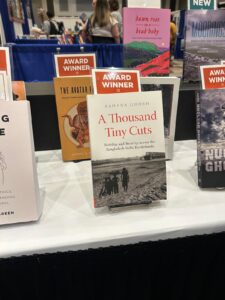 Asst Prof Ghosh received the award for her 2023 book, A Thousand Tiny Cuts: Mobility and Security Across the India-Bangladesh Borderlands (University of California Press, 2023), which chronicles the slow transformation of a connected region into national borderlands and shows the foundational place of gender and sexuality in the meaning and management of threat and security in relation to mobility. It recasts a singular focus on border fences and migrants as border-crossers and shows, instead, that postcolonial bordering materialises through multiple forms of violence and devaluation in agrarian, borderland lives. Informed by two and a half years of fieldwork in the borderlands of northern Bangladesh and eastern India, A Thousand Tiny Cuts had previously received the AAA’s Association of Political and Legal Anthropology (APLA) Book Prize in Critical Ethnography 2024, Honorable Mention and the Sardar Patel Dissertation Award for best thesis on South Asia in any discipline at any North American University.
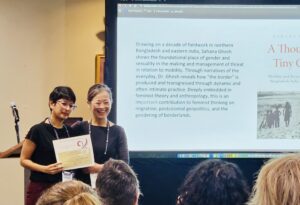 The Michelle Z. Rosaldo Prize for Best First Book was established by the Association for Feminist Anthropology in 2015. It is named for Michelle Zimbalist Rosaldo (1944-1981), a social, linguistic, and psychological anthropologist known for her studies of the Ilongot people in the Philippines and for her pioneering role in women’s studies and anthropology of gender. The prize is awarded annually to a first book that embodies the theoretical rigor, ethnographic richness and advancement of feminist scholarship marked by Rosaldo’s career.
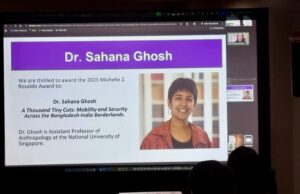 Asst Prof Ghosh employs ethnography and feminist approaches to research borders and borderlands, the mobility of people and goods, citizenship, refuge and neighborliness, the national security state, agrarian change, spatial history, transnational kinship, and the political economy of gendered labour, and other concerns. She is currently preparing her second book, which explores the gendered labours of soldiering in postcolonial India. Based on ethnographic and historical research, the book investigates what makes soldiering – as a form of mobile work – both promising and perilous for individuals, families, and state institutions, and how they in turn make it meaningful and valuable.