

BENJAMIN SCHUPMANN
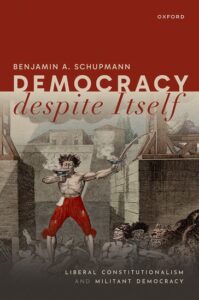
A/P Schupmann examines how democracies can respond both effectively and legitimately to internal antidemocratic threats, such as populism, extremism, and democratic backsliding. His 2024 book Democracy despite Itself: Liberal Constitutionalism and Militant Democracy conceptualises a normative theory for democratic self-defence grounded in principles of liberal constitutionalism, which blends John Rawls’ political liberalism with Carl Schmitt’s constitutional theory to assert that basic liberal rights are an unalterable element of democratic constitutionals and that the state must by right defend its democratic political identity against internal challenges. A/P Schupmann argues that militant democracy is institutionalized by explicit unamendability, political rights restrictions, and guardianship by a constitutional court, as is the case in the 1949 German Basic Law, Germany’s constitution, and that their incorporation is a crucial safeguard of democracy against the threat of legal revolution, offering a model for the design of future democratic constitutions. A/P Schupmann was recently granted the FASS Award for Excellent Researcher (AER). This award is presented to researchers based on the overall impact and strength of their research. The successful researcher would have “achieved consistent research excellence, produced a piece of research of great impact, and be recognised by the research community as having achieved a significant breakthrough.” FASS congratulates A/P Schupmann on this achievement. I had a thought-provoking conversation (which has been edited for length and clarity) with A/P Schupmann about his research over coffee on a thundery December afternoon.
1. How did you initially become interested in contemporary democratic theory and political thought?  I grew up in New Hampshire in the United States, which is the home of the first primary. Even as a teenager I met presidential candidates; it’s normal in the state. For example, in the 2000 election both George W. Bush and Al Gore came to my high school, and I had the opportunity to meet them. I had met other presidential candidates during previous elections, too. There was a diner in town where they would always go, which seats maybe twenty people. Politics was an important part of my early developmental life. I got interested in philosophy and politics during high school and college, and in combining them. Although I was always more of a political philosopher and theorist, when I was a freshman at Boston College I got involved in the Global Justice Project, which was involved in anti-globalisation efforts, such as protests against the WTO (World Trade Organisation) and teach-ins, the latter of which I was part of. This was in my younger days, and I’ve not been involved with the Global Justice Project or similar organisations since then. When the Global Justice Project took a pivot into a direction that I was not interested in, I decided to go a more theoretical route than activist route; in other words, trying to understand the world, rather than just sort of act into it. Also when I was at Boston College, I studied under David Rasmussen, who was Habermas’ first PhD student, and he was a very powerful influence in my life; he was also super generous and probably one of the smartest people I’ve ever met. That’s the power that a good teacher can have on you – they can redirect the path of your life.
2. What challenges have you encountered when constructing and defending your arguments in Democracy despite Itself: Liberal Constitutionalism and Militant Democracy? 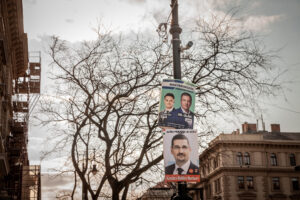 In order to describe the challenges, I thought it would be a good idea for me to lay out what the book’s main idea is. The basic idea behind militant democracy is that there are some articles in a democratic constitution that should be unamendable, and that if a pollical party or association wants to change them, then the state should consider banning them. It’s important to have that in mind, I think, because when we talk about challenges, intuitively, I think for most people, what I just described – that certain laws can’t be changed under any circumstances, and political parties can be banned even if they are really popular – at first glance seems deeply undemocratic. This raises the question, that if the goal is to protect democracy, then isn’t it as problematic to engage in either of those actions, as whatever the party you’re banning is trying to do? It seems like a paradoxical defence, and people who care about democratic theory a lot as well as ordinary practitioners also push back against this. There are reasons to push back and even though it is an idea that I am committed to, it has met a lot of resistance among my peers in political theory and constitutional law. It is not an idea that gains traction easily, so it has been an uphill battle. I keep writing articles defending my thesis, and recent history has kind of been helpful. There have been a couple of cases recently that I think demonstrate the value of the argument. One in the United States is the Supreme Court case Trump v. Andersen in March 2024, when Colorado tried to remove Donald Trump from the ballot under the Insurrection Clause. That’s a case of militant democracy: you have someone who seems to be a threat to democracy, and we aren’t trying to prosecute them criminally, so the goal isn’t to put them in jail. If somebody is a genuine threat to democracy, can we prevent them from running for office? There are many different ways that these political rights restrictions can play out. The most extreme form is the party ban, but different countries have more mild versions. For example, in India, unconstitutional parties or parties that adopt unconstitutional agendas can be prohibited from speaking on the floor of parliament, because they can use that as a way to undermine legislative discussions, and I think they can be prohibited from running for office for one cycle. So you don’t ban the party – you just say, “You’re off the ballot this cycle, you’re back on next cycle”, for example.
3. How did you select the concept of militant democracy to explore and advance?
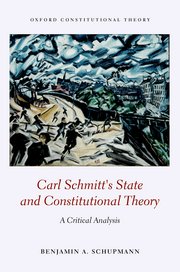
My first book was about a different German constitutional theorist, Carl Schmitt, who is quite notorious. It was about his state and constitutional theory, and when I was finishing that book up here in 2016, and noticing that a lot of the things he was talking about seemed to have parallels to events that were happening in the UK with the Brexit vote, and some of the events happening in Hungary also around that time. And around that same time, some US-based academics started taking an interest in militant democracy. So, between my work on Schmitt, and the renewal of discussion on militant democracy, after almost 80 years of not really saying very much about it, I suppose that’s where it came from.
4. Are there examples of militant democracy being deployed (whether or not they could be considered successful) that you have found instructional?  The two most recent examples which I find heartening are in April 2025, the Korean constitutional court voted to uphold the impeachment of (now former) President Yoon because of his attempt to use emergency powers to overthrow Korean democracy. And so, with that act, he was disqualified, and since then has been brought up on criminal charges as well. I am not as interested in the criminal charges; I would like to keep those things separate. In Brazil, with Bolsonaro, it’s the same thing. They brought him up subsequently on criminal charges. The initial decision in 2023 was to disqualify him from running for office again; in this case, it was 20 years because of the threat they concluded he posed to Brazilian democracy. There are historical examples, too. For instance, in the 1950s Germany banned the Nazi Party and the Communist Party, which was a Stalinist communist party. These historical examples have been instructional in a positive sense.
5. In what situations could militant democracy fail? Thailand is a good example of it failing or being abused in a way that shows that it’s not unambiguously good, that it needs to be installed and used in a very careful way. Militant democracy needs to be constitutionalised very carefully and one thing I don’t really do in the book as much as I should, is look at the way in which the German constitution creates institutional oversight over the party ban, for example. The abstract concern is that whoever gets to decide on the ban looks at the party and says, “I don’t like them”, and bans them. The way that the German system is designed still has problems, but there are at least three levels in the German system that have to act in concert to succeed. There is an institution called the Federal Office for the Protection of the Constitution, which is a government administrative organisation that just monitors parties and assigns them three levels of threat. In recent news, the AfD (Alternative for Germany) has been escalated to the highest of these levels, which in the English term is a concerned case of extremism. They have not been banned, but I think they should have been a while ago. Taking that step is an important evidentiary precursor. It’s a way of gathering evidence and communicating to voters that there is something problematic about this party; some of their values seem to be inconsistent with human dignity, for example. The second tier is some combination of one of the two chambers of legislature, or the government, or ideally, all three, can decide that they feel that that this is an actionable case, and will submit it to the constitutional court, which is the third tier. The judges will then decide, it will be an open trial, evidentiary, and the accused will have the right to defend themselves. So it works in a very legalistic process, ideally governed by rule of law. That’s something I didn’t pay enough attention to – that it’s lacking in those forms of institutional oversight, separation of powers, and checks and balances. You can see how it could really go wrong. Criminality and unconstitutionality can be intertwined, and for my work I want to look at a pure case where parties are not doing anything illegal. They are studiously adhering to the rule of law – what the law says. Because as soon as they start committing political assassinations or get involved in racketeering – that sort of thing – it muddies it because obviously criminals should be punished for criminal behaviour, even if they’re not a threat to democracy. I really want to look at cases where somebody is not breaking the law at all; they’re just legalistically getting rid of democracy. The legal scholar at Princeton University, Kim Lane Scheppele, who has been in the news a lot, calls this autocratic legalism. And Victor Orban in Hungary is doing this. He is not really breaking any laws – him personally – so there is not a way to hold him and his party accountable for his criminal behaviour. So that raises the question, how can we hold him accountable for dismantling Hungarian democracy? Militant democracy would disqualify Orban. Ultimately, the question is, how can we protect democracy against this very specific problem?  Militant democracy doesn’t have to involve a ban; the ban is the most extreme form. Anyhow, it’s sad, but it’s too late for militant democracy to rescue Hungary’s democracy at this point. What I’m arguing for is a pre-emptive measure, so it needs to happen when the party or candidate is a minority candidate – certainly before they’ve taken power. Once they’ve taken power, the game is over. In Hungary – and maybe this is a failure in militant democracy – with Fidesz (Orban’s party), it wasn’t obvious at the time, when they were running for office. I think it’s the same with Trump in 2016. Looking at him then, it’s difficult to say that he was a threat to democracy. I’m not sure there’s a strong case there. It’s the same with Orban in 2010 when he was running for office. So, would these have been cases where militant democracy would have prevented him from running for office? I don’t think so. Now, Trump in 2024 – that’s a different story. Or the AFD in 2016. Again, these are cases where they seem like they are unambiguously candidates for disqualification.
6. To what extent could your ideas be applied in other Asian nations?  One of the countries I talk about in the book is India, which I think is becoming less of a case that I look at with alarm. But back when I was first writing the book in 2019, it seemed like Narendra Modi was going to combine the National Register of Citizens (NRC) with the Citizenship Amendment Act (CAA), and the goal was basically to disenfranchise millions of Indians from political participation based on religion. And that seemed to be at odds with what’s called the Basic Structure Doctrine of the Indian Constitution, which is basically that there is this unamendable core of secularism as one of its constitutive features. Even though Modi is less of a threat as his popularity wanes, I think India is still sort of ripe for that abuse; Hindutva isn’t going away, and neither is religious nationalism. I mentioned Korea already, and I think Korea is a great example of the success of militant democracy, but even there it could be better systematised – it could be constitutionalised better. But my theory is really a normative theory, so it’s about how we should design constitutions. And once a constitution is designed a certain way, should democrats be confident in using these measures? So it’s more about looking into the future of how we should design our states and we should design democracy. Many constitutions could be better designed to better incorporate the principles I’m talking about. I already mentioned the party ban, and I would like to bring up unamendability. The idea behind unamendability is that basic liberal values – like due process, or freedom of conscience, or religious liberty – ought to be entrenched in the constitution, and this is what democracy needs to guard against. That is, parties that seek to change them. In Asia these issues play out a little bit differently than in Europe, but those fundamental values could be constitutionalised better. There could be mechanisms to protect the constitution better against parties that would derogate – that is, enact laws or policies that are unconstitutional, but are not changed – that is, not invalidated. This is not a silver bullet. What we hope it does is just by disbursing this power and giving it to the judiciary, which has been called the least dangerous branch of government, you reduce the possibility that it would be abused in an authoritarian way. But you can look at the US now as an example of how the judiciary can be colonised – because the Executive Branch appoints them. This process can be undermined by things like that happening, but you can see that it does work. A good example of this is Israel today. The Supreme Court has done a good job of opposing Netanyahu and the Knesset. Israel does not really have a constitution – it’s complicated – but their Supreme Court has worked hard to enact a set of fundamental rights. And up until 2023 it looked like they were actually going to do something to reign in Netanyahu. There were protests happening, but this was before October 7th, 2023, which completely eclipsed that. One of the things about the Israeli Supreme Court is that it is highly professionalised to prevent against colonisation. Basically, the Israeli Bar Association has input into who gets appointed, ensuring that the opposition has some say in the appointment of judges, unlike in the US, which is winner take all. So, it is possible to design the constitutional court to be colonisation or intimidation proof. The US is not a very good example of how to design a constitutional court; Israel or Germany are much better examples. Judges do not have lifelong tenure in Israel and Germany, which also have multiparty democracy.
7. Who are your biggest research influences and how have they shaped how you conceptualise your projects?
8. What future or ongoing projects are you most excited about? I thought I would move on from this, but given the state of the world today, right now I’ve been working a lot on spinoff work related to militant democracy. But I have started thinking about my next book project. One thing I’m thinking about doing is abstracting from this. There is a tradition  that is called reason of state, which is the idea that when the state faces a crisis, like an emergency, it is justified in doing something immoral or illegal, or – as it originated in the 16th century – unchristian, in order to save itself. The idea behind this goes back to ancient Rome, and you find it in various forms. Basically for all forms of government, thinkers have struggled with this. And I want to look at militant democracy as an attempt to constitutionalise reason of state. To flesh it out a little bit more, the traditional model has always been to look at taking exceptional action by suspending the normal legal order and acting outside of it. In the 16th century, you would not be suspending the constitution – you would be suspending Christian morality for a moment, but God would forgive you because you were defending Christian order. To be clear, this is the Suspension Model – the old model – which I am not endorsing. If we could do something illegal or immortal to preserve the state, then it is justified – is the Suspension Model. Another example from US history is Abraham Lincoln’s decision to suspend habeas corpus (due process). There are so many examples, but the underlying logic is that the state is in danger, and if we don’t break the law, if we don’t do something immoral, then the state will die, democracy will die. That’s the Suspension Model. It’s obviously disquieting or troubling, because if we are suspending habeas corpus, or torturing (engaging in cruel and unusual punishment), haven’t we already destroyed who we are? Doesn’t that defeat the purpose? If our goal is to save this constitutional order, then the actions we’re taking seem to destroy it. So that’s the fundamental problem with the Suspension Model. And of course there are many other problems with it as well. So I want to look at the approach the German constitution is taking, as an alternative to the Suspension Model. They are not suspending the constitution at all; they are insisting that certain aspects, like human dignity – basically Articles 1 through 19 of the German constitution – even in an emergency, can’t be suspended. This is why they have really been struggling with some of the COVID-19 Pandemic restrictions, like the restrictions on the freedom of movement that they imposed in 2020 and 2021. The COVID-19 Pandemic is not an emergency where it’s another person, but there is this existential threat. Another example is if we suspend freedom of movement, freedom of association in the US – meaning you can’t go to church, you can’t go to a political organisation. That was suspended in many states. But it seems at odds with the US constitution – it violates freedom of assembly. I don’t know if any cases have been brought in the US, but I don’t think you can, precisely because you can declare an emergency and suspend basic rights. But it should be troubling if we think this is part of the thing that we are trying to save, that we’re throwing it out in order to save the thing we have discarded. That’s kind of the dynamic and the goal is that the German constitution offers an alternative to suspending the constitution in order to save it. I think that the German constitution is the best real model we have. This is because the people who wrote the German constitution were a combination of Americans and German lawyers who had to flee Nazi Germany either because they were liberal democrats, or because they were Jewish, or both – and they came back and said, “How do we prevent this situation from ever happening again?” They worked really hard, and I think they came up with the best constitution we have today.
9. Lastly, what are some of your most memorable teaching experiences at NUS?
Another thing I will mention, is that I got some advice from a senior colleague that students want to hear about what you’re doing, which I had never considered. I had never wanted to teach my own work, but a senior colleague recommended it to me. So then I started putting sections of my book, when it was just a manuscript before it was published, in my courses as part of their readings. And it was really rewarding as students took it very seriously and came in with questions. They would take the time and read it carefully. I gave the class a draft chapter from my book, and one of my students read the entire thing. We talked about it in class, and she wanted to come to office hours afterwards and talk to me about it. It was really nice to see undergraduates engaging with this stuff. I don’t think the book is really an undergraduate text. The class is a democratic theory course, so it’s sort of scaffolding them up to what I was working on. And I’ve seen that with a lot of students.
Thank you very much for taking the time to answer these questions, A/P Schupmann, and congratulations again on being awarded Excellent Researcher! |

 Militant democracy dates to 1937 when a German-Jewish constitutional lawyer named Karl Loewenstein who had to flee Germany in 1934 I think and ended up in the US, teaching at Amherst College. He coined the term in 1937 in a couple of articles. There are some really famous lines in the literature, like “Democracy needs to fight fire with fire.” Governor Gavin Newsom was using that exact same language to justify the California redistricting. “If fascists are using the tools of democracy to attack democracy, it’s time for democracy to fight back. Democracy must become militant,” was his 1937 argument. Of course, you know history – it was too late at that point. The postwar constitution of Germany was designed with those ideas in mind – not his exclusively, but the ideas of a lot of German constitutional lawyers who had reacted to the Nazi Party’s legal assumption of power in 1933.
 In my research, I keep coming back to the German constitutional figure, Carl Schmitt. John Rawls also plays an important role in my thinking – I did this degree in Italy before doing my PhD, and it was basically a school of Italian Rawlsians. At Columbia I did my PhD on Schmitt under Jean Cohen. So I think I carry both of those influences, with Schmitt being more important.
 I really appreciate my students. I am still in touch with one of my favourite students today. When she was a freshman, she came in during office hours because she had a question about a reading on Rousseau. It was a very interesting question, and she was making connections that I would not even have expected of a senior, let alone a freshman. I remember thinking that if she wants to explore this, I can let her do it in the paper that is due later in the semester, and just see what happens. I think it kind of freaked her out a little bit, and it seemed like it was going to be a lot of work. But she sat down, did the research, and wrote a pretty good freshman paper that I would not have expected a Columbia undergraduate to write. It was incredibly rewarding to see a student to come in with an incredibly interesting question about a text, prod it a little bit, work on it, step up to the challenge, and deliver on it.