


Where Will You Make Your Impact?
Understand The World. Shape Your Future.
From climate resilience to global justice, NUS Geographers learn from today’s problems to design tomorrow’s solutions. Through an interdisciplinary curriculum that integrates physical and human geography, students examine real-world challenges across local, regional, and global contexts. Grounded in research and practice, NUS Geography equips learners with the critical and applied skills needed to shape more equitable and resilient futures.

Climate Change
How do we respond to a warming world?
Analyse climate impacts and adaptation strategies to drive solutions in policy, planning, and environmental consultancy.

Sustainable Development
How can we live well on a damaged planet?
Evaluate and design pathways for balancing growth, equity, and environment to shape sustainable futures across public and private sectors.

Globalisation & Inequality
Is there hope for the future?
Examine how global flows of power, trade, and culture create uneven geographies, opening pathways into public policy, urban and corporate consultancy.

Our Everyday Worlds
How do we create meaningful worlds for ourselves and others?
Explore how identities, practices, and cultures shape everyday spaces and places, building skills for careers in planning, community engagement, marketing and project management.

Geospatial Intelligence
Want to see the world in 4D?
Apply spatial analysis, mapping, and data visualisation to solve real-world challenges in industry, government, and academia.

The Geographical Sciences
Want to shape the world, literally?
Study Earth’s dynamic systems to build skills in analysis and field research, leading to careers in environmental consultancy, resource management and conservation, and sustainability planning.
Explore Our Programmes
Green, W. N., & Kenney-Lazar, M. (2025)
Sustainability capitalism: Investing in climate transitions
Environment and Planning A: Economy and Space
Brady, D. (2025)
Toward a geographical stack: Reworking state-less and scale-less conceptions of the digital in China and California
Progress in Human Geography
Li, M., et al. (2026)
Why methane surged in the atmosphere during the early 2020s
Science/AAAS (American Association for the Advancement of Science)
Feng, C.-C., et al. (2025)
Nonlinear dynamics of natural and cultural ecosystem service supply and demand
NPJ Heritage Science
News & Happenings
NUS Geography Now
The Straits Times features Dr Nawaz’s expert insights on ground tremors felt in Singapore following the Sabah earthquake on February 24, 2026.
Upcoming Events
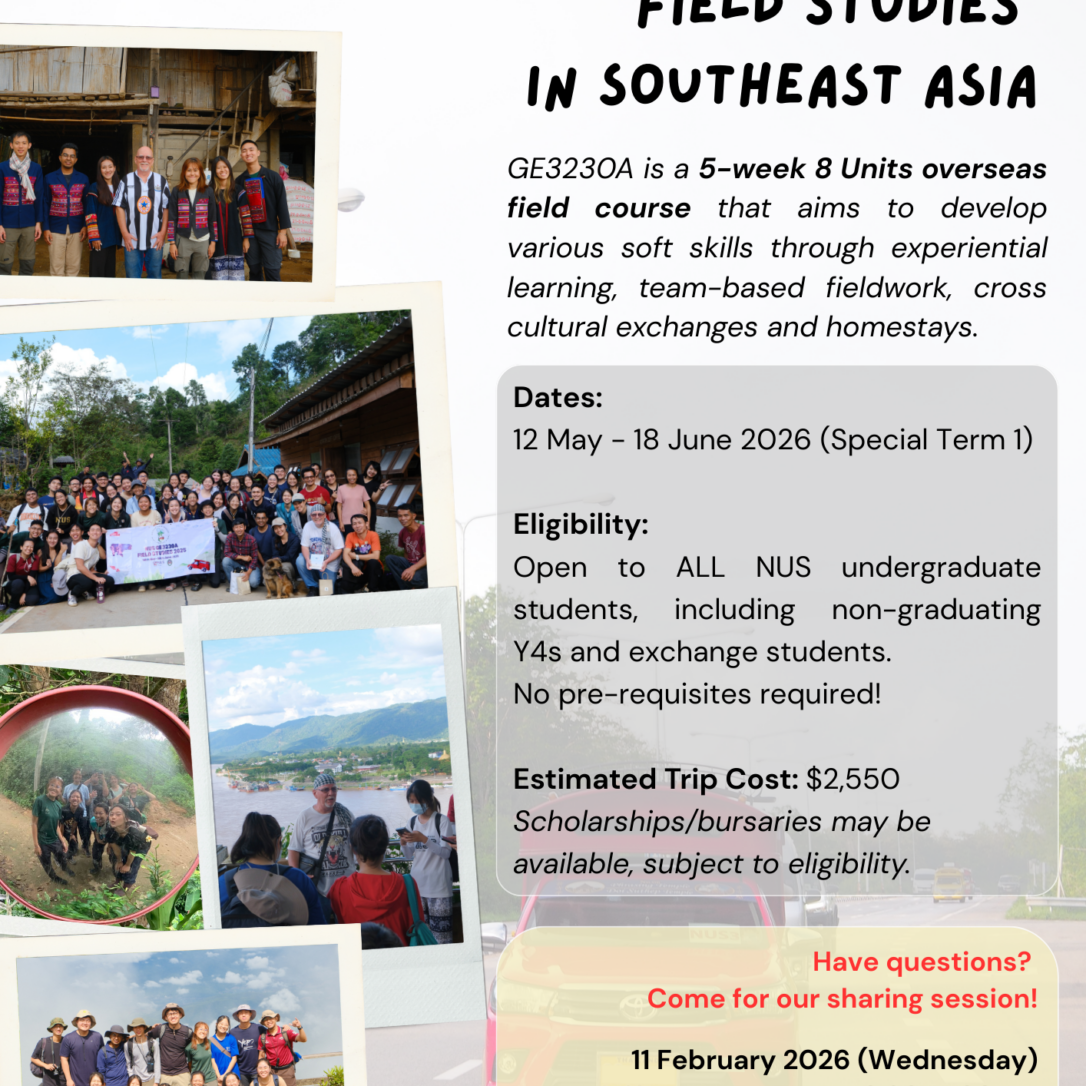
Field Studies 2026 - Official Registrations Open!
GE3230A is a 5-week, 8-unit overseas field course conducted in Southeast Asia during Special Term 1 (12 May - 18 June 2026). Students interested in enrolling can officially register for the course via the link below.

Seminar
Radical Care-work, Critical Pedagogy and the Livable City: Revisiting the History of Urban Squatting in West Berlin, 1968-1977, by Professor Alex Vasudevan, School of Geography and the Environment University of Oxford on Monday 16 March 2026, 9.30am, Geography Seminar Room, AS2 #03-02.
Seminar
Accountability in the AI Production Network: Introducing the Fairwork Action Research Project by Professor Mark Graham, University of Oxford, Thursday 26 March 2026, 3pm, Geography Earth Lab, AS2 #02-04.

Seniors are taking the kampung spirit beyond the neighbourhood
By Professor Elaine Ho (Senior Research Fellow at the NUS Asia Research Institute and Vice Dean – Research at FASS), Associate Professor Vincent Chua (NUS Sociology and Anthropology), and Associate Professor Feng Chen-Chieh (NUS Geography).
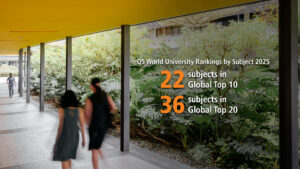
22 NUS programmes in global top 10 in QS World University Rankings by Subject 2025
History of Art, Geography, Linguistics and Politics & International Studies at NUS ranked in the Global Top 10 of the latest Quacquarelli Symonds World University Rankings (QS WUR) by Subject 2025 released on 12 March 2025.

Half of land use carbon emissions in Southeast Asia can be mitigated through peat swamp forest and mangrove conservation and restoration
Southeast Asia (SEA) is home to approximately 34% of the world’s mangrove forests, representing a crucial component of coastal ecosystems. From Singapore’s Sungei Buloh Wetland Reserve to Thailand’s Tarutao National Park, these peatlands and mangrove act as natural carbon sinks by absorbing more carbon than they release, with the excess accumulating as partially decomposed organic […]