

Empowering tomorrow’s economic leaders in a divided world
July 11, 2025

In a time marked by rising global tensions, fractured trade relations, and deepening social and economic divides, the National Economics and Financial Management Challenge (NEFMC) 2025, organised by the NUS Economics Society (ECS), brought together nearly 1,000 pre-tertiary students in June to grapple with a question that could define their generation: What does economic resilience look like in a world that’s increasingly divided?
This year’s theme, “Economic Resilience in a Divided World”, reflects a reality that young people are already living through — a world where geopolitical instability, climate shocks, and market fragmentation are no longer abstract headlines, but defining features of the systems they will one day lead.
Hridayansh Khera, the incoming 63rd ECS President and a first-year Faculty of Arts and Social Sciences Economics major, remarked at the opening ceremony, “The theme couldn’t be more timely. Our participants aren’t just solving economic problems — they’re building the mindset needed to lead through disruption.”
A landmark year of record participation, esteemed collaborations and thought leadership
Organised annually by ECS, NEFMC 2025 saw its biggest edition yet with participation expanding nearly threefold in scale this year compared to previous iterations. This year also marked a major milestone, with the Monetary Authority of Singapore (MAS) joining as the event’s key sponsor for the first time, underscoring the challenge’s increasing significance in the national pre-tertiary academic landscape.
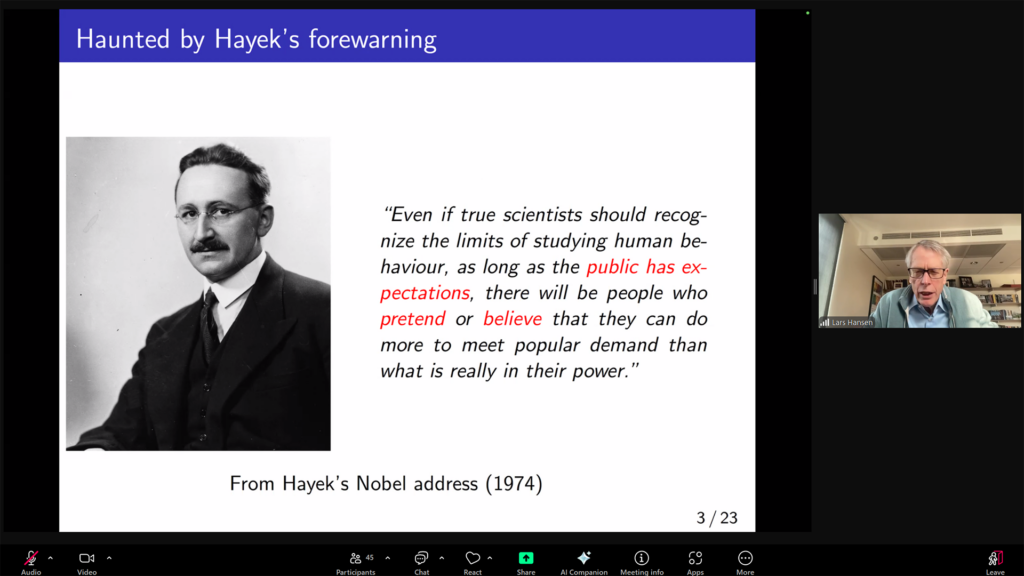
The competition scored another first when it hosted Professor Lars Peter Hansen, the 2013 Nobel Laureate in Economic Sciences from the University of Chicago, for a virtual keynote dialogue on 10 June 2025 titled “Scientific Uncertainty in Climate Policy: Conceal or Confront?”.
At the session, Prof Hansen emphasised that uncertainty in climate models should not be a justification for inaction but directly integrated into policymaking. He cautioned against the risks of overconfidence in the modelling process and explained why effective policies must strike a balance between preparation for worst-case scenarios and waiting for better data.
During the competition, students across three regional rounds tackled real-world economic challenges through case analyses, policy strategy and live presentations. The first two rounds saw teams of four or five competing in an online assessment that tested their understanding of economics and finance fundamentals, followed by a research analysis of the effects of geopolitical tensions on supply chain dynamics. The top six teams entered the final round and presented their cases for how low- and middle-income countries can navigate geopolitical shocks in areas such as trade finance, energy transition, and wealth and income inequality.
The esteemed panel of judges included Mr Joe Hooper, Director of the United Nations Development Programme (UNDP) Global Centre for Technology, Innovation and Sustainable Development; Mr Eduardo Pedrosa, Executive Director of the Asia-Pacific Economic Cooperation Secretariat; Mr Richard Stein, Managing Director at Goldman Sachs; and Ms Benish Aslam, Regional Lead of Government Affairs and Policy at The Asia Pacific Medical Technology Association (APACMed).
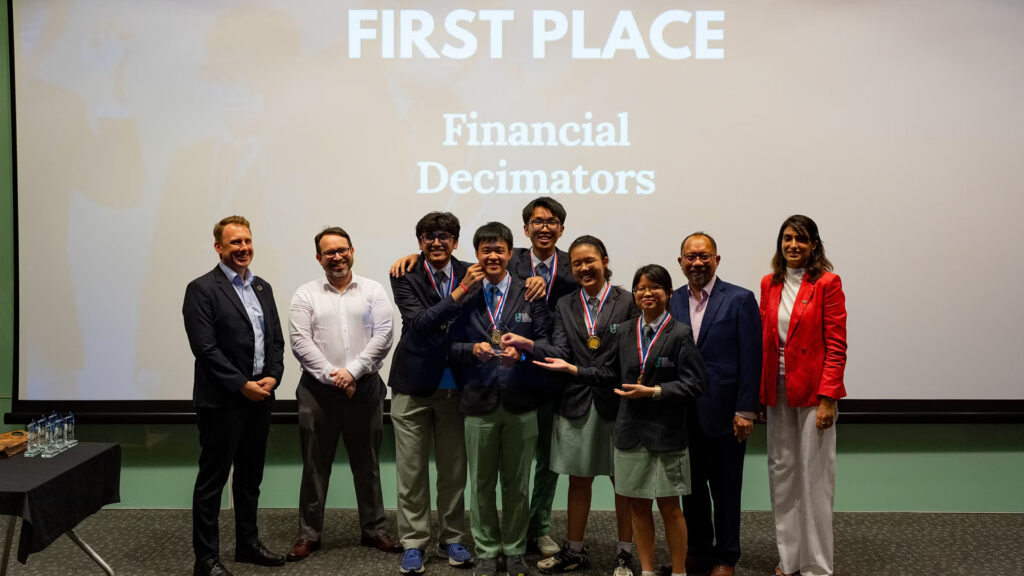
After intense deliberation, the judging panel awarded the top prize to Team Financial Decimators from NUS High School of Mathematics and Science. Their presentation stood out for its detailed analysis and strong, evidence-based policy recommendations tailored to the needs of developing countries. The winning team represented Singapore at the Australasian Economics Olympiad last week and emerged in second place in the team category!
Building a green Singapore
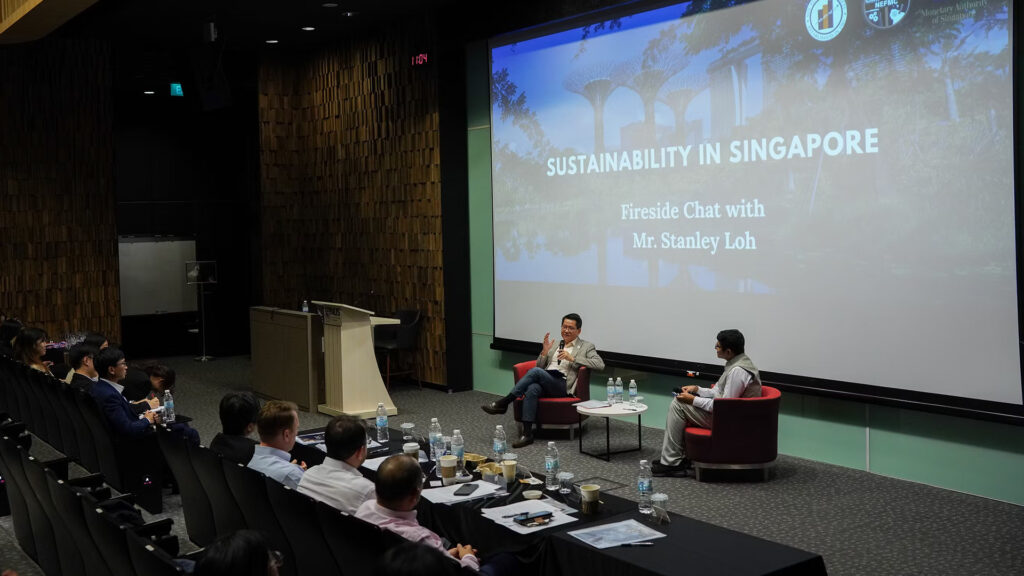
The finals also saw Mr Stanley Loh, Permanent Secretary at the Ministry of Sustainability and the Environment, deliver his keynote address titled “Sustainable Singapore: Building a Green Economy in an Ever-Evolving World”. Mr Loh, who is also an alumnus of NUS Economics and former ECS President, then participated in a fireside chat with Mr Khera, discussing the impact of geopolitical tensions on the development of a green economy and some of his personal experiences from when he was a student.
Mr Loh laid out the stark implications of climate inaction, warning that sea levels could rise by up to 1.15m by 2100 – a scenario that would place large parts of Singapore at serious risk. He noted that temperatures could rise by up to 5°C, with today’s coolest month (January) being warmer than the hottest month (May) in the 1960s. Beyond these extremes, he emphasised the severe externalities climate change could bring, including detrimental impacts on public health, infrastructure, and food systems.
Global coordination, he reminded participants, is essential, with the global community leveraging the diverse relative strengths of nations to create a more efficient and globally coordinated response to the climate crisis. “Each country brings something different — some have advantages in alternative energy, others in R&D or systemic implementation. We need to tap on comparative advantage in climate action too.”
Inspiring young economists
Reflecting on the experience, Zhu Yancun from Team Financial Decimators noted how the NEFMC was an incredible opportunity for the team to explore the exciting intersection of economics, geopolitics, and finance. “We worked across multiple time zones during the competition period because we were in different countries across the competition period. The challenges of collaborating online only strengthened our bond as a team and made our success more rewarding. We now walk away inspired by the role economists can play in building a more sustainable and equitable world.”
At the closing ceremony, outgoing and 62nd ECS President Colin Chow shared, “At its core, NEFMC has always been more than just observing policy from the sidelines. It’s about sparking curiosity, challenging assumptions, and empowering students to reshape the way we think about policy. I believe that the best ideas come when students are given the space to experiment and reimagine—and it’s been incredibly rewarding to watch this cohort do exactly that.”