

Can AI help improve care for older adults? Experts weigh in
July 22, 2025
Imagine an older adult who lives alone laughing and chatting while on a video call – with a jovial 3D avatar. On platforms like Replika, artificial intelligence (AI) companions can hold conversations that not only feel strikingly lifelike, but also generate a sense of connection akin to human relationships.
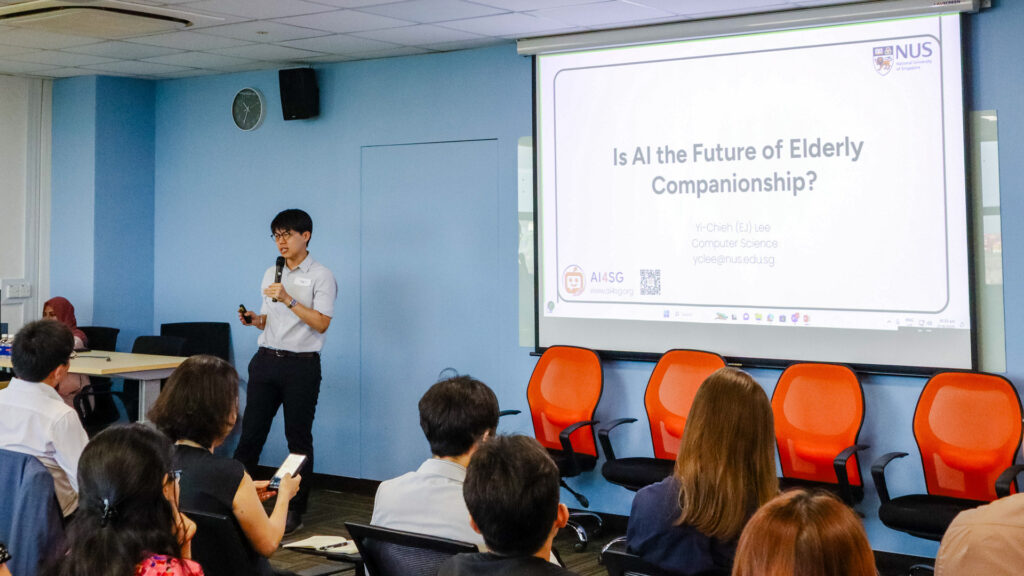
Such AI companions could even be used to improve the well-being of older adults who live alone by offering them opportunities to assist AI in tasks instead of the other way around, said Assistant Professor Yi-Chieh Lee, from the NUS Department of Computer Science. “We found that if people contribute to and ‘help’ the AI, they will increase their self-esteem and decrease their feelings of loneliness,” he said at an expert meeting held on 27 June 2025 at NUS. It was organised by NUS’ Centre for Family and Population Research (CFPR) in collaboration with Sweden’s Lund University.
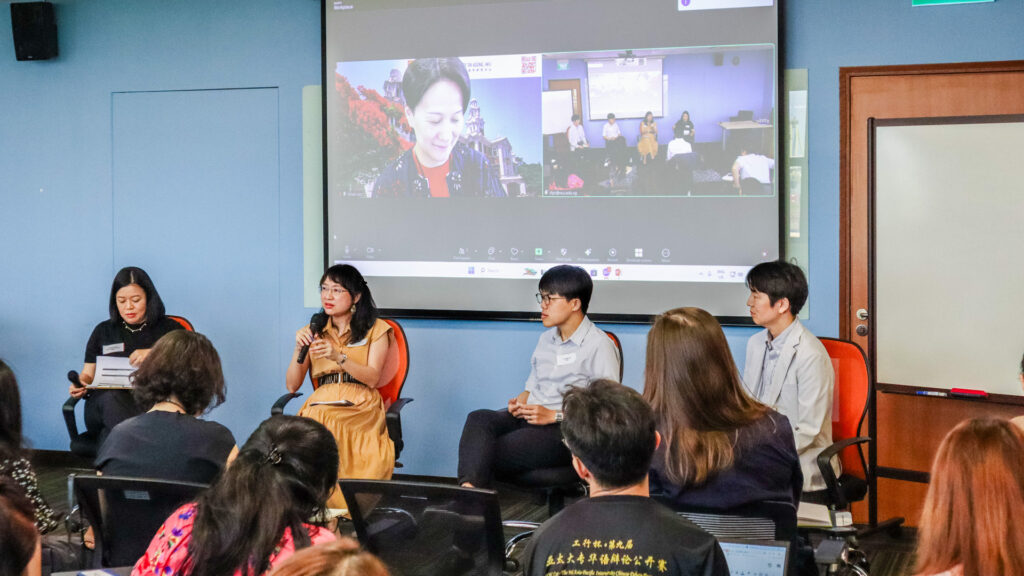
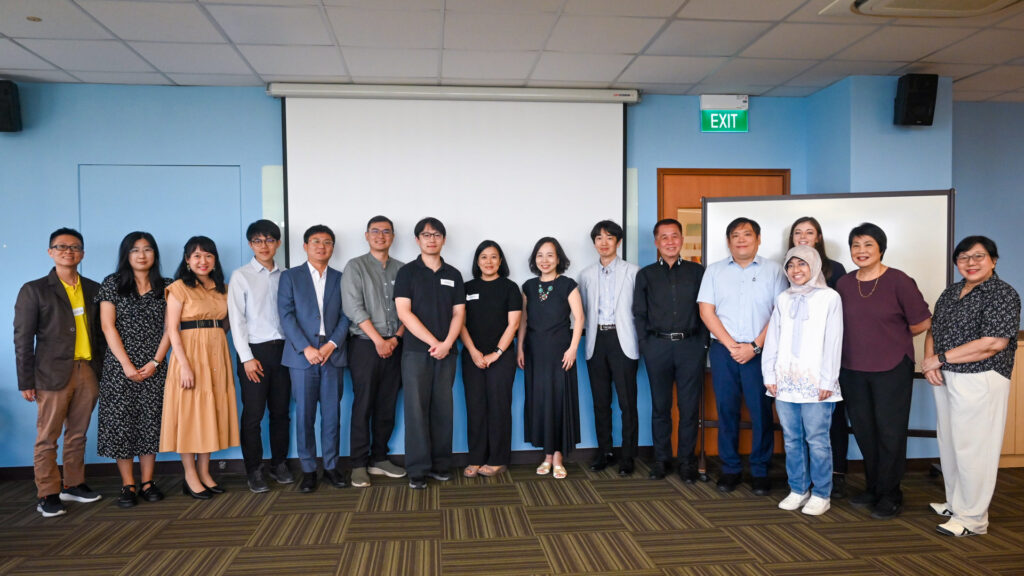
Titled “AI-Powered Care Interventions and Support Systems for Older Persons with Limited Kin Availability”, the event drew a diverse slate of academics from Australia, Hong Kong, South Korea, and beyond, who discussed how AI may help fill the caregiving gap for older persons, particularly those ageing with limited family support. While AI has potential to support more personalised and integrated care, panellists emphasised not to overlook ethical concerns.
In Asst Prof Lee’s research, study participants were asked to help an AI agent named “Chatti” develop a messaging app by providing insights. Subsequently, they were asked to respond to emotive statements measuring their self-esteem and loneliness, such as “I am satisfied with myself” or “I feel that I lack companionship”. The award-winning study found that humans helping AI contributed to a greater sense of autonomy. In this way, AI can potentially help isolated older adults reconnect with society, he said.
Tech that lends a hand
Such AI solutions will play an increasingly crucial role as family networks shrink at an alarming rate. Research projects that by 2050, an average 65-year-old woman in China will have about 30 living relatives — down from 60 in 2000. Similar declines in kin availability are expected globally.
This means that older persons in the near future may have fewer family-based resources to draw on in old age, noted NUS Associate Professor of Sociology and Anthropology Bussarawan “Puk” Teerawichitchainan, who is Co-Director of CFPR.
This issue is equally pressing in Singapore, where the total fertility rate has been persistently low, plateauing at 0.97 since 2023. “We must ask, how can emerging technologies, particularly AI-powered technology, complement family and community-based support systems?” said Assoc Prof Bussarawan, who co-organised the expert meeting with Dr Wenqian Xu, a postdoctoral fellow at Lund University.
AI can help to ease labour shortages in healthcare while making care more personalised. Associate Professor Moon Choi from the KAIST Graduate School of Science and Technology Policy in South Korea noted how AI-powered phone services like CLOVA CareCall are already conducting weekly check-ins with older adults in South Korea, which is currently experiencing a shortage of nurses.
AI is also increasingly viewed as a key enabler of future living environments designed to support ageing in place for all older adults, particularly those with limited kin ties. Dr Kentaro Watanabe from Japan’s National Institute of Advanced Industrial Science and Technology (AIST) emphasised that smart home environments must integrate both technological and social resources to adapt effectively to the evolving needs of older adults.
Looking ahead, AI could enable hyper-personalised support and care through the use of digital twins — virtual models that mirror an individual’s physical and biological traits. Professor Vivian Lou from the University of Hong Kong is working with her team to develop a digital twin based on her own skeletal and muscle data. Such projects could pave the way for support and care that is ultra-tailored to an individual’s healthcare needs.
But Professor Pei-Lee Teh of Monash University Malaysia offered a word of caution. “AI should complement, not replace a human. It may monitor our health, but it cannot hold our hand the way that our children, family, or friends can,” she said.
AI’s hidden biases
Like humans, AI is susceptible to bias. For example, it can be ageist, said Associate Professor Xin Zhang of Peking University.
Specifically, AI scores high in “benevolent ageism” – a well-meaning yet patronising attitude that assumes an older person needs help. Dr Kathryn Lynn Muyskens, a research fellow at NUS’ Centre for Biomedical Ethics, referred to it as “a form of misrecognition and a failed connection”, adding that it can contribute to the widespread issue of loneliness among older adults, rather than help to solve it.
“It’s good to have a robot that seeks engagement and offers some sort of amusement to the older person. But if we’re talking about older adults who are lonely, this isn’t an antidote,” she said. “I’ve never felt lonelier personally than when I’m in a crowded room, for example. It’s the misrecognition in society that can make you feel lonelier.”
Care infrastructure for older adults therefore needs to be centred on older adults themselves, not what others, including AI, think they need, said Assoc Prof Zhang.
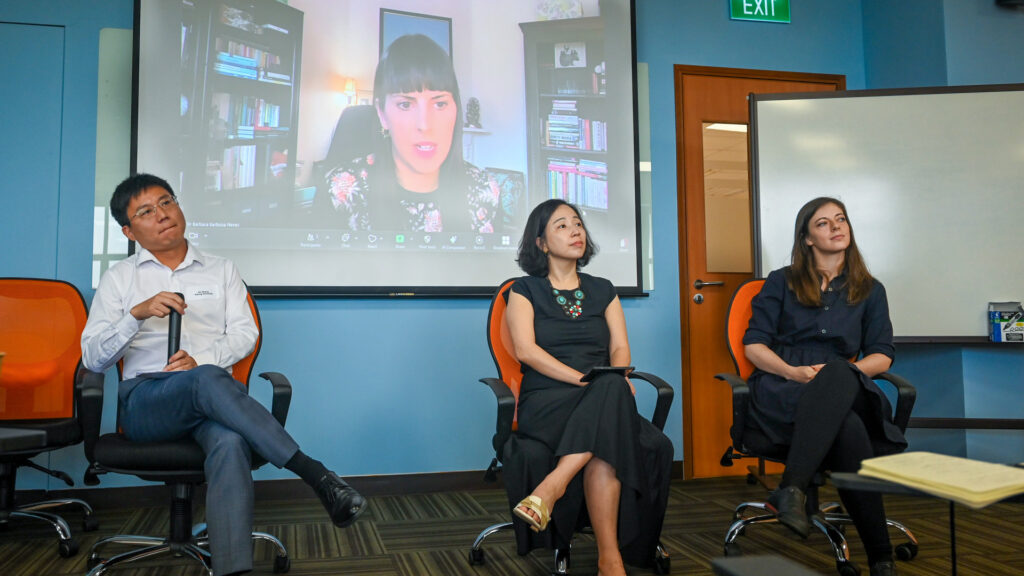
Even older adults with cognitive conditions, such as dementia, can be included in the conversation. “The idea that people living with dementia have no agency is something we need to question… in my experience, you can still engage them in co-designing technology and solutions,” said Dr Barbara Barbosa Neves from the University of Sydney.
For some attendees, the meeting sparked new awareness and hope. “(It) inspired me to talk to older adults to understand what they’re really looking out for,” said Harry Wu, a Year 2 Business undergraduate from NUS who attended the event.
“We need to hear from older adults about what they think they need,” added the 21-year-old, who is also minoring in AI.
At the end of the day, technology is a double-edged sword. “With one hand it gives, and with the other, it takes away,” said Dr Muyskens. The question is, as she put it: “Will (AI) make us more or less human?”
“This event marks just the beginning of much-needed interdisciplinary dialogues on how AI can be thoughtfully integrated into care systems,” said the expert meeting’s organiser Assoc Prof Teerawichitchainan. “Singapore and several Asian societies are facing profound family and demographic transitions, and we must explore how technology can support, not replace, human care.”
“Co-designing technologies, research and policies with older adults, caregivers, and other key stakeholders is essential,” added co-organiser Dr Xu. “That’s how we create care systems that are both innovative and inclusive.”