

International Journal of Press/Politics holds Annual Conference at NUS (20-21 Nov 2025)
November 27, 2025
The International Journal of Press/Politics (IJPP) held its eleventh annual conference at NUS’s Shaw Foundation Alumni House on 20 and 21 November. Hosted by the NUS Department of Communications and New Media, the event featured presentations from over 75 scholars from a variety of nations and disciplines, focusing on the relationship between media and politics from an international perspective. The conference was organised by the Editor-in-Chief of the IJPP and Associate Professor at NUS Communications and New Media, Taberez A. Neyazi, who is currently also a Member at the Institute for Advanced Study, Princeton.

Sabina Mihelj (Loughborough University), who studies the interaction between media, politics, and culture, in semi-democratic, authoritarian, and post-authoritarian nations in particular, delivered the keynote, ‘Trust and Disinformation in Times of Illiberalism’ at the conference’s first plenary session. She spoke about the importance of understanding political communication in our current age of normative and geopolitical instability that is marked by doubts about liberal democracy as a model of politics, society, and culture, and especially doubts in the ability of Western democracies to provide a viable and appealing model of organising our societies and political life in the future. She offered suggestions for rethinking three key concepts in political communication: the public sphere, media trust, and disinformation.
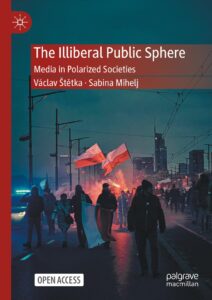
Prof Mihelj next discussed her book, The Illiberal Public Sphere: Media in polarized societies (Palgrave, 2024, with V. Štětka), which identifies the key stages in the illiberal public sphere’s development and explains what makes illiberalism distinct from related phenomena such as populism. She also talked about her Illiberal Turn research project (funded by the UK Economic and Social Research Council from 2019-22), where she served as Co-Investigator, and which was the first systematic and comparative study of news consumption and political polarization in Central and Eastern Europe.
Prof Mihelj additionally spoke about her research on the changing nature of media trust, explaining that as the illiberal public sphere advances, the scope for impartial news coverage shrinks, and news consumption becomes increasingly detached from media trust, as well as the importance of reconceptualising disinformation, looking at the role of morality in this reconceptualization, and exploring the implications of its politicisation. She then discussed her current project, (Mis)Translating Deceit: Disinformation and a Translingual, Discursive Dynamic (funded by the UK Arts and Humanities Research Council from 2023-26, Co-Investigator), which explores how practices of and ideas about disinformation evolve over time and in relation to one another, and how they change according to geopolitical setting, language, and cultural context. Prof Mihelj ended by elaborating on lessons learned regarding the benefits of qualitative research, learning both from other disciplines and from classic debates on communication, and moving from categories of practice to categories of analysis
The session was followed by panels on ‘Artificial Intelligence, News, and Public Engagement’, ‘Digital Campaigns and Political Identities: Mobilization Across Platforms and Contexts’, and ‘Soft Power in Motion: Media, Culture, and Global Political Contestations’, which featured studies on AI-powered visual propaganda in Indonesia, South Korean soft power in India, and visual character frame-building in election campaigns in Kenya and Germany, among others.
The presentations included ‘Modelling Civic Engagement in the Age of AI: A Communication Mediation Approach to AI News, Multifaceted Trust, and Participation in a Two-Wave Panel Study’ by Fanjue Liu (Shanghai Jiao Tong University), Jun Luo (University of California, Los Angeles), Lee LaPlaca (University of Florida), and Chris DeFelice (University of Florida), which employed the Orientation–Stimulus–Reasoning–Orientation–Response (OSROR) model to examine how AI news consumption across multiple platforms (television, social media, newspapers, online sites) influences civic participation through the mediating roles of interpersonal discussions and multifaceted trust.
The presentation, ‘From Distrust to Mobilization: Conspiratorial Mentality, Collective Efficacy, and Social Media Engagement in Japan’, by Akiko Matsuo (University of Tokyo) and Kazutoshi Sasahara (Institute of Science, Tokyo), analysed data from a January 2025 survey in Japan using probability-based sampling to elucidate the relationships between social media use, conspiratorial mentality, and collective efficacy to show how they interactively predict support for emerging minor parties promoting conspiratorial and xenophobic narratives, local politicians positioning themselves in sharp opposition to mainstream media, and Donald Trump.

Mehdi Ghassemi and Camila Cabral Salles’s (ISTC (Université Catholique de Lille)) presentation, ‘Authoritarian smart futures in a global mediascape: circulation, contestation, and reframing of NEOM across seven news outlets (2017-2024)’, examined how NEOM, Saudi Arabia’s flagship “smart” megaproject, travels through and is remade within a diversified global news economy; it combined critical discourse analysis with comparative framing analysis to analysis 398 news items published between 2017 and 2024 by seven outlets that span media-system types, geopolitical alignments, and linguistic communities: the Saudi state–aligned Al Arabiya, The New York Times, Le Monde, El País, O Globo, Al Jazeera, and Iran’s Kayhan.

The mid-afternoon panels titled ‘Emotion and Identity in Digital Spaces: Social Media, Discourse, and Information Practices’, ‘Media Ownership, Influence, and Newsroom Transformation’, and ‘Civic Engagement, Incivility, and Popular Politics’ featured presentations on the information processing style among mainland Chinese migrants in Hong Kong, the digital transformation of newspapers in South Korea and Japan, the celebritisation of politics in Asia, and other timely topics.

In ‘How the State Politicizes Everyday Language: A Computational Analysis of Discursive Shifts on Chinese Social Media’, Yufan Guo and Longhan Wei (Chinese University of Hong Kong) investigated linguistic politicization on Chinese social media, with a focus on the role of state-affiliated media accounts in catalysing these shifts. They employed fine-tuned, time-annotated word embeddings to trace the evolving semantic relationships of non-political words on nearly 190 million posts from 2012 to 2022 on Weibo and constructed time series data from non-political words, using fixed effects models to reveal how state media promoted their politicization levels.
The paper by Bouziane Zaid (University of Sharjah) titled ‘Structural Media Capture: Rethinking Media in the Global South’ argued that media systems in the Global South have followed a trajectory of adaptive negotiation, rather than failed liberalization, tracing the evolution of media capture across three phases: 1) the post-independence era, where media institutions were instrumentalized to serve state-building and political legitimacy, a pattern seen across the Arab region, where public broadcasters operated as extensions of state authority; 2) the subsequent wave of privatization, where direct state control was replaced by economic pressures such as advertising dependency, elite sponsorship, and foreign aid, which influenced editorial autonomy; and 3) the current platform era of infrastructural capture, where global technology platforms mediate visibility, monetization, and legitimacy.
In ‘When yelling is compelling: Who perceives and approves of uncivil discourse in politics?’, Emma van der Goot and Chiara Vargiu (University of Amsterdam) examined how citizens perceive and evaluate incivility and conflict during the 2023 Dutch election campaign, alongside their social grievances (such perceived status loss and marginalization) using data from multiple waves of that year’s election survey.
The late afternoon panels, ‘Digital Media, Public Opinion, and Journalism’, ‘Artificial Intelligence Narratives, Ethics, and Policy Challenges’, and ‘Journalism, Law, and Ethical Boundaries’ had talks on party election manifestos from Nigeria, possibilities and problems with acceptance of AI-assisted policymaking in Japan, news provision and activism of German right-wing media actors on X and Telegram, among other projects.
Mohammad Syaban (Kyoto University), in his study, ‘Media-Politics Intersections in Narrative Control: Buzzers and the Press in Indonesia’s Policymaking Landscape (2014-2024)’, explored the evolving relationship between digital actors and institutional journalism in the construction of policy narratives in Indonesia under President Joko Widodo, focusing on the intersection between news media and politics in the dissemination and contestation of controversial policy discourse, with specific reference to two key cases, the Omnibus Law on Job Creation and the legislative revision that weakened the Corruption Eradication Commission (KPK), which triggered widespread public debate and polarised responses.
Yifei Wang (UC Santa Barbara) and Zening Duan’s (University of Wisconsin-Madison) presentation, ‘Good AI, Bad AI: Examining the Moral Discourse of Generative Artificial Intelligence on X’, used Moral Foundations Theory (MFT) to analyse 4.3 million English-language tweets (January 2022-April 2023) referencing ChatGPT, OpenAI, and related terms, employing a mixed-method computational approach that combined topic modelling (LDA and BERT-based techniques) with moral lexicon analysis (Moral Foundations Vec-tionary) to identify thematic content, quantify moral framing, and measure user engagement (likes, retweets, replies). Using multilevel regression models, they assessed how specific moral foundations (e.g., care/harm, fairness/cheating) are associated with engagement and whether moral framing moderates the relationship between topics and virality.
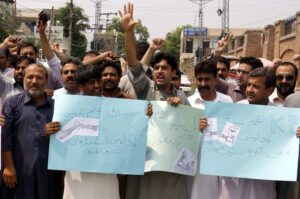
In her paper ‘Strategic Legalism and Journalistic Agency under Security Governance’, Saira Ali (Adelaide University) examined how journalists in Pakistan assert the political role of the press in a legal environment structured by national security imperatives, reframes journalistic agency as political reassertion in contexts where visibility entails legal risk and protection is uneven, and traced how journalists reclaim political space through protest and legal challenge, contesting structures designed to silence them, arguing that Pakistan’s case reveals how security frameworks are used to manage the press through ‘lawful’ means.
Thursday’s sessions concluded with an evening panel titled ‘From the Global South to the Global North: Rethinking Identity and Polarization through Political Communication Research’ featuring Profs Barbara Pfetsch (Weizenbaum Institute and Freie Universität Berlin), Natalie Pang (NUS Communications and New Media), and Tetsuro Kobayashi (Waseda University), followed by a networking dinner at the NUS Guild House.
Friday kicked off with three parallel panels: ‘Disinformation and Conspiracy Politics: Polarization in News, Elites, and Public Debate’, ‘Media Narratives, Frames and Representations of the “Other”’, and ‘Media Resilience and Resistance: Journalism, Civil Society, and State Power’, which featured presentations covering misinformation and disinformation, media framing of Papua student activism, media representation and political identity, digital dissent, repression, and authoritarianism, among other relevant topics.
‘Conspiracy Convergence? Tracing the Dynamics of Conspiracy-related Content’ by Curd Knüpfer (University of Southern Denmark), Juni Schindler (Imperial College London), Annett Heft, and Kilian Bühling (both from Weizenbaum Institute, Berlin, University of Tübingen) studied the characteristics and dynamics of conspiracy-related reporting on US-based far-right and legacy news media, focusing on content relating to the so-called “Great Replacement/White Genocide” and the “New World Order” conspiracy theories from 2011 to 2021, finding that conspiracy-related discussion grows in salience across all media types investigated.
Yossi David’s (Ben-Gurion University of the Negev) paper, ‘Stereotyping the Other in the News: A Cross-National Human Content Analysis’, used content analysis among a representative sample (N=11,865) of the news in the UK, the US, Brazil, and Israel from 2016 to 2018 to map patterns of stereotyping the other (e.g., refugees, immigrants, or nations), finding that about a third of the news items include at least one stereotype, gendered stereotypes are more common than ethnic stereotypes, and the representation of marginalized groups is largely stereotypical and negative.
In ‘Digital Repression Against Civil Society Organizations in Indonesia: Localized Dynamics and Global South Implications’, Wijayanto (Universitas Diponegoro) presented preliminary findings on the patterns and dynamics of digital repression targeting civil society organizations (CSOs) in Indonesia, based on a mixed-methods approach involving a national survey of 1,660 CSOs across 38 provinces and in-depth qualitative research on 61 case studies from 17 provinces, conducted between 2024 and 2025.
After a coffee break, attendees were treated to sessions on ‘Artificial Intelligence in Electoral Politics’, ‘Public Opinion and Journalism in Transition’, and ‘Surveillance and Resistance: Media Frames, Digital Blackouts, and Contestation’, which included papers on youth interpretation of GenAI content in Indonesian political campaigns, YouTube journalism in Morocco, and framing Somali and Darfur conflicts in Kenyan media.
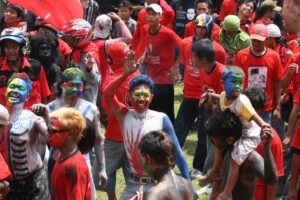
In the motivated reasoning project, ‘The Persuasion of Precision in Politics: AI Targeting Strategies in a Comparative Perspective’, Svenja Schäfer, Alice Hamilton, Puck Guldemond, Jade Vrielink, Carmen Dymanus, Annelien van Remoortere, Sanne Tamboer, Rens Vliegenthart, Susan Vermeer, and Sophie C. Boerman (Wageningen University & Research) studied the persuasive effects of AI-generated messages in online political targeting across different countries. Through an experimental design conducted during the 2024 European Elections across 16 countries with 7,632 respondents, they found that political targeting based on voters’ pre-existing political orientation (receiving messages from a party that is already favoured by the recipient), had a persuasive impact on voters, and age-based targeting or targeting using a combination of multiple categories did not. Notably, the length of EU membership conditions the effects of personality targeting, with longer membership showing stronger effects for messages tailored to a personality trait.

Aysenur Dal’s (Bilkent University, Turkey) paper, ‘Justifying Digital Oversight: Informational Learned Helplessness and Public Support for Social Media Surveillance in Conflict Settings’, examined whether individuals’ perceived inability to evaluate the accuracy of information (i.e., informational learned helplessness) contributes to greater demand for governmental surveillance of social media in the context of conflict. Utilizing original data from a 2025 survey of 1,862 adults in Turkey, she investigated the link between individuals’ informational learned helplessness and support for government surveillance of online political expression about conflict processes.
Ozan Kuru (NUS Communications and New Media) presented ‘Conditioning Public Opinion Perceptions by “Survey Methods 101”: Informing, Engaging, and Motivating Individuals for Critical Processing of Public Opinion Polls’, where he demonstrated three interventions to inform (passive literacy), inform and engage (active literacy), and inform, engage, and motivate (psychological inoculation) individuals to boost their critical processing of public opinion evidence. His study evaluated the causal effects of these interventions in a longitudinal survey-experiment in Singapore.
The first session of the afternoon showcased panels on ‘Protest and Populism in Media Narratives: Contesting Power in South and Southeast Asia’, ‘Trust, Engagement, and News Avoidance: Comparative Perspectives’, and ‘Platform Politics and Governance: Migration, Participation, and Polarized Media’, with studies on constructing Sikh identity, the politics of personal curation, and mapping polarised news ecosystems.
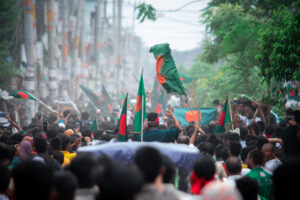
Abdul Aziz (Monash University Malaysia)’s presentation, ‘‘‘It’s not a protest anymore, it’s a (digital) war now”: Mediated visibility, affective politics and resistance during youth-led mass uprising in Bangladesh’, explored the role of digital and social media in shaping political dissent and mediated resistance during the youth-led mass uprising in Bangladesh using digital ethnography, visual analysis, and in-depth interviews with activists. Aziz examined how social media, particularly Facebook, was mobilized as a strategic arena for visibility, affective engagement, and resistance, drawing from data collected during the June 5-July 5 2024 movement, using digital and visual methods to analyse how youth-led digital activism evolves under authoritarian pressure and redefines the terms of protest and participation.
In ‘Is Europe Tuning Out? Selective News Avoidance and Low News Consumption Across 15 Countries in the European Parliament Elections’, Sanne Tamboer, Sanne Kruikemeier, Rens Vliegenthart, Alice Hamilton, Annelien van Remoortere, and Susan Vermeer (Wageningen University & Research) conducted a cross-national survey of 7,633 people in 15 EU countries before and during the 2024 European Parliament elections. They measured two types of news avoidance – selective avoidance and low news consumption – and included individual-level predictors (interest, efficacy, media perceptions) and country-level indicators (public broadcasting, media freedom, political rights).
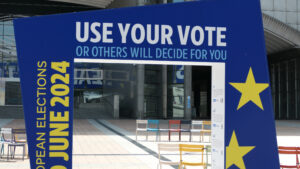
Siyu Liang, Jun Luo, and Je Hoon Chae (University of California, Los Angeles) presented ‘From TikTok to RedNote: Unpacking Digital Platform Migration’, which drew on psychological reactance theory to find that perceived threats to digital freedom are a strong predictor of migration behaviour. Their survey of approximately 1,200 regular US TikTok users revealed that those who believed the U.S. government was infringing on their online freedoms were significantly more likely to download RedNote; in contrast, individuals who perceived China as a national security threat were much less likely to engage with the platform. Moreover, the likelihood of migration increased drastically when concern over freedom outweighed concern over China.
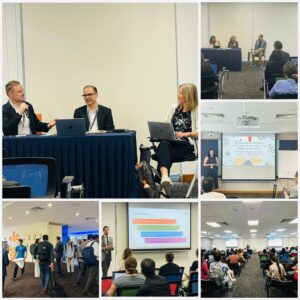 The panels were followed by a plenary session, ‘Behind the Pages: Standards, Expectations, and Editorial Insights’ by Curd Knüpfer (University of Southern Denmark) and Taberez A. Neyazi (NUS Communications and New Media).
Prof Neyazi had this to say about the event: ‘Organizing this conference was a privilege, and I was proud to witness how diverse perspectives, from senior scholars to emerging researchers, and especially voices from the Global South, shaped our conversations and opened space for new collaborations and research directions. The richness of ideas affirmed why global, inclusive spaces like this matter.’
Stay tuned for next year’s conference and upcoming issues of the IJPP! Download the conference programme here.