

Made in Shenzhen: A Global History of China’s First Special Economic Zone
November 27, 2025
Where Expert Thought Leads the Conversation
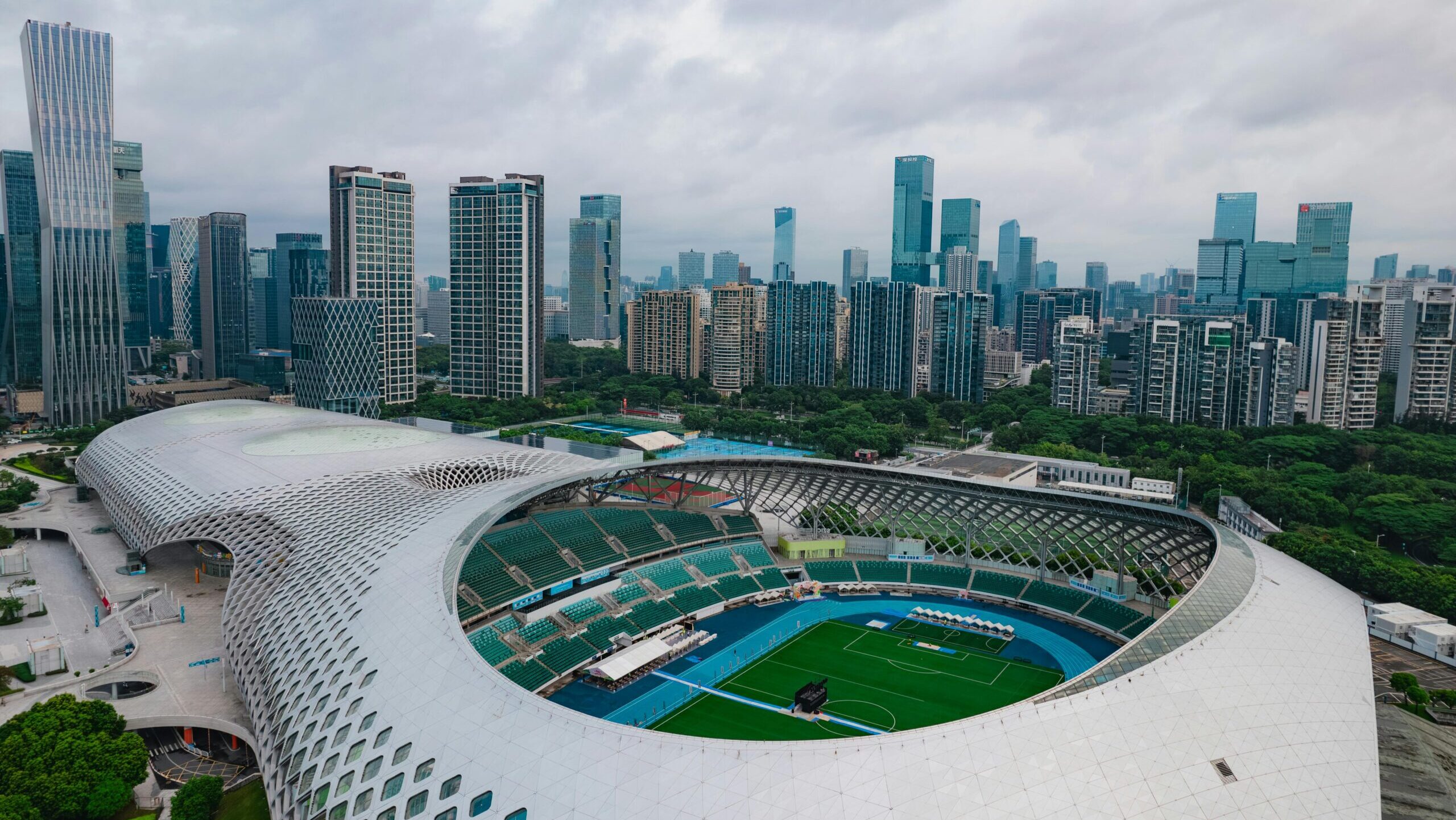
BY ASSOCIATE PROFESSOR TAOMO ZHOU
Wherever you live, you have seen things made in Shenzhen, China. T-shirts and Cabbage Patch dolls in the 1980s; TV sets and electronic watches in the 1990s; iPhones in the 2000s; the WeChat app, BYD electric cars, DJI drones, and Huawei cellular phones and 5G networks of today. This southern Chinese city has created an adaptive, evolving economic institution that has enabled the global circulation of locally produced commodities and technologies, empowered rapid urban expansion, propelled China’s transformation, and significantly influenced the development of the world economy in the past four decades.
My current book project, tentatively titled Made in Shenzhen: A Global History of China’s First Special Economic Zone (Stanford University Press, forthcoming), tells that story.
Located immediately north of Hong Kong, Shenzhen is China’s first and most successful special economic zone (SEZ). Commonly known as the “social laboratory” of reform and opening, Shenzhen was the foremost frontier for the People’s Republic of China’s (PRC) adoption of market principles and its entrance into the world economy in the late 1970s. Acclaimed as the “Silicon Valley of the East,” Shenzhen has produced some of China’s most dynamic and internationally competitive technology firms in the past two decades.
The official account of Shenzhen’s growth centres on how political decisions by top leaders in Beijing decisively transformed an impoverished border town into a modern metropolis. Made in Shenzhen tells a more complex and more human story. It looks at the city’s development from the ground up, connecting the lives of ordinary migrants to global shifts in the world economy—especially the neoliberal turn of the 1970s and the rise of export-driven “Asian Tiger” economies.
After World War II, many countries experimented with enclaves that operated under different rules—zones with lower taxes and looser labour laws. These exceptional economic spaces took the form of free ports, free economic zones, and free trade zones, where preferential treatment was given to overseas investors and manufacturers. From Puerto Rico to Mauritius, the number of zones has grown exponentially since the 1970s. The Reagan-Thatcher revolution of de-regulation and privatisation drove Western corporations to the developing world in search of lower labour costs and less onerous tax burdens. Across Southeast Asia, Indonesian, Malaysian, and Singaporean governments deploy similar developmental strategies to industrialise quickly and compete in global markets.
China’s leaders adopted this idea in their own way. Shenzhen became an experimental zone where market-oriented policies were tested before they were introduced into the core of the planned economy. During the Mao era (1949–1976), Bao’an County—the geographic equivalent of Shenzhen today—was a poor and volatile frontier area known as a gateway for illegal migration. From 1951 to 1980, at least one million undocumented immigrants fled mainland China to Hong Kong via Bao’an. Yet Shenzhen’s marginal position during the Mao era, as well as its proximity to Hong Kong and historical access to overseas Chinese communities, made it an ideal pilot site for market reform.
Human mobility lies at the heart of Shenzhen’s transformation. Shenzhen has witnessed one of the largest internal migration movements in the twentieth-century world. Long before it became an SEZ, Bao’an and neighboring Hong Kong were hubs of maritime trade and overseas migration. In the late nineteenth century, Bao’an residents moved to Hong Kong and from there to Southeast Asia, the Americas, and beyond. By 1980, half of Shenzhen’s population had relatives living in Hong Kong and 36 other countries. These family and business networks brought in foreign investment and management know-how.
At the same time, Shenzhen’s proximity to Hong Kong and distance from Beijing attracted ambitious, market-minded migrants from all over China—especially after the Tiananmen Square incident of 1989. Shenzhen’s extensive migrant connections at home and abroad attracted labor, capital, talents, technologies, and social networks, contributing to the city’s success in forging a business environment that encouraged experiments and entrepreneurship.
The story of Shenzhen is central to modern Chinese history and crucial to our understanding of the contemporary world economy. Without Shenzhen, China would not be the China we know today. Without the manufacturers, consumers, investors, and innovators China has brought to global markets, the world would be a different place.
Associate Professor Taomo Zhou (NUS Chinese Studies, and also Dean’s Chair at the NUS Faculty of Arts and Social Sciences) is a historian of modern China and Southeast Asia, and her current research focuses on migration, technology, and the international political economy.