

NUS: Reprogrammed for Tomorrow
January 12, 2026
Among the courses on governments and Singapore politics that first-year political science student Tan Yong is taking, one involved trooping down to the headquarters of superapp Grab to observe how operations staff are using AI algorithms. The brand-new course Machines that Learn is being offered to the pioneer cohort of 220 residents at Acacia College, Singapore’s first AI-focused university residential college.
“It was eye-opening because seeing AI at work helped me contextualise its capabilities,” said Tan Yong, 21, who chose Acacia College because he wanted to stay on top of AI developments. “I saw how AI was used to produce reviews for the businesses that were subscribed to Grab’s services.”
First-year law student and fellow resident Choo Hao Wen, 21, who joined the 18-student trip, added, “The Large Language Models (LLMs) that they used relate to words, syntax and language—and they are pertinent to law. It’s good to be wary of what AI has in store for us.”
AI has already changed and will continue to change the world. Singaporeans seem particularly partial to the technology: recent data from OpenAI showed that the country has the highest per capita ChatGPT usage globally — one in four people use it weekly.
Within higher education, AI has had an outsized impact. The turning point occurred when AI chatbot ChatGPT, the first of its kind, became publicly available in November 2022. A New York magazine article stated, “ChatGPT has unravelled the entire academic project”, quoting a study suggesting that just two months after its launch, 90 percent of US college students were using ChatGPT to help with assignments.
Vacillating between fears of student cheating and the potential AI offers, universities worldwide responded either by banning AI altogether, embracing it entirely, or taking a middle path. NUS, as a university that prizes innovation, had explored AI much earlier. The NUS Artificial Intelligence Laboratory was started in 2019. In the opinion of Professor Simon Chesterman — the NUS Vice Provost (Educational Innovation) and Senior Director of AI Governance at AI Singapore — the best thing NUS has done when it comes to AI has always been “to encourage experimentation”.
What the launch of ChatGPT did was to accelerate, deepen and consolidate the University’s efforts to harness AI in the most effective and responsible way possible.
Said NUS President Professor Tan Eng Chye: “NUS is mounting a robust and comprehensive approach to AI that spans our core mission areas of education, research and innovation, and administration. NUS will empower and uplift the whole organisation to fully leverage AI in all that we do.” The goal? Prof Tan replied, “To set NUS up to be a leading institution at the forefront of AI.”
An AI Research Powerhouse
A major milestone was in the setting up of the NUS AI Institute (NAII) in March 2024, which brought all of NUS’ existing AI research initiatives and talent under one roof. Comprising 29 Leads and over 200 faculty members, their three focus research areas are: foundational AI research, policy and societal implications of AI, and real-world applications across various domains. NAII also launched the NAII Seed Grant Call, which will disburse up to S$3.2 million per year to high-potential AI projects in NUS.
NUS has taken its AI research capabilities a step further by recruiting and nurturing world-class AI research talents. Over the past two years, NUS has recruited 27 new AI faculty, some of whom are of international renown. Another 53 new hires are contributing to advancing AI in their disciplines or incorporating AI tools to propel their research.
To amplify the research and bring it closer to the real world, NUS is also working with industry partners and global tech superpowers like Microsoft Research Asia, Google, IBM and Nvidia. In its collaboration with Google, both partners will establish a joint research and innovation centre to accelerate applied AI research and nurture skilled AI practitioners.
The Breadth of AI in NUS Education
In the classrooms, because of AI, students at NUS today have markedly different choices and experiences compared to their seniors just a few years ago. In terms of content, there are many more AI-centric courses, including those that layer an AI element on top of existing disciplines, or what is called “X + AI”.
Among the more than 175 AI-themed courses now offered at NUS, over 70 of these are outside the School of Computing — in Business, Engineering, Sciences, Humanities and Social Sciences. These X + AI courses include topics like analysing AI-generated fake news (Communications, New Media and Society), facilitating Socratic dialogue (Introduction to Psychology) and critiquing AI-composed music (Social and Cultural Studies through Music).
To develop deep AI expertise, at least four Bachelor’s and Master’s degree programmes were launched this year, including the Bachelor of Computing in AI, Master of Computing in AI and the Bachelor of Engineering in Robotics and Machine Intelligence. As for alumni, the NUS School of Continuing and Lifelong Education (SCALE) offers a plethora of short courses and certifications for AI and machine-learning in areas like predictive analytics, generative AI and AI for Talent Management and Organisational Design.
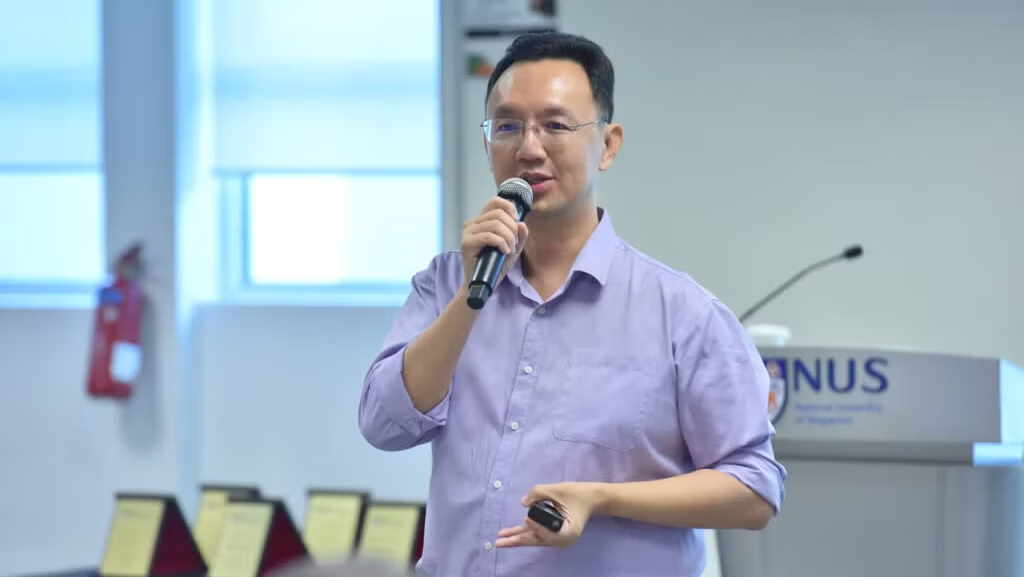
In terms of the educational experience, students who are very much digital natives are now using AI in their take-home assignments to summarise readings or lecture notes, craft essays and solve problems. They simply have to fill in a declaration form listing which AI tools were used. Associate Professor Ben Leong, Director at the AI Centre for Educational Technologies (AICET), said tongue-in-cheek at a recent talk, “We surrender. Ninety percent of our students are probably using AI.”
In class, faculty are using AI to teach better. In a 2024 survey of faculty, it was found that about 23 percent of NUS’ undergraduate and post-graduate courses utilised some aspect of AI. One of the best examples of this is using AI chatbots to role-play with students. For instance, within social work, if students needed to practise counselling in the past, an actor would be hired to work with one student while the rest would observe. But now, every student gets to practise individually with a bot. They engage in dialogue with ‘patients’ from diverse profiles and backgrounds, and the chatbot even describes behaviour — for instance, if the patient looks away or is mildly irritated. After a session is complete, the student gets personalised feedback, both from the bot and an instructor who can view the transcript of the exchange.
Time-starved faculty are not doing this alone. NUS is strategically bringing the best ideas together, sharing these AI tools across NUS and providing support when needed. In 2024, the Centre for Teaching, Learning and Technology (CTLT) was formed by the merger of the Centre for Development of Teaching and Learning (CDTL) and the Centre for Instructional Technology (CIT) to run workshops, courses and consultations on how to use technology to create more personalised or engaging learning experiences. Recently, CTLT collaborated with the NUS Teaching Academy (NUSTA) to develop a proficiency roadmap for AI in education.
Then there is AICET, which has a team of consultants who work with NUS faculty to leverage AI and technology in their teaching through fast experimentation and prototyping of new ideas. AICET’s successes include grading tools that provide accurate, personalised feedback for short-answer quizzes, and chatbots that help nursing students with their research projects or train dental students in radiographic interpretation.
Many of the tools that have proved particularly useful are those involving role-play, where ironically AI enables students to hone human skills by simulating client interviews for social work or mock trials for law students. Said Assoc Prof Leong, “As we move into an AI-driven future, human skills will become increasingly important. We are now taking advantage of advances in AI to teach these practical human skills.”
Safeguarding Focus and Original Thought
But even as educators use AI to achieve better learning outcomes, they are well aware that if students overuse or misuse it, AI can dull thinking ability—an outcome worse than technology merely taking away the need to memorise telephone numbers or read maps.
Prof Chesterman — who likened the desire to resort to AI as the more pleasant choice, akin to choosing to eat ice-cream over broccoli — emphasised this several times in his interview: “If you can’t even form an opinion without asking ChatGPT, then it becomes a big problem.”
According to an MIT study released in June 2025, ChatGPT may be eroding critical thinking skills. In the study of 54 people who were tasked to write an essay, those who used ChatGPT had the lowest brain engagement and “consistently underperformed at neural, linguistic and behavioural levels”, compared to those who wrote without any help, or used Google search.
Likewise, Assoc Prof Leong talked about the “AI Chasm of Death”: students who can only get things done with the help of AI will end up becoming stuck on one side of the chasm; they will only be able to cross over through sheer hard work, knowledge acquisition and critical thinking. “As educators, our job is to help them cross that chasm, by motivating them to put in the effort to think and learn,” he said. “It’s like exercising in the gym. It’s hard work, but you need to do it to grow in strength. Our job is still to get them to exercise those mental muscles.” He added, “The future of education is really one where we, instead of focusing only on teaching students to do things right, we place more emphasis on getting them to learn to do the right things.”
Like eating broccoli or putting in the extra work to exercise, students must be taught to make learning choices that are possibly less pleasant but necessary and good for them—to focus and think without AI.
Nurturing AI-proof Qualities
With naysayers wondering if universities are still relevant in the age of AI, or if AI will one day surpass humans, NUS is cognisant of the need to produce graduates who are not only AI-literate and AI-fluent, but have the qualities that AI cannot replicate. There is a greater emphasis on equipping graduates with higher-level skills like judgement, adaptability and ethical reasoning.
“Instructors deliberately raise the bar by designing tasks that go beyond what AI can produce,” said Associate Professor Melvin Yap (Arts & Social Sciences ’99), who serves as Associate Provost (Education & Technology), Head of CTLT, and faculty member in the Department of Psychology at the Faculty of Arts & Social Sciences (FASS).“These tasks require interpretation, critique and justification, where students question assumptions, evaluate evidence and construct their own reasoning.”
He added that true AI-free thinking ability can still be assessed through in-person, supervised exams, as well as oral presentations, portfolios and lab performances. He said, “These formats demand originality and on-your-feet reasoning, making clear that learning outcomes cannot be outsourced to technology.”
Learning how to adapt, work in a team and get along are human qualities that manifest outside of the classroom and this is where NUSOne — an approach designed to encourage students to participate in out-of-classroom activities for a well-rounded student life — comes in.

Then there are human skills. In a paper titled “Will AI make EQ more important than IQ?” by Prof Chesterman and Associate Professor Loy Hui Chieh, who is from the Department of Philosophy at FASS, they questioned whether universities should switch from educating the mind to educating the heart. “There is emerging literature about the feeling economy, which is the idea that your value is not just your brain but your heart—in your ability to persuade and engage people to do all sorts of things that, for the moment at least, AI can’t do,” said Prof Chesterman. “We must be more intentional about cultivating what it is that makes us truly human.”
What all this translates to are NUS graduates who are not only AI-literate and AI-fluent, but who are inherently employable.
Said Assoc Prof Yap, “AI is integrated thoughtfully to amplify humanistic values such as judgment, creativity, and ethical leadership, while embedding critical engagement with AI across disciplines. This approach ensures graduates are capable of questioning assumptions, critiquing outputs, and making decisions with integrity. This approach prepares graduates not only to use AI effectively but also to lead with adaptability, discernment, and integrity in a world where technology continues to evolve.”
This story first appeared in AlumNUS on 1 January 2026.