

Students examine what makes a liveable city at 30th NUS Geography Challenge
March 29, 2026
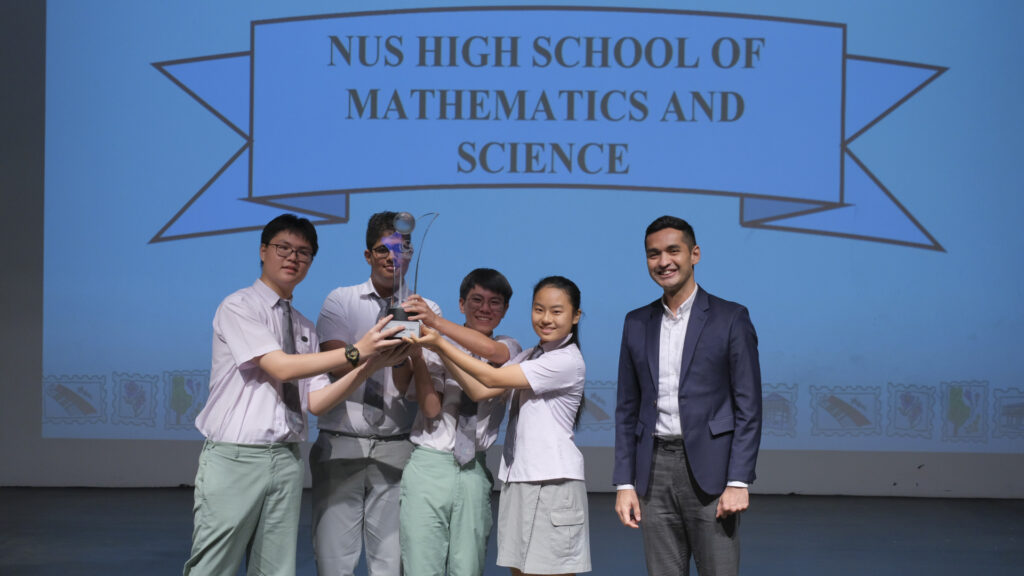
Students from the NUS High School of Mathematics and Science yesterday emerged champions of the 30th NUS Geography Challenge, a national competition organised by the Department of Geography at the National University of Singapore (NUS).
The milestone edition brought together close to 500 students from over 120 secondary schools across Singapore – the largest participation to date – to examine this year’s theme, “City For Tomorrow: Shaping Our Liveable Future.”
The theme challenged students to think about how cities like Singapore can remain liveable while balancing competing priorities such as housing, infrastructure, green spaces and environmental sustainability.
In the Grand Finals, the top five teams competed across three rounds: A Judges Round, “GeoPardy” quiz segment (Jeopardy-style quiz), and a fast-paced Speed Round. Teams were tested not only on their geographical knowledge, but also their ability to analyse urban liveability challenges and communicate their ideas effectively.
“What stood out amongst the top teams in the 30th NUS Geography Challenge was the calibre of teamwork and presentation skills,” said Professor Tim Bunnell from the NUS Department of Geography and finals judge. “Geography provides students not only with applied and analytical skills for planning and policy but also with a human-level appreciation of lived, social environments.”
He noted that the finalists showed a strong understanding of complex urban planning challenges, and a clear grasp of how Singapore’s Master Plan and Green Plan shape sustainability, green spaces, and community policies in developing a liveable city. “It was enlightening to see how they combined analytical thinking, field observations, and creative ideas, engaging with urban liveability challenges through fresh perspectives.”
Field investigations across Singapore
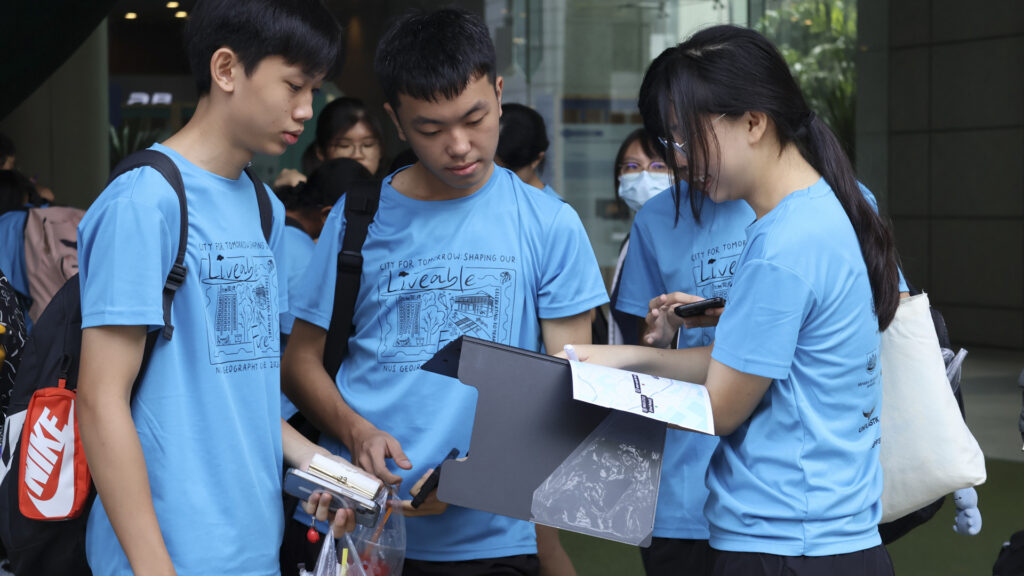
During the Geo-Trail semi-finals held earlier during the day yesterday, participants carried out field-based investigations at seven checkpoints across downtown and suburban Singapore, including one-north Park, Enabling Village by SG Enable, Toa Payoh Central, Smith Street in Chinatown, and grovve, Singapore’s first integrated youth-focused wellness centre. Each site was strategically selected to showcase different aspects of city planning, from environmental sustainability and green spaces to accessibility and social inclusivity.
At each location, students made on-site observations and discussed how cities can be designed not just for efficiency, but for inclusivity, sustainability, and well-being. They also considered how, beyond physical infrastructure, different communities experience shared urban spaces, and how cities can balance competing priorities such as housing, recreation, heritage preservation, and environmental protection.
Ms Ong Lay Kheng from Tanjong Katong Girls’ School, which participated in this year’s competition, is appreciative that students get to explore different parts of Singapore in the Geo-Trail.
“Rather than studying concepts abstractly, students examine actual urban infrastructure and develop innovative solutions, transforming them from passive learners into active problem-solvers,” said Ms Ong who teaches geography at the school.
Nurturing future geography talent
Mr Vijay Liew, Group Director (Corporate Development) (Designate) of Urban Redevelopment Authority, one of the competition’s partners, said competitions like the NUS Geography Challenge help nurture students’ interest in cities and urban planning, and grow awareness on how planners balance challenges such as climate resilience and competing land uses to shape Singapore’s future.
“Such programmes encourage our youths to think critically and creatively about Singapore’s urban challenges, and do their part to make our city even more liveable.”
Beyond the competition, students who show strong aptitude may be invited to the Geography Talent Development Programme organised by the Ministry of Education (MOE), which prepares students to represent Singapore at the International Geography Olympiad.
Ms Leah Aw, MOE’s Director of Humanities, Curriculum Planning and Development Division (CPDD) said that the NUS Geography Challenge is an important platform for discovering and nurturing Singapore’s future geography talent, as it connects classroom learning with vital contemporary issues like urban sustainability and environmental stewardship, making learning more dynamic and empowering.
“MOE’s Talent Development Programme then helps the most promising students deepen their expertise, with an opportunity to represent Singapore at the International Geography Olympiad,” said Ms Aw.
Singapore has performed strongly in the international competition, including placing first in 2022 among teams from 54 countries.
Organisers hope the competition will continue to inspire young people to develop a deeper interest in geography and the complex challenges shaping cities and environments around the world.
This story first appeared in NUSnews on 29 March 2026.