



Psychology
The NUS psychology programme was first introduced during the 1986-87 academic year and is the oldest psychology programme in Singapore.
NUS offers a full undergraduate programme, including an honours course, as well as Masters and Ph.D. programmes. Since its inception, the psychology programme has attracted a strong response from students in the Faculty of Arts and Social Sciences. Psychology contributes to society by providing behavioural scientists who are equipped with the skills to use empirical research methods to seek an account of human behaviour and experience. It has been only a little over a hundred years that psychology has been a discipline in its own right.
News
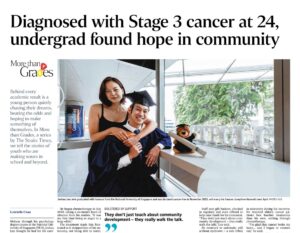
Diagnosed with Stage 3 cancer at 24, undergrad found hope in community
Read about NUS Psychology graduate Joshua Lee’s journey of resilience, community support and hope as he overcame cancer and graduated with honours from NUS FASS.
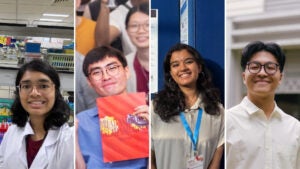
Asking the big questions: Meet the five NUS undergraduate researchers behind tomorrow’s discoveries
Going beyond what is taught in classrooms and textbooks, these students from the NUS Class of 2026 have led inquiries of their own — pushing disciplinary boundaries and exploring new frontiers of knowledge.

NUS research reveals how parenting styles influence children’s honesty
What if punishing a child for lying makes them more likely to hide the truth next time? Parents often turn to strict discipline because they want to teach children right from wrong. However, new research from the NUS Department of Psychology suggests that harsh or overly controlling parenting may have the opposite effect. Rather than […]

The link between hours of centre-based childcare and child development in 3- to 6-year-olds: Evidence from Singapore
Marked by long working hours and high academic expectations, Singapore’s competitive culture has heavily influenced the early childhood education (ECE) landscape. With ECE centres operating long hours to support working parents, the structured curriculum prioritises academic preparation, distinguishing it from models in countries that focus on holistic child development. This raises important questions about the […]

NUS research reveals how parenting styles influence children’s honesty
Drawing on two long-term studies of Singaporean families, researchers from NUS Psychology found that ‘authoritarian parenting’ and ‘harsh punishments’ were associated with greater dishonesty in children across early and middle childhood.
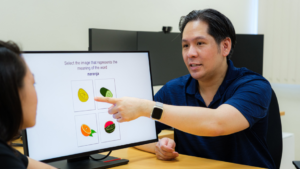
NUS study confirms that guessing before learning improves memory in language learning
A simple habit many learners try to avoid, guessing, may actually be the key to learning languages more effectively. In ‘Duolingo-inspired pretesting with words and pictures improves vocabulary learning’ (Cognitive Research: Principles and Implications, 2026), Assistant Professor Steven Pan and Ms Tabitha Chua (both NUS Psychology) have found that attempting an answer before knowing it, […]

NUS study confirms that guessing before learning improves memory in language learning
The study is one of the first to test the science behind the word-picture “pre-testing” exercises used in popular language-learning applications

The influence of socio-economic status on child temperament and psychological symptom profiles
Socio-economic status (SES) is a well-established determinant of individual outcomes, with inequalities potentially shaping child development in areas such as cognitive abilities, educational performance, and the exhibition of emotional and behavioural challenges. This is particularly pertinent in Singapore, a highly affluent nation with significant income inequality, ranking 27th out of 172 countries on the Gini […]
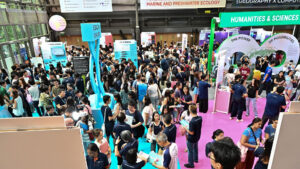
NUS Open House 2026: From the future of learning to the pulse of student life
Prospective students turned out in force for the NUS Open House 2026, one of the University’s largest events of the year, with some 21,500 visitors packing University Town on 7 March for a first-hand look at the University’s distinctive academic programmes and its vibrant campus community.
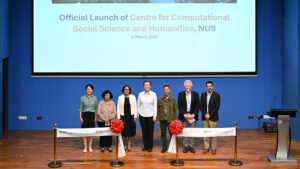
New Centre for Computational Social Science and Humanities at NUS to advance interdisciplinary research on complex societal challenges
By combining technological innovation with human insight, the Centre for Computational Social Science and Humanities (CSSH) aims to generate research that improves lives, strengthens institutions, preserves cultural knowledge, and shapes more inclusive and resilient societies in Singapore and beyond.