




Psychology
The NUS psychology programme was first introduced during the 1986-87 academic year and is the oldest psychology programme in Singapore.
NUS offers a full undergraduate programme, including an honours course, as well as Masters and Ph.D. programmes. Since its inception, the psychology programme has attracted a strong response from students in the Faculty of Arts and Social Sciences. Psychology contributes to society by providing behavioural scientists who are equipped with the skills to use empirical research methods to seek an account of human behaviour and experience. It has been only a little over a hundred years that psychology has been a discipline in its own right.
News
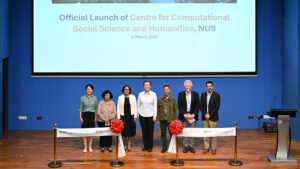
New Centre for Computational Social Science and Humanities at NUS to advance interdisciplinary research on complex societal challenges
By combining technological innovation with human insight, the Centre for Computational Social Science and Humanities (CSSH) aims to generate research that improves lives, strengthens institutions, preserves cultural knowledge, and shapes more inclusive and resilient societies in Singapore and beyond.

When Objective Ambivalence Predicts Subjective Ambivalence: An Affect–Cognition Matching Perspective
Have you ever experienced mixed feelings? Objective ambivalence occurs when someone holds both positive and negative evaluations toward the same object. It is typically measured by averaging separate unipolar scales for positive (“P”) and negative (“N”) reactions. The degree of ambivalence is then calculated using the Thompson et al. (1995) formula: [(P+N)/2 – (P-N)], with higher […]

NUS: Reprogrammed for Tomorrow
In just three years since the launch of ChatGPT, NUS has launched ambitious programmes to nurture AI-fluent students and use AI effectively in teaching, research and corporate functions.
Beyond medicine: Health District @ Queenstown and experts explore vital themes shaping Asian healthy longevity
Organised by the West Pacific Rim Consortium and hosted by the Health District @ Queenstown (HD@QT), the West Pacific Rim Consortium for Healthy Ageing Symposium 2025 brought together close to 30 policymakers, healthcare practitioners, researchers, and community leaders from leading institutions in Asia to share regionally grounded approaches to ageing well.

Parental warmth moderates the relation between children’s lying and theory-of-mind
Children learn to lie from about the age of two, typically to conceal their wrongdoings. Lying is considered a milestone for children’s social and cognitive development. To tell a successful lie, they have to infer and reason about the lie-recipient’s mental state, and realise that other people may believe things that are wrong. This skill […]

The moderating role of trajectories of family hardiness in the relationship between trajectories of economic hardship and mental health of mothers and children
On 20th November 2024, the ComLink+ scheme celebrates its one-year anniversary, having provided support to about 14,000 families across areas such as pre-school education, employment, and home ownership. Minister for Social and Family Development Masagos Zulkifli described the scheme as a significant step towards enhancing resilience and promoting social mobility in Singapore, particularly for low-income […]
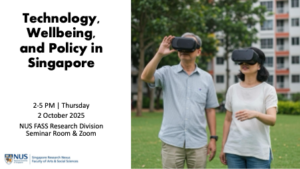
Watch the Recording: Technology, Wellbeing, and Policy in Singapore (2 Oct 2025)
Missed the live event? You can now watch the recording of our outreach event on Technology, Wellbeing, and Policy in Singapore, which brought together researchers from NUS Psychology and NUS Social Work to explore how technology shapes mental health and wellbeing in Singapore today. The four presentations discuss digital harms, AI, and the promise and […]

Chatbots could be first responder for mental health issues, but with limits
By D Nur Hani Zainal, Presidential Young Professor in Clinical Psychology at NUS Psychology, and Director of the Optimising Wellness Lab.

Validating the biosocial model of borderline personality disorder: Findings from a longitudinal study
We celebrate World Mental Health Day every 10 October, raising awareness about mental health education and advocacy against social stigma in Singapore and beyond. ‘Validating the Biosocial Model of Borderline Personality Disorder: Findings from a Longitudinal Study’ (Development and Psychopathology, 2023) by Dr. Stephanie S. M. Lee and Associate Professor Ryan Y. Hong (both from NUS […]
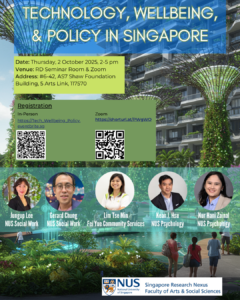
𝗘𝗩𝗘𝗡𝗧 | 𝗧𝗲𝗰𝗵𝗻𝗼𝗹𝗼𝗴𝘆, 𝗪𝗲𝗹𝗹𝗯𝗲𝗶𝗻𝗴, 𝗮𝗻𝗱 𝗣𝗼𝗹𝗶𝗰𝘆 𝗶𝗻 𝗦𝗶𝗻𝗴𝗮𝗽𝗼𝗿𝗲 | 𝟮 𝗢𝗰𝘁, 𝟮-𝟱 𝗽𝗺
𝗘𝗩𝗘𝗡𝗧 | 𝗧𝗲𝗰𝗵𝗻𝗼𝗹𝗼𝗴𝘆, 𝗪𝗲𝗹𝗹𝗯𝗲𝗶𝗻𝗴, 𝗮𝗻𝗱 𝗣𝗼𝗹𝗶𝗰𝘆 𝗶𝗻 𝗦𝗶𝗻𝗴𝗮𝗽𝗼𝗿𝗲 | 𝟮 𝗢𝗰𝘁, 𝟮-𝟱 𝗽𝗺 The Singapore Research Nexus is holding ‘Technology, Wellbeing, and Policy in Singapore’, an event featuring four presentations: 1. ‘𝗧𝗲𝗰𝗵𝗻𝗼𝗹𝗼𝗴𝘆-𝗥𝗲𝗹𝗮𝘁𝗲𝗱 𝗛𝗮𝗿𝗺𝘀 𝗮𝗻𝗱 𝗬𝗼𝘂𝘁𝗵 𝗠𝗲𝗻𝘁𝗮𝗹 𝗛𝗲𝗮𝗹𝘁𝗵’ by Dr Jungup LEE, Associate Professor, NUS Social Work 2. ‘𝗖𝗼𝗿𝗲 𝗖𝗼𝗺𝗽𝗼𝗻𝗲𝗻𝘁𝘀 𝗼𝗳 𝗘𝗳𝗳𝗲𝗰𝘁𝗶𝘃𝗲 𝗧𝗲𝘅𝘁-𝗯𝗮𝘀𝗲𝗱 […]