

Revitalising youths and textiles: The story of Repurposed
August 14, 2025
Matthew Tan, a student at the NUS Faculty of Arts and Social Sciences (FASS), and FASS alumna Desiree Chang launched Woofie’s Warehouse in 2021 based on a hybrid concept that blends thrift and vintage by selling second-hand clothing primarily sourced from Japan.
Purchasing the merchandise in bulk often meant that about 5 to 10 per cent of the clothing was unfit for sale due to being in poor condition or heavily damaged. Faced with unsold inventory and Singapore’s dismal textile recycling rate of just 2 per cent in 2023, the environmentally-conscious pair decided to act. Their solution? Repurposed – a bold initiative that transforms unsellable garments into stylish upcycled pieces, while empowering youths to explore their passion for design and fashion.
Repurposed – An idea borne at the FASS Social Entrepreneurship Incubator Pitch Competition
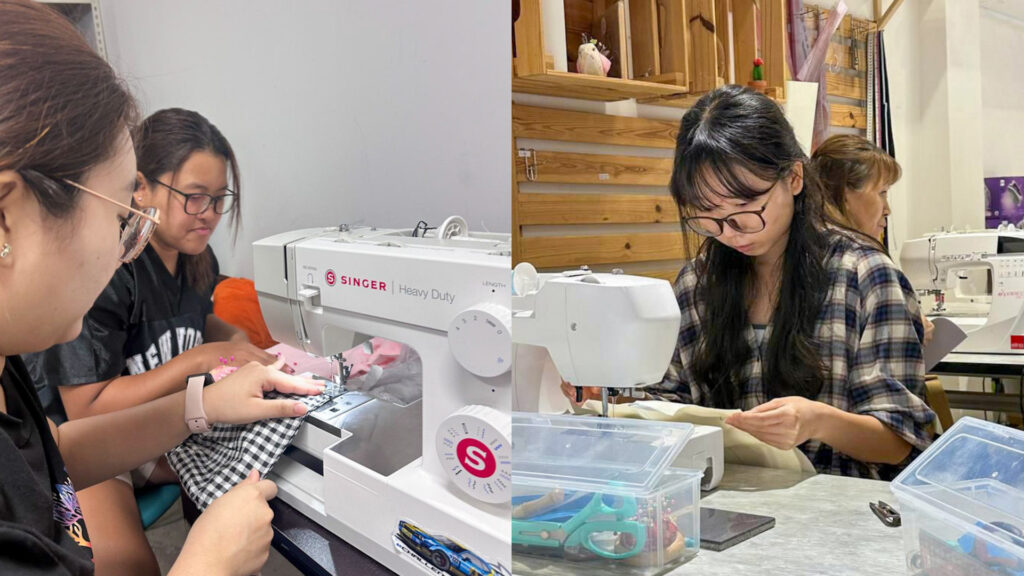
Repurposed, an initiative that was launched in April, offers young people passionate about sustainable fashion and entrepreneurship hands-on training in sewing, embroidery, and textile reworking. Participants have the opportunity to upcycle Woofie’s unsold merchandise into their own clothing lines, which are then sold in stores. Alongside practical skills, they receive mentorship on the ins and outs of running a thrift business, equipping them with the knowledge to turn their creativity into entrepreneurial ventures.
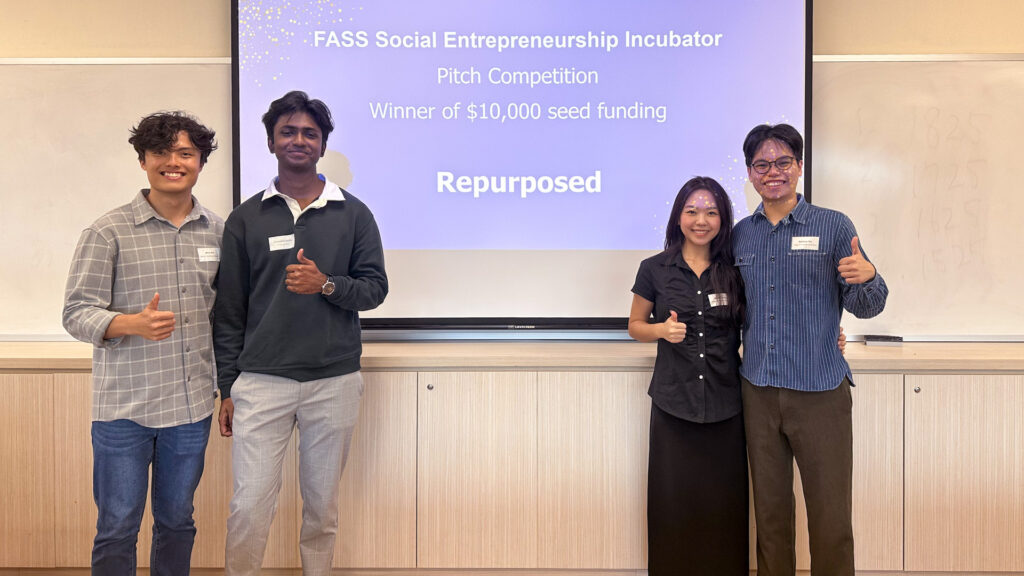
The idea emerged after Matthew and Desiree banded with like-minded entrepreneurial friends, NUS Faculty of Science students Avaneesh Reddy and Novin Sim, to participate in the FASS Social Entrepreneurship Incubator (SEI) Pitch Competition at the end of last year.
Matthew, a third-year History student, shared how the team initially approached the competition with a broader idea to address Singapore’s textile waste problem, but the judges offered valuable guidance to help refine their pitch.
He recounted, “They advised that given the scale of the textile waste problem in Singapore, it would be more practical to focus on addressing the issue within a specific social group and in the process, create meaningful impact.” Because of this, the team decided to tap into Woofie’s unsold inventory and target their efforts on youths passionate about sustainability but who may not have access to creative reworking opportunities, entrepreneurial exposure or confidence-building platforms.
In addition to teaching youths how to upcycle textiles, the team will aim to leverage Novin’s background in life sciences to explore sustainable dyeing techniques using natural ingredients like coffee grounds for Repurposed. This will add another layer of innovation and eco-consciousness to their initiative. “We’re not just empowering youths to rework clothes,” Novin explained, “We’re equipping them with the skills to think creatively and to innovate.”
The team’s vision eventually earned them first prize in the competition – S$10,000 in seed funding to invest in the training workshops and equipment needed, as well as a one-year mentorship experience with the SEI steering committee to carry out the business idea.
Repurposed’s challenges and early wins

Launching Repurposed came with its fair share of challenges. The team initially struggled to recruit youths in April, as many were hesitant to commit long-term due to concerns about balancing involvement in the programme with schoolwork and exams. Others – such as students from fashion design schools – were drawn more by enrichment opportunities than genuine need.
Undeterred, the team pressed on. Through numerous interviews and extensive outreach, they successfully recruited an inaugural batch of four youths in May. Alongside Desiree, the youths completed a foundational textile reworking workshop at the end of May and have since independently crafted their very first bags, pouches and water bottle-holders.
To further support their learning journey, the team purchased sewing and embroidery machines and set up a dedicated workstation at Woofie’s Eunos back office. There, the youths continued to hone their skills learnt from the foundation workshop to develop more polished pieces, with guidance from the team. This August, they will sell their handcrafted items at a flea market held by social enterprise City Sprouts in Pasir Ris. They will also attend a second advanced workshop at the end of the month to further refine their sewing and embroidery techniques and explore more distinctive patterns and designs with the goal of eventually progressing to developing their own clothing line such as buttoned-up shirts and ladies’ shirts for sale at Woofie’s by year’s end. The team intends to recruit a second group of four to five youths early next year and selected participants will undergo the same training under the team’s mentorship.
Other ways the team plans to support the youths include creating a guide on basic social media marketing and tracking of product sales of each youth. Desiree’s participation in the first foundational workshop and later in the advanced workshop will allow the team to document and digitise the training process, ensuring future cohorts can learn from an online, structured knowledge base when Repurposed continues beyond the seed funding period.
Desiree, a Communications and New Media alumna, shared, “Repurposed is a meaningful initiative and we hope to continue it for as long as our stores are open. Rather than focus on training and recruiting a set number of youths within the seed funding period of one year, the team wants to focus on the longer-term goal of deepening the practical skills of the youths, building their confidence and deepen their appreciation for sustainability.”
One of the participants, Ms Bock Khai Yue, was happy to be a part of the programme. She said, “Through this programme I experienced first-hand the joy of turning an unsellable product into my own creation!”
Avaneesh, a third-year student majoring in Data Science and Economics, reflected on lessons the team has also learnt since the start of the initiative. “When it came to recruitment, we realised that many youths felt hesitant or intimidated to apply, even if they were interested. Some doubted their creativity or feared they would not fit in.” Moving forward, he shared that the team intends to feature more behind-the-scenes content of the reworking process when recruiting the second batch of participants, “not just to showcase what we do, but to make the programme feel more relatable, welcoming and achievable.”
One of the competition judges and a member of the SEI steering committee, Head of NUS Social Work Department Associate Professor Lee Geok Ling, commended the team for the way they had navigated challenges, absorbed feedback and continuously refined their approach towards Repurposed – a testament to both their growth and unwavering dedication.
She remarked, “Their remarkable balance of creative ambition with practical, sustainable considerations exemplifies the desirable mix of idealism and pragmatism that is essential for social entrepreneurs…As they continue to develop, I am excited by the potential, meaningful impact they can make on the youth community, and I am confident that Repurposed will keep thriving, becoming even stronger social entrepreneurs in the years ahead.”