

Teaching with heart: The human side of higher education
December 30, 2025

Forget the confines of a lecture theatre, abstract theories and math equations. For their core Economics introductory course at NUS, students found themselves not in a classroom, but outside Sri Mariamman Temple where their phones buzzed with a Telegram chatbot's cryptic challenge: “All are welcome past the door. So when footwear outside are a-plenty, the temple is a ______, and when footwear outside are a-wanting, the temple is a ______.”
Exchanging puzzled looks, the students typed “/hint” into the chat. “If there are many pairs of footwear outside, it must be crowded (and uncomfortable) inside,” the chatbot prompted. After recognising the relevant concepts, they typed the answers into the Telegram chat before receiving a clue to their next location.
It is not every day that students participate in a chatbot-guided scavenger hunt as part of their core Economics introductory course. But Associate Professor Ong Ee Cheng, Mr Chan Kok Hoe and Dr Timothy Wong from the Department of Economics at the Faculty of Arts and Social Sciences believe that experiential learning can help students better understand key economics concepts in everyday contexts.
This was one of many innovative teaching strategies presented at the Higher Education Conference in Singapore (HECS) 2025. Organised by the NUS Centre for Teaching, Learning and Technology (CTLT), the event held on 10 December 2025 gathered educators from universities across Singapore to explore how to enrich learning experiences.
This year’s theme, “Building Relationships in Teaching and Learning”, echoes Prime Minister Lawrence Wong’s call for education to move beyond narrow definitions of success, and empower learners to discover and develop their unique strengths, in his speech at the Debate on the President's Address 2025.
“It is most fitting that HECS 2025 is championing the human dimension of education. This focus on relational teaching aligns with PM Wong’s call to broaden meritocracy, creating environments where learning is joyful, fulfilling, collaborative, inclusive and future-ready,” said NUS President Professor Tan Eng Chye in his opening speech.
The power of play
A recurring theme throughout the conference was the role of play in teaching — widely used in early childhood education but often undervalued in higher education despite being found to increase student engagement.
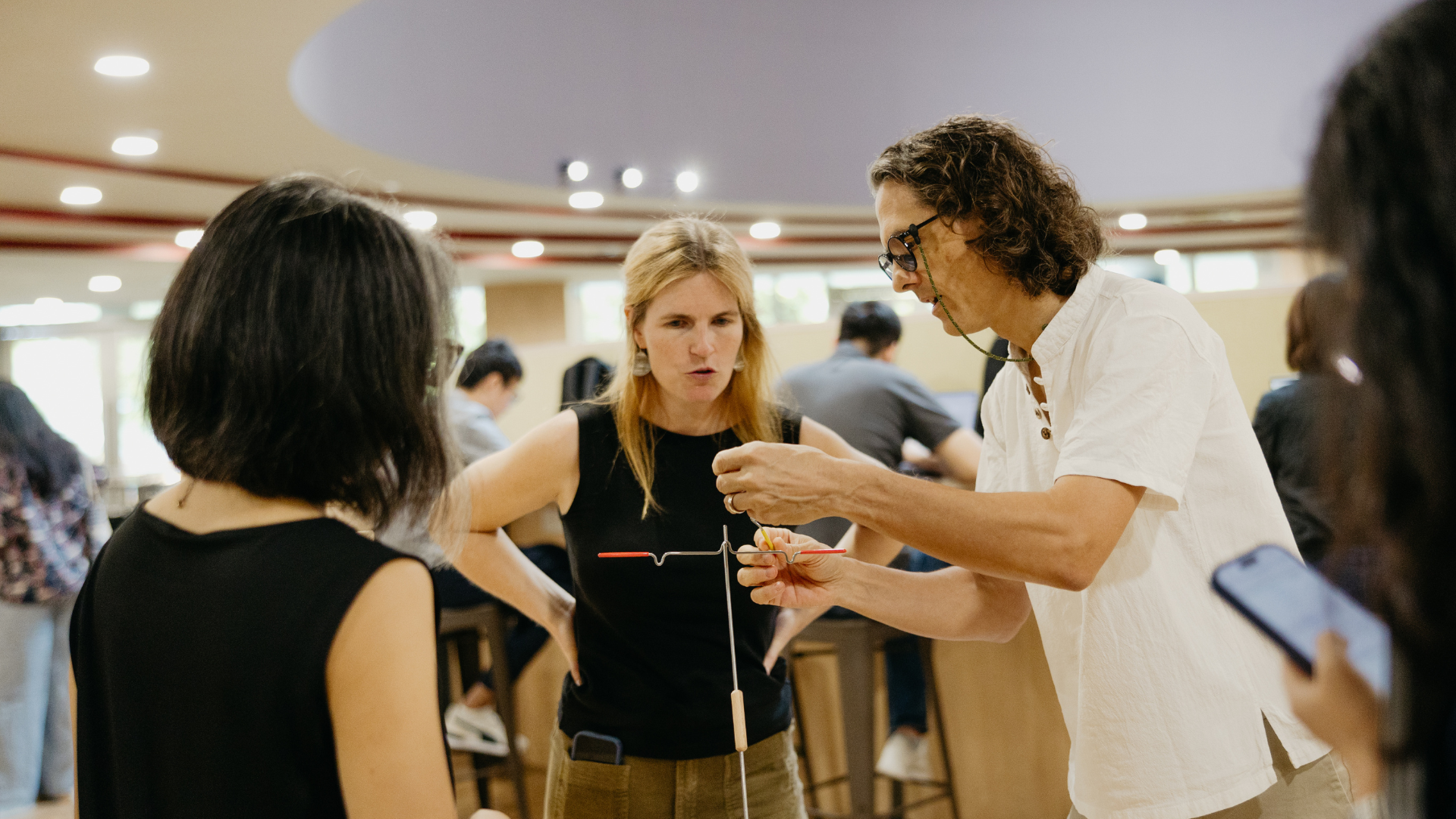
At NUS, faculty members have been experimenting with such approaches, several of which were showcased in the “Playful Minds: Learning Through Play” installation.
One example is the use of tableau, where students create a frozen, dramatic image with their bodies to interpret an abstract prompt. While tableau is most commonly associated with theatre studies, it is also used across humanities disciplines such as anthropology and philosophy, combining embodied, experiential and collaborative learning.
In HS2902: Do Play Play: The Importance of Play, an interdisciplinary course offered as part of the common curriculum of the College of Humanities and Sciences, students design card games about a social issue of their choice. In “We Just Bought a Zoo”, for instance, players juggle the welfare of animals against profit-making, exploring ethical dilemmas surrounding captive animal welfare.
On the sidelines of the “Playful Minds: Learning Through Play” installation, Assoc Prof Ong added, “In the context of higher education, play is about moving away from extrinsic to intrinsic motivation — the feeling of ‘I’m doing it because it’s interesting and I’m curious, not just because I want an A’.”
Different strokes for different folks
While much of the conference focused on undergraduate learners, speakers also highlighted the need to tailor teaching to different learner profiles.
In a paper presentation, Dr Ng Boon Yuen and Dr Ganthi Viswanathan from the Singapore University of Social Sciences (SUSS) examined how adult learners’ sense of belonging affects their learning in online classes.
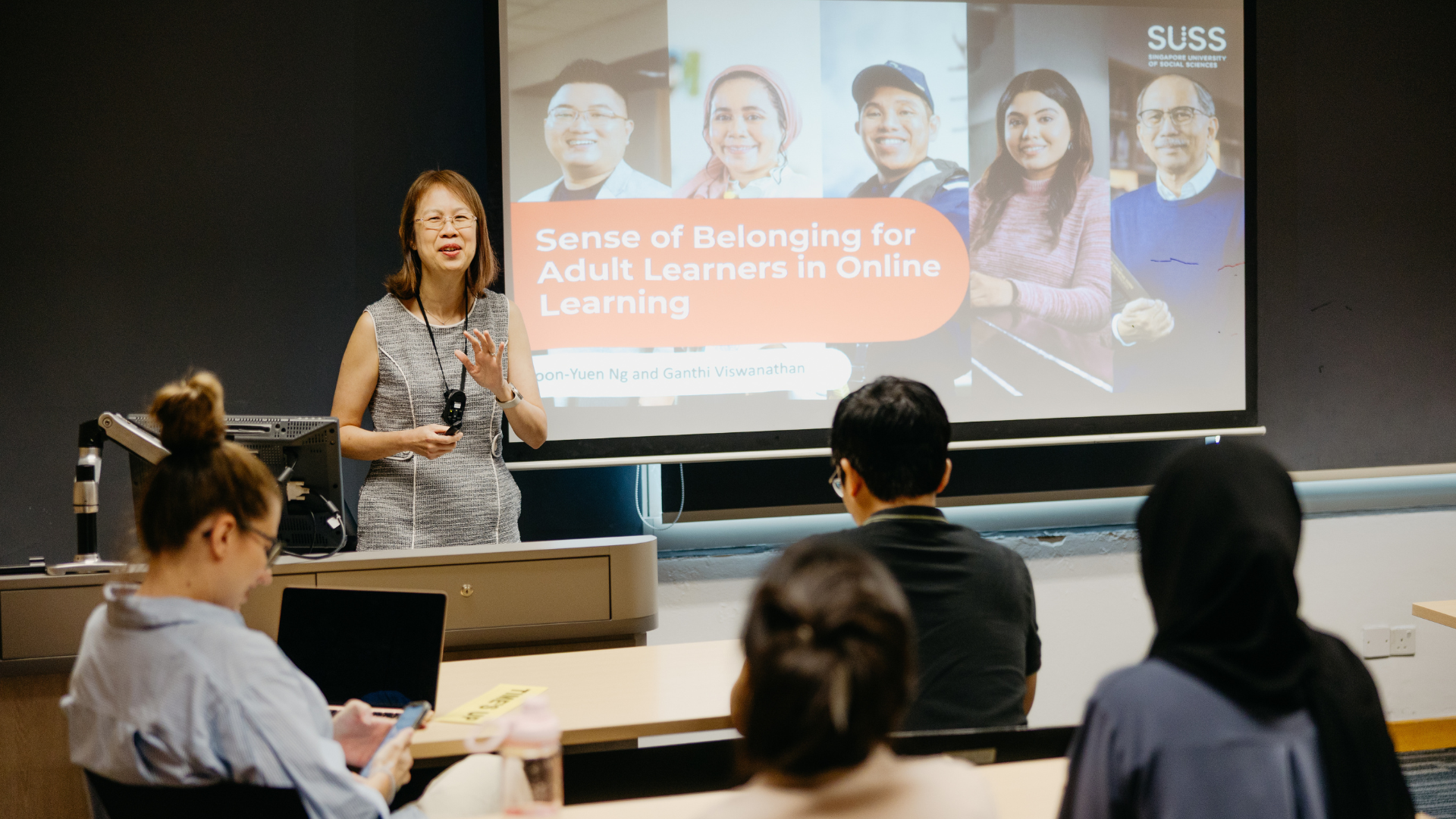
Unlike undergraduates who place greater emphasis on social connection, adult learners prioritise practical factors like convenience and flexibility. While the majority of surveyed students reported that they did not feel a sense of community with their peers, most were satisfied with online courses and planned to continue taking them.
However, this absence of a sense of belonging still manifests in challenges such as a lack of trust among members during group work, noted Dr Ng. To foster stronger rapport, one suggestion was for instructors to facilitate early relationship building through icebreakers and breakout rooms.
Creating a culture of care
Speakers also emphasised that meaningful relationships form the foundation of fulfilling learning experience, whether between educators and learners, or learners and communities. Within classrooms, small, intentional gestures can reshape dynamics. Dr Daryl Ooi, a lecturer at the NUS Department of Philosophy, called these "pedagogies of care”.
“There are a lot of acts that happen to us and in our hearts, we are sorting out what is caring and uncaring,” said Dr Ooi, who was representing an NUS learning community on pedagogies of relationality and care, at the workshop. Pedagogies of care respect students’ autonomy and the plurality of their experiences, opinions and emotions. One participant shared how simply sitting on the floor with her students helped to reduce hierarchical barriers.
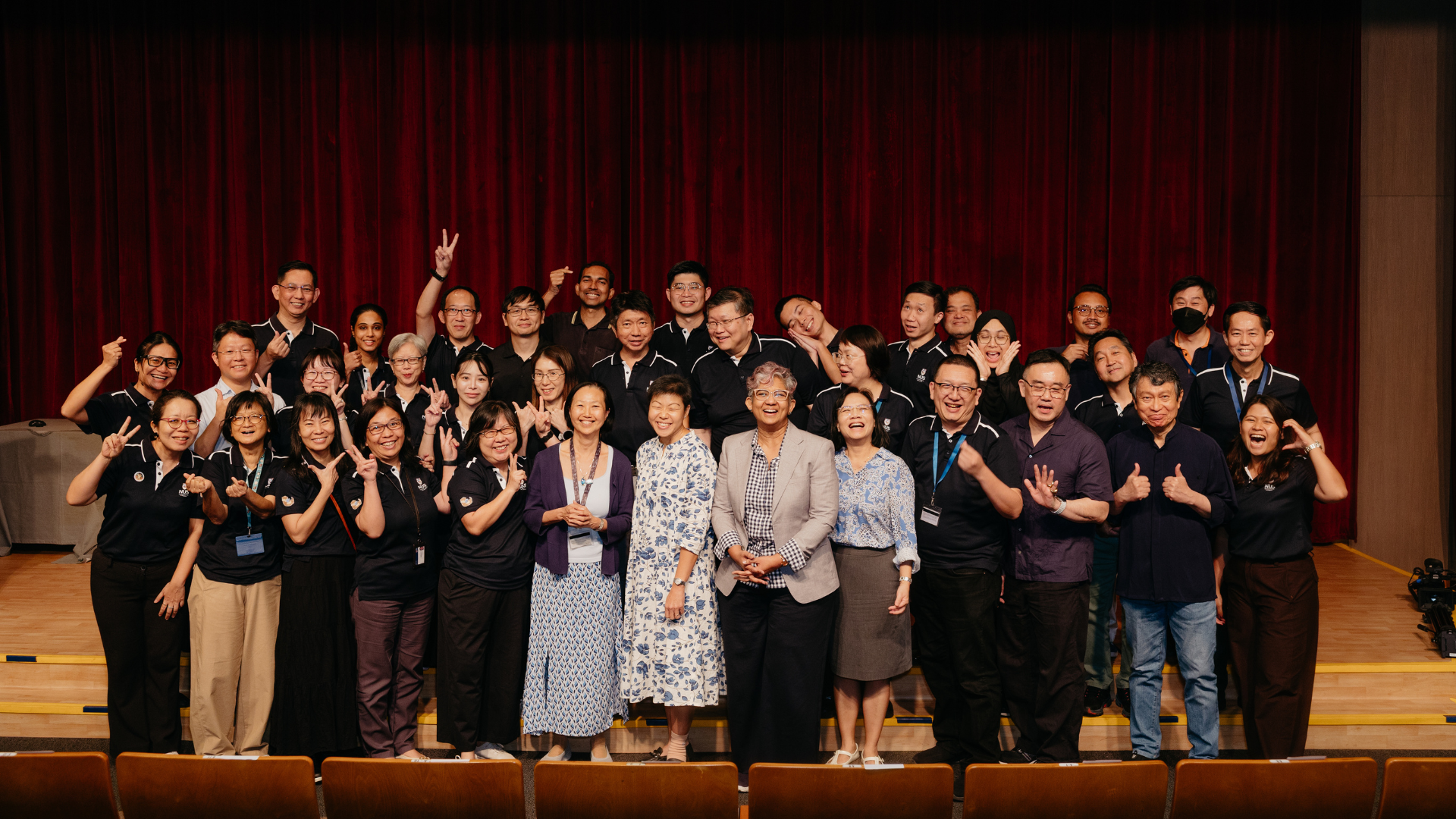
Reinforcing the importance of relationships in her closing keynote, Associate Professor Chng Huang Hoon, Director of the Chua Thian Poh Community Leadership Centre at NUS, said, “High-impact experiences have to be founded on relationships, community bonds and mutual trust. If we can enact an educational experience that is relationship-rich in- and outside our classrooms, we would have gone some ways in restoring the human in the work we do.”
This story first appeared in NUSnews on 26 December 2025.