

Portraits of NUS life: Stories behind the NUS120 Photo Exhibition
January 22, 2026
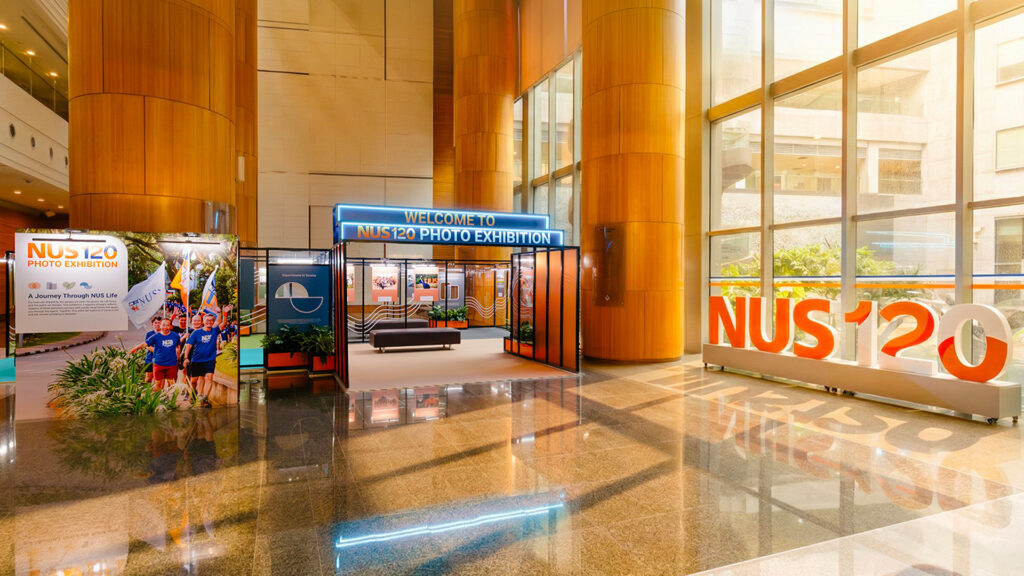
From the friendships forged and the breakthroughs made in the lab, to the iconic spaces that shape our memories and the quiet moments with nature. These are the scenes of campus life brought into focus at the NUS120 Photo Exhibition now on display in the lobby of the Lee Kong Chian Wing at University Hall until 31 March 2026.
Curated by the Office of University Communications from hundreds of photos submitted by the University community, the visual showcase of 46 images is among the highlights of the extended celebrations for NUS’ 120th anniversary. Organised into four themes – ranging from human connection (Humans of NUS) to scientific discovery (Experiments to Eureka), campus architecture (Places That Shaped Us), and flora and fauna (Whispers of Nature) – it gathers not just the striking portraits and candid moments, but the personal stories behind them. To complement the exhibition, a digital collection of 120 photos, including those featured in the exhibition, has now been published.
Four of the photo contributors share the memories behind the moments they chose to capture.
Building bonds through biochemistry
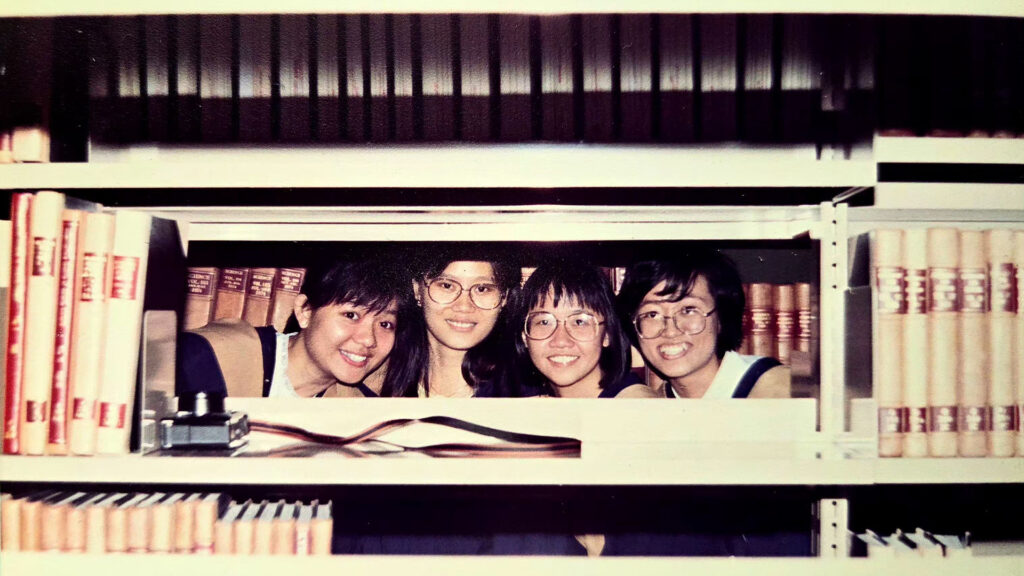
As groups of graduates headed for the picturesque spots on campus to take their celebratory photos, Ms Neoh Chong Eng, then a fresh graduate from the Faculty of Science, and her friends chose a more unusual backdrop: the shelves of the old Science Library. Smiling as they stood in the gaps between rows of periodicals, that image from 1987 now serves as a time capsule of their friendship.
The library was a fitting location: a vital resource back when internet access was not freely available, Ms Neoh explained. “As Biochemistry was a common subject among the four of us, the library was a place we frequented, both to study, and very often, to look up journal articles…Since these Science journals had been a source of our knowledge and information, we thought it apt to frame our convocation with these sources of knowledge.” Though the old Science library was only opened in their final year, the Medical Library had been their primary haunt, as Biochemistry was offered by the Faculty of Medicine, now known as the Yong Loo Lin School of Medicine.
Their bond was forged during the demanding sessions at the Biochemistry lab, the meals they shared while waiting for experiment results and the countless conversations that filled their days. “These long hours of waiting for the collection of experiment data also became time for us to chat, get to know each other better and form a deeper friendship,” she shared.
While time and the absence of instant messaging and social media have meant that only two of the four friends have remained in touch, those hours in the lab and libraries left an indelible mark. For Ms Neoh, it led to a career as a Chemistry teacher. Now retired, and turning 60 this month, she still cherishes the lifelong memories from those formative years immersed in Biochemistry, or as Ms Neoh puts it, “the chemistry of life”.
A moment of quiet poetry
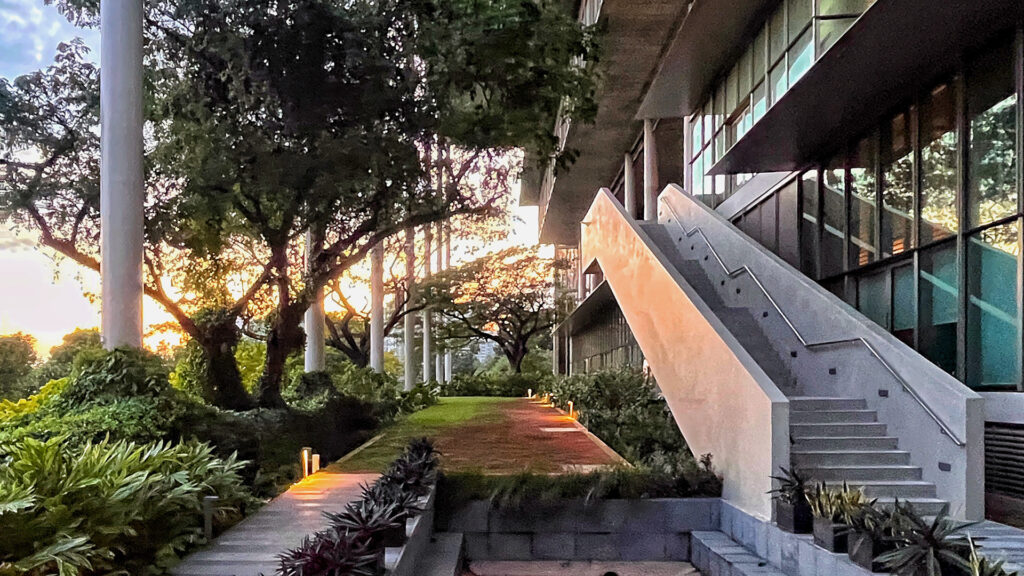
Sunset filters through the trees, casting an orange glow across the glass façade of SDE4 and the concrete staircase leading down to a garden. For Ms Riya Kumari, who graduated from the College of Design and Engineering (CDE) in 2025, that image instantly brings back the sound of birds chirping and the faint traffic noise in the distance.
"To reach this spot, one has to walk up a beautiful staircase framed by trees before entering the building,” Ms Kumari said, of the photo she took one evening in early September 2024 on her walk from the Central Library towards the SDE4 building. “Although it is technically the back entrance of SDE4, I always found it far more peaceful and visually calming than the main front entry.”
While pursuing her Master of Science in Integrated Sustainable Design, Ms Kumari found in this tranquil spot a daily reminder for her and her groupmates to pause amid intense deadlines and back-to-back assignments. “Many days started early in the morning and stretched late into the night. During those intense periods, we developed a habit of taking a short sunset break,” she recalled.
Revisiting this memory immediately transports her back to those evenings. “There was something deeply grounding about that combination of nature, structure, and stillness.” Today, as a Project Architect at Aikyam Design Studio, a multidisciplinary architecture and interior design practice based in the Delhi region of India, she continues to draw inspiration from those moments. “As I move forward in my professional journey, I carry with me the habit of consciously slowing down, observing my surroundings, and finding meaning in everyday spaces. That mindset continues to shape how I approach design, creativity, and life beyond university.”
Engineering the perfect fold
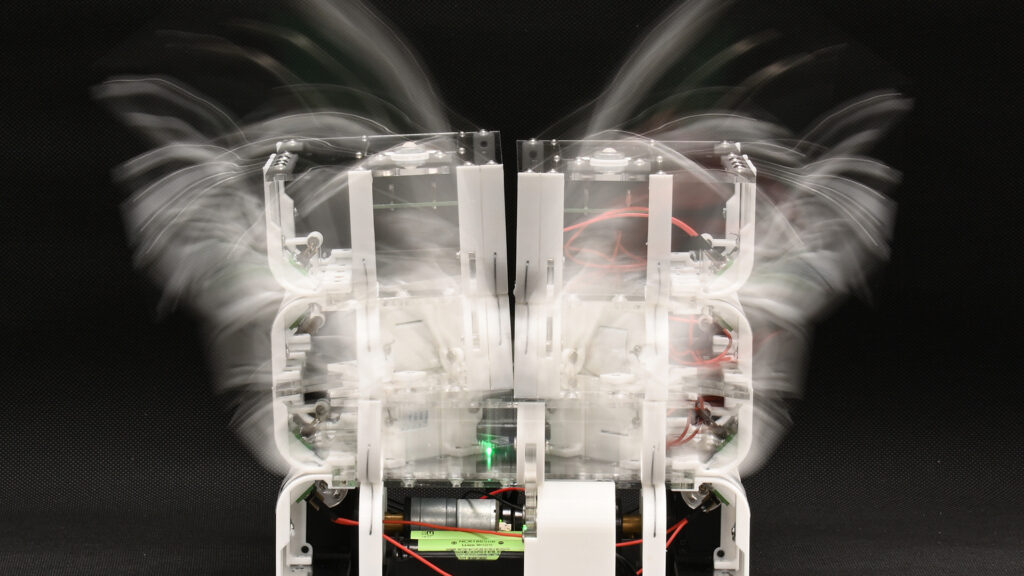
As the side panels of the robot folded swiftly upwards, transforming it into a compact cube, Fan Zirui noticed that its shape-changing motion resembled a bird flapping its wings. This striking vision prompted the PhD student from the CDE’s Department of Mechanical Engineering to capture the moment.
Developed in 2023 under the supervision of Dr Zhang Hongying from the Compliant Robotics and Engineering (CORE) Lab at NUS, OSCAR (Origami-inspired Shape-Changing Autonomous Robot) was Zirui’s Bachelor of Engineering (Mechanical Engineering) final-year project. Designed to tackle ground coverage tasks, such as floor cleaning, it addresses a key limitation of conventional robots: navigating wide-open spaces and cramped corners alike. The Japanese art of paper-folding was a natural choice for the robot’s structure because it offered “strong potential for achieving large, reversible shape changes,” he explained.
Through its seven distinct configurations, OSCAR is capable of contracting to just one-third of its original width to access tight gaps and expanding in open areas for maximum coverage. Translating this flexibility to the robot's thick and rigid panels, however, was the biggest challenge – a problem he solved by designing an innovative, low-profile hinge mechanism driven by a single motor. “The ‘eureka’ moment was during the first successful folding test…Seeing the mechanism operate smoothly for the first time was both thrilling and a major relief," he recounted.
While the prototype is currently remotely controlled, Zirui and his team are developing the robot’s perception and navigation capabilities for a fully autonomous operation. For Zirui, the project was a pivotal moment in shaping his career path. “It introduced me to the beauty and potential of origami-based structures and motivated me to pursue academic research.”
Moments in the wild
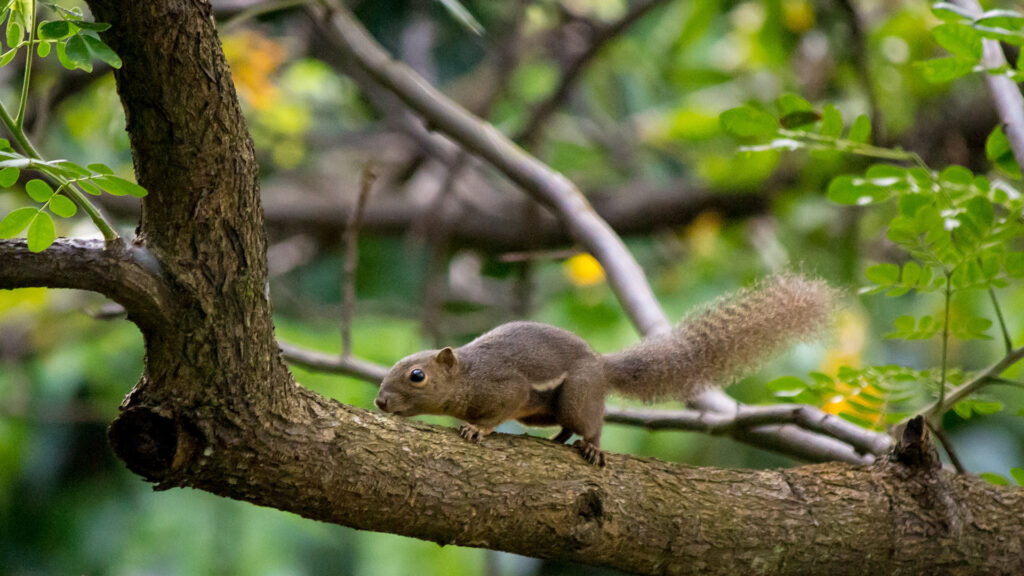
Unlike many perfectly-timed photographs that begin with a captivating sight, it was a familiar sound that made Mr Athanasius Koh, an Assistant Manager at NUS Giving, stop and take a closer look one morning in 2021. "A rustling in the trees piqued my interest," Mr Koh recalled, describing the scene just before he snapped the spontaneous shot of a plantain squirrel scurrying across a tree branch.
Then a Management Trainee at the Dean’s Office in the Faculty of Arts and Social Sciences (FASS), he was on his morning walk to the office, passing the stretch of greenery between the AS4 and AS5 buildings, when he heard the rustling from the canopy and instinctively reached for his camera.
An FASS alumnus and passionate nature enthusiast, Mr Koh’s interest in documenting the campus flora and fauna began when he was a Political Science undergraduate. “I’ve always been a fan of nature photography and NUS has always presented opportunities to spot new and interesting species thanks to its abundant greenery,” he shared. He counts the collared kingfisher, red junglefowl, rose-ringed parakeet and changeable lizard among the diverse array of campus wildlife he has been fortunate to encounter and photograph.
Today, Mr Koh’s lifelong passion for nature and wildlife finds greater significance through his professional work. In his role at NUS Giving, the University’s philanthropic arm, he is part of the team raising funds and awareness for initiatives like the Plant-It-Forward Challenge, which plants a tree on campus for every S$1,000 raised for student financial aid, and the NUS CatCafé, a student group which cares for the community cats on campus. Through these efforts, he hopes to nurture and protect the natural spaces that have shaped his journey at NUS. “It’s comforting to see that our green spaces remain vibrant enough for a wide variety of animals to truly call them home,” he reflected.
This story first appeared in NUSnews on 21 January 2026.