

As machines learn, humans must think: How NUS Philosophy is nurturing critical thinking through courses that bridge disciplines
November 22, 2025
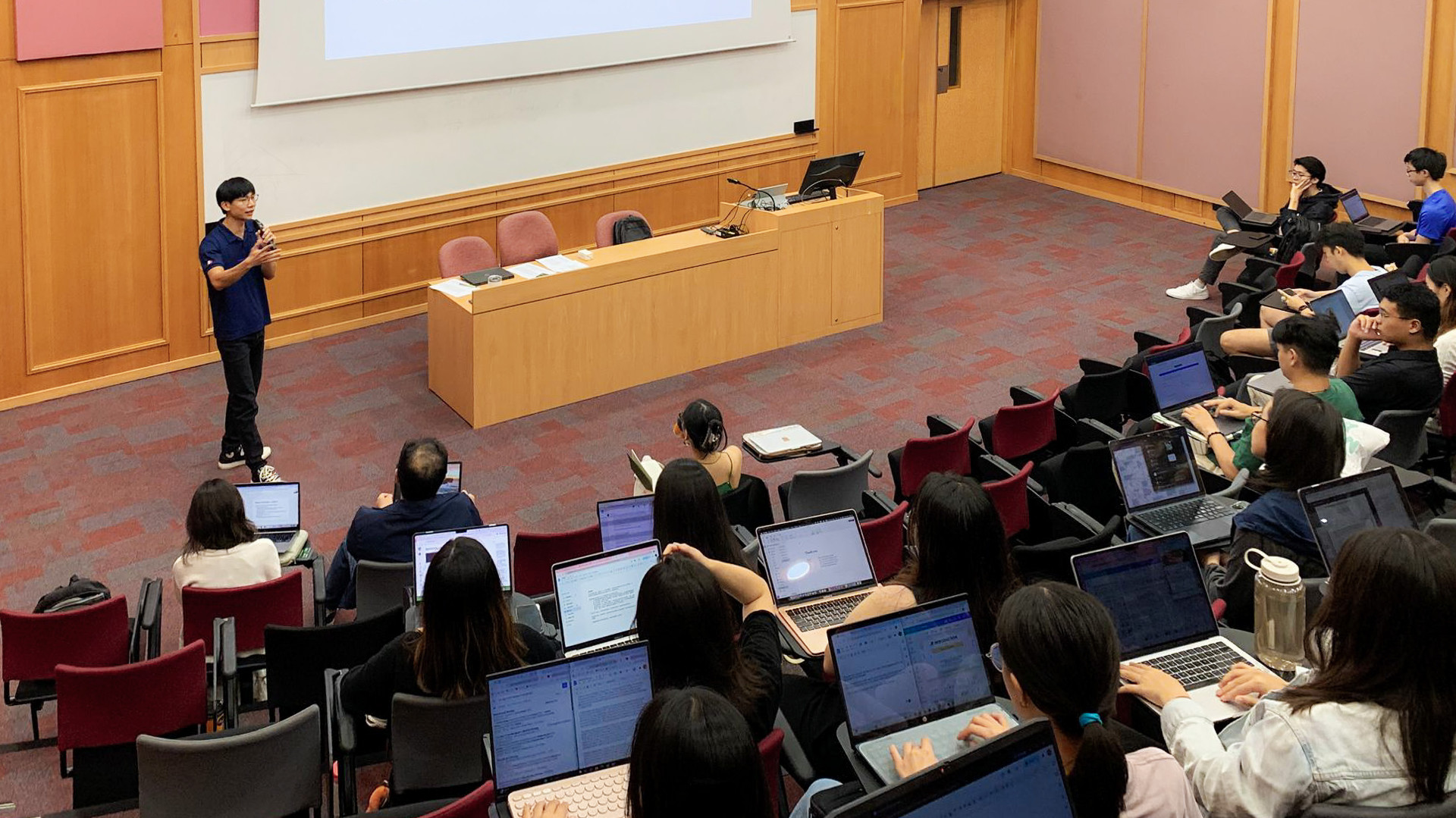
Machines can learn from vast amounts of data, identify patterns, and make predictions at speed. With advancements in robotics and artificial intelligence (AI), AI is now even taking on physical forms to interact with the world in ways we once thought uniquely human, but it continues to do so without understanding meaning, context, or ethics.
Us humans, on the other hand, can think, empathise and reason. We are able to weigh the consequences and navigate moral landscapes, asking questions that help us differentiate between good and bad, wrong and right.
These are the kinds of questions philosophers have wrestled with for thousands of years, from Socrates’ call to “know thyself”, Confucius’ teachings on how to live harmoniously with others and modern debates about whether a self-driving car should swerve to save a pedestrian at the cost of its passenger’s life.
At its core, Philosophy is the disciplined pursuit of understanding why we believe what we believe and how we should live. It helps us see beyond convenience or efficiency and illuminate what truly matters.
At the NUS Faculty of Arts and Social Sciences, the Department of Philosophy (NUS Philosophy) is showing that these age-old questions about morality, truth, and human experience are more relevant than ever, helping students think critically in a rapidly changing world.
Thinking critically, acting ethically, and staying deeply human
Today, discussions about being future-ready tend to centre on arming oneself with the skills to be tech-savvy. Beyond technological proficiency, however, being future-ready involves exercising judgement, ethical reasoning, and having the capacity to navigate complex moral and social challenges that technology alone cannot resolve.
“Philosophy is very much at the interface between science and the humanities, and in the age of AI, it's becoming ever more important to have people working at that interface, exploring the humanistic sides of technological breakthroughs, advances in machines and technology and formal languages,” says NUS Philosophy’s Associate Professor Isaac Wilhelm.
For instance, questions about AI sentience or bias are just as philosophical as they are technical. What does it mean to know something? Can a machine have intention or moral responsibility? Grappling with such questions trains students to think clearly and carefully, even when there are no easy answers.
To help them bring this way of thinking into the real world, NUS Philosophy offers several interdisciplinary courses (IDCs), most of which have been co-designed with other departments such as Pharmacy, Medicine, Mathematics and Economics. These IDCs aim to show how philosophical ideas can shed light on real issues like ethics in AI, responsibility in healthcare and even fairness in economic policy.
Associate Professor Tang Weng Hong, Head of NUS Philosophy, said, “These IDCs don’t just extend philosophy’s reach; they also bring philosophy into dialogue with other forms of inquiry. Working and teaching with colleagues from other disciplines helps us test and refine philosophical concepts and ensures that our philosophising remains relevant to contemporary scientific, technological, and social developments.”
Since their introduction in August 2024, these IDCs have been well received by students from across the humanities and sciences, most of whom are not Philosophy majors but are curious about how its ideas connect to their own fields.
Amongst them is “Pain Points: The Problem with Pain”, an IDC course offered at NUS Philosophy in collaboration with the NUS Yong Loo Lin School of Medicine, which now enrols 140 students in its second run in August 2025, more than a third of whom are from the NUS Faculty of Science.
Beyond studying the science of pain, students in this course confront questions like: What is the meaning of pain? Can pain ever be good? How can we be better caregivers to our loved ones who experience pain? These are inquiries that are just as philosophical as they are medical, and tackling them together deepens both understanding and empathy.
Stephanie-Renee Teong, a Year 4 Pharmaceutical Sciences student who took the course, said, “I always viewed pain through biological or psychological frameworks – something measurable, diagnosable, and to be treated. Yet, this module revealed its depth beyond science and the concept of total pain encompassing the physical, emotional, social, and spiritual. I began to see pain not as a singular experience but as something deeply personal and fluid, defined differently by every individual.
She added: “Discussions with my classmates were equally transformative; each story and reflection reminded me that everyone carries their own form of pain, often unseen. The classroom became a safe and compassionate space where vulnerability was met with respect. Through it, I not only learned about pain but also found healing in understanding — and in the act of listening."
Conversely, Zachary Lee Jie Lun, a Year 4 Philosophy major, said he appreciated how the course brought a medical perspective to philosophical questions, reminding him that every theoretical abstraction has practical implications.
For Zachary, a guest lecture by a doctor working in palliative care made a deep impression. “The reflections and dialogues during her session reminded me that everyone, regardless of success or circumstance, experiences suffering. This realisation encouraged me to look at my own life with a greater honesty and to make more thoughtful choices for the people I care about,” he said, adding that her session shifted his outlook on life to a more hopeful one, knowing that when pain is embraced, life is experienced in its deepest profundity and joy.
Dr Daryl Ooi from NUS Philosophy, who co-teaches the course on pain, said, "I'm consistently impressed by how eager and capable our students are to boldly explore the physical, emotional and social dimensions of pain. Our students display so much compassion and thoughtfulness in their discussions of this difficult topic, being willing to sit with difficult emotions when we discuss topics such as chronic pain, pain at the end of life, and whether it’s ever ethically permissible to abandon a loved one in pain.”
He continued, “Credit must also be given to the teaching team, who put in much heart and hard work in ensuring that we create a careful space for our students to engage with these important experiences.”
Equally popular IDCs, each attracting over 100 students, are “CRISPR: Saving Lives or Playing God?”, taught in collaboration with NUS Department of Pharmacy and Pharmaceutical Sciences which examines the ethical and regulatory conundrums of genetic editing tools, and “Major US Supreme Court Cases and Big Ideas Behind Them”, a collaboration with the NUS Department of Economics. The latter introduces the basics of US political and Constitutional history, while treating the topics as opportunities for reflection on more general philosophical issues that not only concern law and politics, but ethics, rationality and personhood.
In CRISPR, students debate questions that blur the line between progress and hubris: What limits should science observe? Is altering genes an act of compassion or control? In the Supreme Court course, they learn that behind every landmark legal ruling lies a tangle of philosophical arguments about freedom, fairness, and what it means to be human.
Other interesting IDCs include Effective Altruism In Theory and Practice, Agree to Disagree Well: Disagreement in Singapore, Grasping Infinity: Paradoxes and Understanding AI and Its Impact: From Turing to ChatGPT.
Year 3 Social Work major, Keane Ong, took the Effective Altruism course because he was interested to learn about large-scale interventions that can improve the well-being of our society, and by extension, our world.
He said, “I thoroughly enjoyed how each lecture alternated between the philosophical and economic perspectives, showcasing how they interact. Regarding the topic on well-being, it was interesting to see the differences in opinions between philosophers and economists, and how these differences could lead to very different policies for the world. An example of this pertains to how philosophers generally do not agree with a pure time preference discounting of well-being, while many economists do. These differing views could lead to very different degrees of prioritisation regarding long-term global challenges like climate change.”
This interdisciplinary spirit mirrors NUS’ wider educational philosophy, which brings together expertise from different fields to address the world’s most pressing challenges. With its strong ecosystem of collaboration across faculties, NUS is uniquely placed to marry disciplines and offer a more holistic outlook on life and learning — one that helps students see connections between technology and ethics, science and humanity, and knowledge and purpose.
Come January 2026, NUS Philosophy will be offering three new IDCs for the first time: Understanding AI and Its Impact, Agree to Disagree Well, and Grasping Infinity, each also exploring how philosophy helps us make sense of knowledge, reasoning, and moral choice in the modern world.
In an age where technology and information move faster than thought, philosophy is a reminder to pause and ask deeper questions not just about what we can do, but what we should do. This will anchor our pursuit of progress on the qualities that keep us uniquely human.
This story first appeared in NUSnews on 20 November 2025.